
(Prefer videos? Watch a brief summary of this article below.)
A warehouse execution system (WES) translates orders and operating priorities into floor-level action. It releases work to people and machines, watches queues and capacity, then recalculates when conditions shift. In a mixed manual and automated facility, that coordinating layer keeps order fulfillment moving without forcing every resource to follow a stale plan.
Warehouse Execution Systems in Brief
- Purpose: A WES coordinates the next best task across labor, robots, and equipment.
- Inputs: It uses demand, inventory status, resource availability, congestion, and deadlines.
- Best fit: Complex, high-volume sites with several automation technologies gain the most.
- Caveat: Results depend on clean data, solid integrations, and well-designed processes.
What Is a Warehouse Execution System (WES)?
A WES is the operating layer that coordinates warehouse operations between business planning and equipment control.
Definition and primary purpose
Also called WES software, warehouse execution software, or a warehouse execution platform, it manages warehouse workflows by balancing service levels, labor, assets, and material flow.
A WES turns operating priorities into executable work. The resulting warehouse workflow management can cover picking, replenishment, movement, packing, staging, sortation, and other processes.
Why WES has become essential in automated warehouses
Warehouse automation creates capacity, though it also creates more points that need coordination.
The U.S. Census Bureau reported that seasonally adjusted U.S. retail e-commerce sales reached $340.2 billion in the second quarter of 2026, growing 3.8% over the first quarter. At the same time, logistics facilities continue adding robots, automated storage, conveyors, and software-driven handling systems. The International Federation of Robotics reported continued growth in transportation and logistics service robots in its 2025 market data.
More moving parts mean more dependencies.
A picker may finish before an AMR arrives. A tote might reach packing before capacity is available. A replenishment shortage can stall several orders at once. A warehouse execution system continually reevaluates such situations and changes the sequence where appropriate.
How WES differs from WMS and WCS
These systems can overlap, and vendors do not always use the terms consistently. Still, the general distinction is useful.
| System | Main responsibility | Typical question |
|---|---|---|
| Warehouse Management System (WMS) | Inventory, orders, locations, replenishment | What work needs to be completed? |
| Warehouse Execution System (WES) | Warehouse orchestration, sequencing, task release | What should happen next? |
| Warehouse Control System (WCS) | Equipment-level execution | How should automated equipment perform the command? |
| Enterprise Resource Planning (ERP) | Enterprise transactions and planning | What does the wider business require? |
A WMS may determine that an order must ship today. The WES decides when its tasks should enter the operation. The warehouse control system then helps machinery execute the relevant commands.
How Does a Warehouse Execution System Work?
The simplest way to understand WES is as a repeating operational cycle.
Data arrives. Priorities are calculated. Tasks are released. Results come back. The next decision changes accordingly.
Managing warehouse workflows
WES software receives information about orders, inventory, deadlines, resources, and equipment status.
From there, it can create or sequence warehouse tasks so that work reaches each zone at a manageable pace.
Releasing too much work at once can create congestion. Releasing too little leaves capacity unused. The ideal point keeps changing, which is why real-time warehouse execution matters.
Coordinating automation and labor
A modern facility may contain people, conveyors, an automated storage and retrieval system (AS/RS), autonomous mobile robots (AMRs), automated guided vehicles (AGVs), scanners, sorters, and other material handling equipment.
Some sites also operate warehouse robotics from providers such as AutoStore or Geek+, alongside industrial automation from Dematic, Swisslog, KNAPP, and other vendors.
WES helps coordinate work across these resources.
Labor management may consider employee location, qualifications, workload, and workstation demand. Machine assignments can account for availability, queue length, or downstream congestion.
Prioritizing orders dynamically
Warehouse priorities move.
A carrier cutoff approaches. A high-value order becomes urgent. A packing station develops a backlog. Inventory arrives later than planned.
Dynamic task management allows task prioritization to respond without waiting for the next manually planned wave.
The sequence can change several times during a shift. That is expected.
Monitoring execution in real time
Real-time analytics gives supervisors visibility into what the floor is doing now rather than what the plan expected it to be doing.
Information can come from scanners, Industrial Internet of Things (IIoT) devices, machine controllers, robots, and operator actions.
Artificial Intelligence (AI) may add predictive recommendations or identify patterns, although the value of any model still depends heavily on reliable operational data.
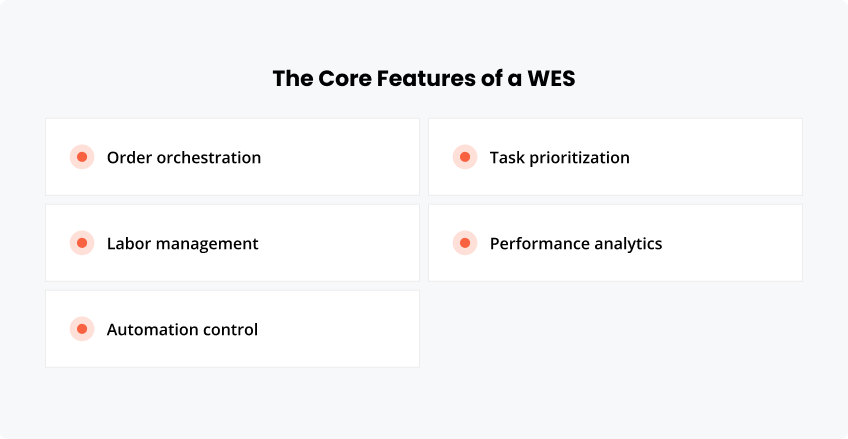
What Are the Core Features of a WES?
Capabilities vary between products, but several functions appear repeatedly.
Order orchestration
Order orchestration determines when to release work and how tasks should move through available capacity.
It can reduce the familiar problem of one zone drowning in work while the next waits.
Labor management
WES platforms can distribute activities based on availability, zone, skills, travel distance, or workload.
Managers still need the ability to intervene. Warehouses are full of local context that software may not fully understand.
Automation control
Automation control in WES usually happens at the orchestration level.
The platform may send missions or priorities to robotic and equipment systems while lower-level controls manage navigation, motors, PLC logic, charging, and safety functions.
Task prioritization
A useful WES keeps asking a deceptively simple question: which task creates the most value right now?
That calculation may include deadlines, order type, available inventory, travel, downstream capacity, and equipment conditions.
Performance analytics
Common measures include order cycle time, throughput, queue age, utilization, backlog, exceptions, and recovery time.
Metrics are more useful when they reveal flow across several processes rather than maximizing one isolated station.
What Are the Benefits of a Warehouse Execution System?
WES benefits usually appear through better coordination.
Faster order fulfillment
Orders spend less time waiting between processes when work is released according to current capacity.
Urgent jobs can also move ahead without requiring supervisors to rebuild a large batch.
Better resource utilization
People, robots, stations, and other equipment can be assigned work that reflects where capacity actually exists.
This reduces avoidable idle periods and helps prevent localized overload.
Increased warehouse productivity
Productivity deserves careful wording. Installing more software does not automatically increase output.
The U.S. Bureau of Labor Statistics reported a 7.4% decline in warehousing and storage labor productivity over the 2019–2024 business cycle — the largest annual decline among all the service-providing industries selected for the study. That does not point to one single cause. It does underline the importance of process design when new technology enters a warehouse.
A well-configured WES can help remove unnecessary waiting, travel, and poorly timed task releases.
Improved operational visibility
Supervisors can see queues, exceptions, blocked work, aging tasks, and available capacity in one operational view.
That speeds up intervention and reduces reliance on fragmented spreadsheets, radio calls, or hallway conversations.
Greater flexibility during demand fluctuations
Demand rarely arrives in even hourly increments.
Warehouse execution systems can alter release rates and task sequences as volume changes, giving the facility more room to adapt during peaks, promotions, late arrivals, or unexpected equipment downtime.
friendlyway helps digitize appointments, gate processes, driver communication, and yard workflows around your existing logistics systems.
What Are the Challenges of Implementing WES?
WES projects touch several systems at once. That makes architecture and operating discipline just as important as the software itself.
Integration with existing systems
WES may need interfaces with SAP, Oracle, Blue Yonder, Manhattan Associates, ERP applications, WMS platforms, WCS tools, conveyors, robotics, and custom equipment.
Every important event needs a clear owner.
If two systems believe they control the same task, problems become difficult to diagnose.
friendlyway’s integration capabilities can complement warehouse technology by connecting gate, check-in, access, and operational workflows to the wider digital environment.
Warehouse process complexity
Automation exposes weak processes quickly.
Poor replenishment rules, unnecessary travel, inconsistent master data, or unclear exception ownership should be addressed before they are embedded inside an execution platform.
Workforce adoption
Employees need more than instructions about which button to press.
They should understand why priorities can change, how exceptions are handled, and when human intervention takes precedence.
Initial implementation costs
Licensing is only part of the budget.
Integration development, controls engineering, network improvements, testing, process redesign, simulation, training, and temporary disruption can all contribute materially to project cost.
According to the 2026 MHI and Deloitte Annual Industry Report, 56% of surveyed supply-chain organizations expected to increase innovation investment.
Continuous optimization requirements
A WES implementation is never completely static.
SKUs change. Order profiles shift. New automation arrives. Customer expectations move. Logic that worked well last year may quietly become inefficient.
Reviewing rules and performance should become part of normal warehouse management.

Which Industries Use Warehouse Execution Systems?
WES appears most often where operational complexity makes manual coordination difficult.
E-commerce fulfillment
Fast shipping promises, high SKU counts, returns, and volatile demand all benefit from dynamic sequencing.
Manufacturing
Manufacturing facilities use WES to coordinate line-side delivery, component movement, finished goods, kitting, and Industry 4.0 environments.
Retail distribution
Retail operations may need to balance store replenishment, direct-to-consumer orders, promotions, and reverse logistics within the same building.
Third-party logistics (3PL)
A 3PL often manages several customers with different service levels and operational rules. Configurable orchestration helps keep those priorities separate.
Healthcare and pharmaceuticals
Traceability, controlled handling, service deadlines, and strict operational procedures make predictable execution particularly important.
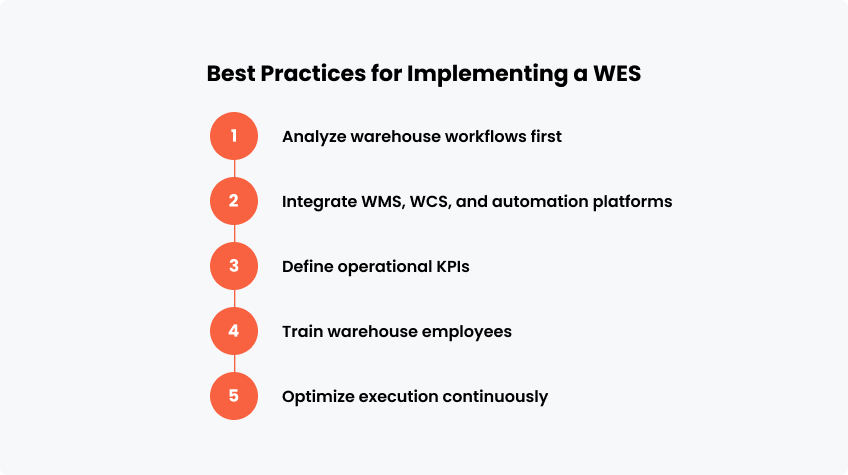
Best Practices for Implementing a WES
A good starting point is the warehouse floor, not the software configuration screen.
1. Analyze warehouse workflows first
Map where work waits.
Find repeated manual overrides, unnecessary travel, blocked queues, and recurring exceptions. Those moments usually tell you where execution logic needs attention.
2. Integrate WMS, WCS, and automation platforms
Define system ownership before development begins.
Document event timing, retry behavior, fallback procedures, and downtime responsibilities.
3. Define operational KPIs
Measure what the project is expected to improve.
Cycle time, on-time shipment, queue age, equipment utilization, exception recovery, and backlog are often more revealing than raw task counts.
4. Train warehouse employees
Include exception scenarios in training.
Normal workflows are usually easy. The difficult part begins when inventory is missing, a station stops, or an urgent order enters the queue.
5. Optimize execution continuously
Review operating data regularly.
Small changes to release thresholds, task logic, or routing rules can affect several downstream processes. Test deliberately.
Common Mistakes When Implementing a WES
Several mistakes appear repeatedly.
Automating inefficient warehouse processes
If a workflow already contains unnecessary steps, automating it usually makes those steps happen faster.
Simplification comes first.
Ignoring integration planning
Poorly defined interfaces create duplicate events, missing confirmations, and difficult-to-trace exceptions.
Integration architecture belongs near the beginning of the project.
Underestimating scalability requirements
Test more than average volume.
Peak periods, robot expansion, additional facilities, data spikes, and partial network failures reveal weaknesses that ordinary daily traffic may hide.
Failing to monitor warehouse performance
A dashboard full of numbers is not operational control.
Each critical metric should have a threshold, an owner, and a clear response.
Neglecting employee training
Training should continue after launch, especially when workflow rules or equipment change.
friendlyway can support driver check-in, appointment validation, instructions, and dock coordination around your ERP, WMS, and warehouse execution environment.
Conclusion: Where WES Creates Lasting Value
A warehouse execution system gives fast-moving facilities a way to keep operating decisions connected to current conditions.
It can coordinate labor, warehouse robotics, automation, inventory-driven tasks, and service priorities within the same execution layer. The value becomes clearer as the facility grows more complex: fewer decisions remain isolated, and supervisors gain a better picture of how one delay will affect the next process.
Successful warehouse execution solutions still depend on fundamentals. Clean data matters. Integration ownership matters. Employee judgment matters. Continuous improvement matters.
Get those pieces right, and WES can become the operational connective tissue between planning systems and the physical warehouse floor.
Sources
- U.S. Census Bureau — Quarterly Retail E-Commerce Sales, 2026
- International Federation of Robotics — World Robotics 2025 Service Robots
- U.S. Bureau of Labor Statistics — Labor Productivity Trends in Service-Providing Industries, 2025
- MHI and Deloitte — 2026 Annual Industry Report
Frequently Asked Questions
A warehouse execution system is software that coordinates real-time work across employees, robots, equipment, inventory, and order priorities. It determines which warehouse tasks should happen next, monitors execution, and adjusts the sequence when conditions change.
A WMS mainly manages inventory, locations, replenishment, and orders. WES focuses on dynamic task release and warehouse orchestration. WCS operates closer to conveyors, sorters, PLCs, and other automated equipment. Exact boundaries depend on the software architecture and vendor.
No. Smaller or relatively stable operations may have enough execution capability within their WMS. A dedicated WES becomes more useful when a facility has multiple automation systems, frequent priority changes, complex order flows, tight shipping cutoffs, or significant coordination between people and machines.
Yes. A WES can assign work and priorities to warehouse robotics, including AMRs and other automated systems. A separate robot fleet manager usually handles navigation, charging, traffic rules, and low-level machine behavior.
Useful KPIs include order cycle time, throughput, queue age, on-time completion, backlog, labor utilization, equipment utilization, exception frequency, and recovery time. The best set depends on the operational objective the WES was introduced to improve.