
(Prefer videos? Watch a brief summary of this article below.)
A trailer arrives early. Another is parked somewhere in row C, though nobody is quite sure where. A driver is waiting for a dock that has technically been free for twelve minutes.
None of these situations is unusual. The problem is that small gaps in information pile up quickly.
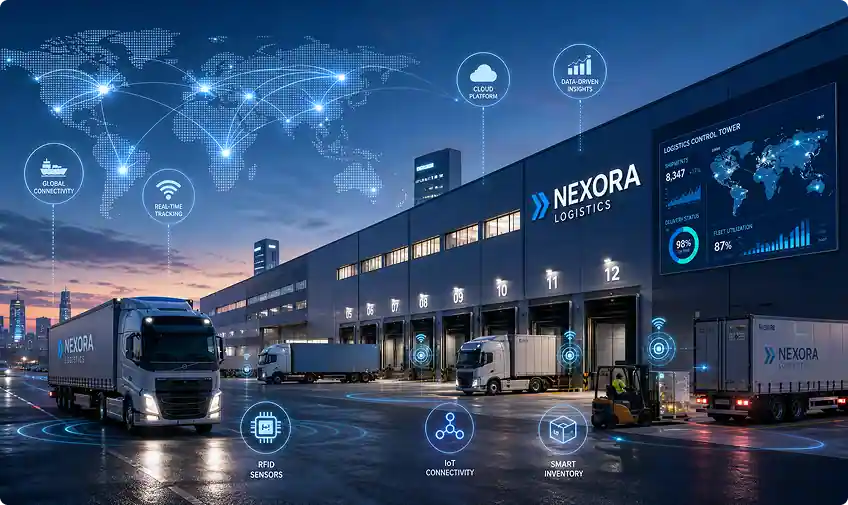
Smart yard management closes those gaps by connecting physical movements with live digital data. RFID tags identify assets. GPS and telematics show where vehicles are. Sensors report movement or status changes. Software pulls it together so operators can see what is actually happening — not what was happening twenty minutes ago.
For companies looking to connect those moving parts, friendlyway offers a dedicated digital yard management solution that brings gate, dock, scheduling, and operational workflows into one environment.
The Short Version
- More reliable visibility: A smart yard replaces periodic checks with continuously updated information.
- Less searching: RFID, GPS tracking, BLE sensors, and telematics support real-time location tracking for trailers and equipment.
- Faster coordination: A yard management system can turn tracking events into tasks, alerts, and scheduling decisions.
- Fewer information gaps: Better yard visibility helps operations teams react before queues and delays become bigger problems.
What Is Smart Yard Management?
At its core, smart yard management is the digital coordination of trailers, tractors, docks, gates, equipment, and people inside a logistics site.
Definition and core objectives
The objective is not complicated: identify each asset, know its location and status, then make the next move obvious.
That sounds straightforward. In a high-volume facility, it rarely is.
A trailer may have been dropped by one carrier, moved by a hostler, reassigned to another door, loaded by a warehouse team, then marked for outbound collection — all within a few hours.
Why traditional yard operations are becoming obsolete
Manual logs struggle with that pace.
Phone calls, radio messages, handwritten notes, and manual yard checks create snapshots. The operation keeps moving while those snapshots age.
Once volumes rise, teams begin spending a surprising amount of time simply establishing where things are.
The role of real-time visibility in logistics
Real-time yard tracking changes the starting point. Instead of reconstructing events afterward, teams can work from current information.
It also extends supply chain visibility into a part of logistics that is often less digitized than transportation or warehouse execution.
How Do IoT, RFID, and Sensors Improve Yard Management?
The technology works best when it disappears into the process.
A truck passes a reader. An identifier is captured. A trailer changes position. A sensor reports it. Software updates the record without asking somebody to stop what they are doing and type the change into a spreadsheet.
IoT devices for asset connectivity
The Internet of Things (IoT) connects physical assets with software systems.
An IoT device might transmit position, temperature, movement, door status, battery condition, or another operational signal. In IoT yard management, those signals become part of the live operating picture.
RFID for trailer and asset identification
RFID yard tracking is particularly useful at predictable checkpoints.
Tags attached to trailers, containers, or equipment can be read automatically at gates, lanes, parking areas, or loading positions. GS1 standards support RFID-based identification and traceability across supply chains.
The practical benefit is simple: fewer manual scans and cleaner event records.
GPS and telematics for vehicle tracking
RFID signals to a system that an asset has passed a point. GPS tracking can go further by providing coordinates.
Combined with telematics, it can support vehicle location, movement history, utilization data, trailer tracking, and broader fleet visibility across larger sites or transport networks.
Smart sensors for monitoring yard activities
Not every asset needs GPS.
Smart sensors that detect motion, proximity, temperature, door status, or Bluetooth can fill in smaller but useful pieces of operational context.
Which Technologies Power Smart Yard Management?
There is no single “best” tracking technology. A large outdoor facility behaves very differently from a compact distribution center, and a parked trailer does not need the same data frequency as a moving tractor.
Most deployments therefore mix technologies.
| Technology | What it does well | Common use |
|---|---|---|
| RFID | Automatic identification | Gates, trailers, equipment |
| GPS | Outdoor positioning | Tractors, vehicles, mobile assets |
| Bluetooth Low Energy (BLE) | Short-range positioning and proximity | Local asset tracking |
| LoRaWAN | Long-range, low-power communication | Remote sensors |
| 5G | High-capacity wireless connectivity | Automation and connected equipment |
IoT platforms
An IoT platform receives data from connected devices and makes it useful elsewhere — in dashboards, alerts, workflows, analytics, or APIs.
Without that layer, sensors are just producing data.
Passive RFID tags are inexpensive and require no internal battery. Active tags can transmit over greater distances but come with different cost and maintenance considerations.
Companies such as Zebra Technologies and Honeywell provide RFID hardware used in logistics and asset identification.
GPS tracking systems
GPS is particularly useful for outdoor assets that move across large yards or between facilities, where coordinates matter more than checkpoint detection.
BLE and wireless sensors
Bluetooth Low Energy (BLE) is often used when proximity or local positioning matters more than long-distance communication.
For devices that must transmit smaller amounts of information over greater distances while preserving battery life, LoRaWAN can be a useful alternative.
AI-powered analytics and automation
Once sufficient reliable data is available, artificial intelligence (AI) can help detect patterns that are difficult to spot manually: recurring congestion, unusual dwell times, inefficient moves, or capacity pressure.
Some operators go further and create a digital twin — a virtual representation of the physical site that changes as real-world activity changes.
What Are the Benefits of Smart Yard Management?
The biggest improvement is often not a dramatic new capability. It is the removal of dozens of tiny uncertainties.
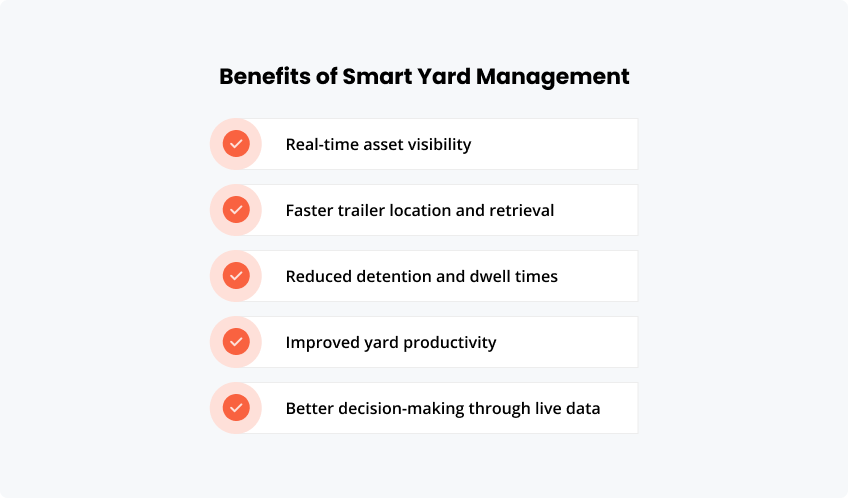
Real-time asset visibility
Reliable asset tracking lets dispatchers see what is present, where it is located, and which assets need attention.
Faster trailer location and retrieval
Drivers can be sent toward a known position instead of searching rows one by one.
That matters more than it may sound. A few wasted minutes multiplied across dozens — or hundreds — of daily moves becomes real capacity.
Reduced detention and dwell times
Live arrival information, parking status, and dock readiness can reveal delays while teams still have a chance to intervene.
Improved yard productivity
Yard automation can eliminate repetitive status checks and routine data entry, allowing operators to focus on exceptions and coordination.
Better decision-making through live data
Managers also get a stronger basis for decisions about staffing, dock assignments, parking capacity, and carrier performance.
Connect gate activity, scheduling, vehicle movements, and dock workflows in a shared operational view.
What Are the Challenges of Smart Yard Management?
Connected operations are useful. They are not automatic.
A poor implementation can produce plenty of data while solving very little.
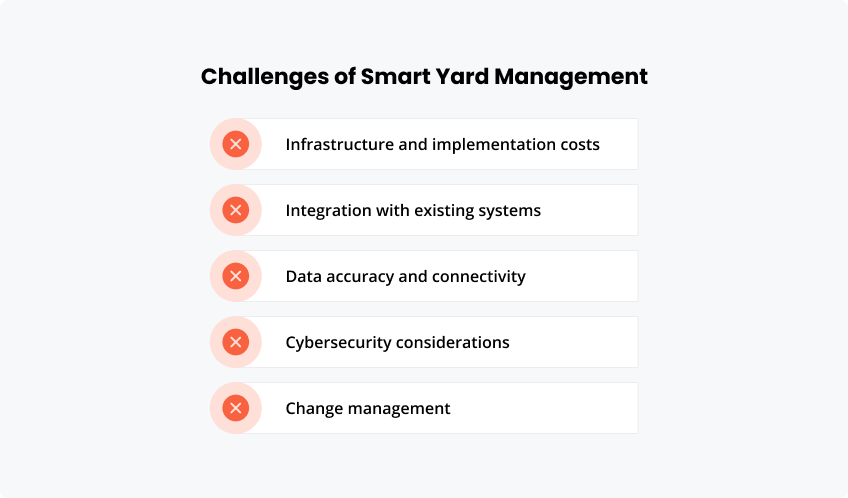
Infrastructure and implementation costs
Readers, tags, networking, sensors, software, integration, and maintenance all cost money.
The sensible starting point is usually a measurable problem — not a shopping list of technologies.
Integration with existing systems
A yard management system (YMS) rarely operates alone.
It may exchange information with a transportation management system (TMS), warehouse management system (WMS), or enterprise resource planning (ERP) platform.
That can include enterprise environments built around SAP or Oracle, as well as specialist logistics applications.
Data accuracy and connectivity
Automation depends on trustworthy inputs.
A damaged tag, a poorly positioned reader, a weak wireless signal, a duplicate identifier, or an outdated master data record can create a very confident-looking error.
Cybersecurity considerations
More connected endpoints also mean a wider security surface.
IoT devices should be included in authentication, access control, monitoring, updating, and risk management practices rather than treated as isolated hardware.
Connectivity may involve Wi-Fi, cellular networks, LoRaWAN, or 5G. Vendors such as Cisco provide private-network technologies designed for connected industrial and logistics environments.
Change management
Then there is the human part.
If a new workflow requires six clicks to do what a dispatcher previously handled in ten seconds, people will find another route. Often, that route is a spreadsheet.
Good implementation has to fit the work.
Which Industries Benefit from Smart Yard Management?
The strongest use cases appear where vehicle volume, time pressure, asset value, or space constraints are high.
Manufacturing
In Industry 4.0 environments, connected outdoor logistics can link inbound transportation with production planning, warehouse logistics, and outbound shipping.
Retail and distribution
Distribution centers often manage dense carrier schedules, seasonal peaks, trailer pools, and limited dock capacity. Better location data gives teams more room to adjust.
Third-party logistics (3PL)
For a 3PL, the challenge is multiplied across customers, carriers, service rules, and equipment types. Consistent digital tracking can reduce that complexity.
Food and beverage
Temperature-sensitive operations can integrate movement data with environmental monitoring, particularly when staging and loading windows are tightly controlled.
Ports and intermodal terminals
Large numbers of containers, trailers, tractors, and transfer movements make automatic identification especially valuable in intermodal environments.
Best Practices for Implementing Smart Yard Management
Technology selection comes later than many teams expect. Start with the operational friction.
A practical sequence looks like this:
- Define operational objectives. Measure search time, gate queues, dwell time, missed appointments, or unnecessary moves.
- Integrate with yard management systems. Connect tracking events with YMS and relevant TMS, WMS, or ERP workflows.
- Standardize asset identification. One trailer should not appear under three different naming conventions.
- Monitor KPIs continuously. Track gate turnaround, dock utilization, yard occupancy, dwell time, exceptions, and asset utilization.
- Expand automation gradually. Prove value in one workflow or zone before adding more hardware and automation.
This approach tends to expose process issues early, when they are still inexpensive to fix.
Common Mistakes in Smart Yard Management
Most failures begin with process design and data discipline rather than the choice of sensor.
Relying on manual yard tracking
Manual inspection may be accurate at 9:10, yet by 9:25 the picture may already be wrong.
Ignoring system interoperability
A tracking platform that cannot exchange information with operational software only creates another place to look.
Underestimating sensor placement
Metal, walls, trailers, weather, interference, traffic patterns, and mounting height all affect real-world performance. Test on site.
Neglecting data quality
Accurate coordinates paired with the wrong asset ID are not useful data.
Identification standards, naming rules, and master-data ownership deserve serious attention.
Failing to measure operational performance
Before deployment, establish a baseline. Otherwise, there is no reliable way to separate genuine improvement from the novelty of a new system.
Bring scheduling, gate workflows, live coordination, and connected self-service into one operational process.
Conclusion
Smart yard management is less about covering a logistics site with hardware and more about removing blind spots from everyday operations.
RFID handles identification well. GPS and telematics provide broader location data. BLE and other IoT sensors capture local events. Yard management software gives those signals context.
The strongest deployments choose technology selectively, connect it with existing systems, and measure whether search time, dwell, congestion, and avoidable moves actually fall.
That is the useful test. Not how many sensors were installed.
Frequently Asked Questions
Smart yard management uses connected hardware, software, tracking systems, and automated workflows to coordinate vehicles and assets inside a logistics yard. It can provide operators with up-to-date information on arrivals, trailer positions, dock activity, queues, and asset status without relying on repeated manual checks.
RFID lets tagged trailers, containers, or equipment be identified automatically when they pass within range of a reader. In a yard, those readers may be installed at gates, lanes, or loading positions. Each detection creates an event that a yard management system can use to track and automate workflows.
IoT connects physical equipment with digital systems. Devices can report movement, position, temperature, door status, or other conditions. This information helps teams monitor activity, trigger alerts, and automate selected processes without requiring manual recording of every change.
Common options include RFID tags, GPS units, BLE beacons, motion sensors, door sensors, temperature monitors, cameras, and other connected devices. The right mix depends on range, accuracy, battery requirements, operating conditions, asset value, and how frequently the location or status needs to be updated.
Yes. A yard management system can receive tracking and identification data while exchanging information with TMS, WMS, and ERP software. That allows yard activity to remain aligned with transportation, warehousing, scheduling, and business processes rather than existing as a separate operational layer.