
(Prefer videos? Watch a brief summary of this article below.)
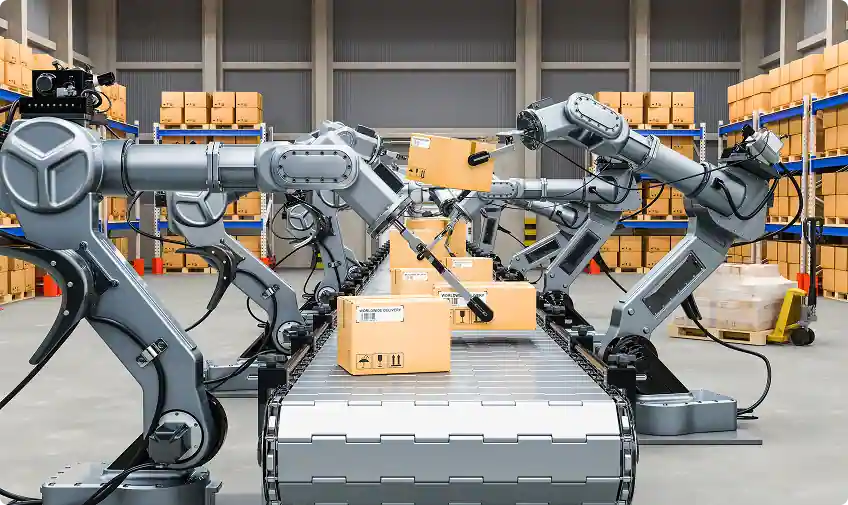
Warehouse automation is easy to notice. Conveyors hum. Shuttles dart between racks. Robots arrive at workstations with almost theatrical precision.
The intelligence preventing all that machinery from getting in its own way is far less visible.
A warehouse control system works inside the gap between intention and reality. A higher-level platform may request that an item be retrieved, picked, packed, or dispatched. The WCS deals with what is actually happening on the floor: a full buffer, a delayed station, an unavailable lift, or a route that looked clear three seconds ago but no longer is.
The WMS writes the intention. The WCS negotiates with reality.
Quick Takeaways
- A WCS coordinates warehouse equipment and converts tasks from WMS, WES, or ERP software into executable movements.
- WCS software manages routes, equipment availability, queues, task priorities, and operational exceptions.
- It connects conveyors, sorters, robotics, AS/RS equipment, AGVs, AMRs, and machine controls.
- Its purpose is to preserve smooth material flow — not simply to make individual machines run faster.
- A WCS is especially valuable in facilities where one delayed zone can disrupt several downstream processes.
What Is a Warehouse Control System (WCS)?
A warehouse control system (WCS) is the real-time decision layer inside an automated warehouse system. It determines how work should move through available equipment at that particular moment.
Definition and primary purpose
The primary purpose of warehouse control systems is to coordinate physical execution.
They receive a request, examine current operating conditions, select an appropriate route or resource, and ensure the task is completed. When circumstances change, the system adjusts. It does not expect the warehouse floor to behave like a static diagram.
The role of WCS in warehouse automation
Warehouse automation produces speed, but speed without coordination can only create congestion sooner.
Warehouse control software prevents separate pieces of the material handling system from operating as isolated islands. It aligns their actions so that a fast conveyor does not overwhelm a slower workstation, an automated crane does not retrieve stock for an unavailable destination, and a robot does not deliver work into a queue that is already saturated.
This makes the WCS an important part of industrial automation, Industry 4.0, and the connected digital warehouse. It is where data becomes movement — and where movement immediately creates new data.
How WCS differs from WMS and WES
The different systems look at the same warehouse from different distances.
| System | What it concentrates on | Example decision |
|---|---|---|
| Enterprise Resource Planning (ERP) | Orders, resources, and wider business activity | Which customer demand must be fulfilled? |
| Warehouse Management System (WMS) | Inventory and warehouse processes | Which stock should be picked or replenished? |
| Warehouse Execution System (WES) | The timing and orchestration of work | Which task should be released next? |
| Warehouse Control System (WCS) | Immediate equipment and material movement | Which available route should this item take now? |
A warehouse management system may decide that a tote is required at a picking station. A warehouse execution system may decide when that task should enter the operation. The WCS determines how the tote will physically get there.
Platforms from SAP, Oracle, Blue Yonder, and Manhattan Associates may provide upstream warehouse or enterprise functions. Dematic, Honeywell Intelligrated, Swisslog, KNAPP, and Mecalux offer different combinations of automation, execution, and control technology. The exact boundary between WMS, WES, and WCS therefore varies by architecture.
How Does a Warehouse Control System Work?
A WCS operates through a fast, repeating cycle: receive, evaluate, direct, observe, and adjust.
Communicating with warehouse equipment
The system exchanges instructions and status information with conveyors, sorters, lifts, shuttles, warehouse robotics, sensors, and local machine controls.
This may involve APIs, middleware, vendor interfaces, or PLC integration. Programmable logic controllers still handle immediate machine actions — starting a motor, opening a gate, or triggering a diverter — while the WCS coordinates the larger sequence surrounding those actions.
Managing material flow in real time
Material flow control is less like following a railway timetable and more like navigating busy city streets.
The destination may remain unchanged, but the best route can shift. A buffer fills. A workstation slows. A conveyor section stops. Another path opens.
Real-time warehouse control continuously evaluates those conditions. It may redirect a carton, briefly hold a tote, select a different station, or prevent additional work from entering a crowded area.
Executing warehouse tasks from higher-level systems
A typical task may unfold like this:
- The WMS or WES requests a movement.
- The WCS checks whether the source, destination, and equipment are ready.
- It chooses a route and sends instructions to the relevant controls.
- Sensors and subsystems report progress.
- The WCS confirms completion or records an exception.
- The result returns to the higher-level platform.
This is warehouse execution at ground level. The task stops being a line in a database and becomes a tote, pallet, parcel, or component moving through real space.
Monitoring performance and exceptions
Automation rarely fails in one clean, obvious way. More often, performance frays around the edges.
A destination takes slightly longer to clear. Recirculation rises. One sensor produces intermittent faults. A queue gains three more items every minute.
A WCS watches for those signals. Automated exception handling can pause releases, divert work, flag an operator, or switch to an alternative resource before a local issue becomes a building-wide interruption.
What Are the Core Functions of a WCS?
The exact scope varies from one facility to another, but several responsibilities appear repeatedly.
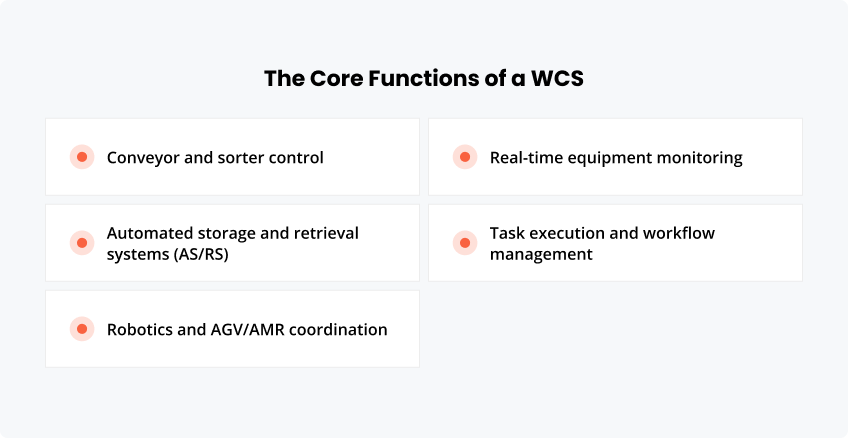
Conveyor and sorter control
Conveyor control manages how items enter, travel through, accumulate within, and leave conveyor zones.
A sortation system then directs those items toward the correct lane, workstation, carrier, dock, or processing area. In large conveyor systems and sortation systems, timing matters as much as destination. A correctly routed parcel is still a problem if it arrives at a destination with no capacity to receive it.
Automated storage and retrieval systems (AS/RS)
An automated storage and retrieval system may use cranes, shuttles, lifts, or robotic mechanisms to place and retrieve goods.
The WCS coordinates requests across that equipment while considering availability, sequence, downstream readiness, and task priority. It helps prevent storage automation from producing work faster than the next process can absorb it.
Robotics and AGV/AMR coordination
An automated guided vehicle (AGV) generally follows predefined routes or guidance infrastructure. An autonomous mobile robot (AMR) can usually adapt its path more freely.
A WCS may assign missions directly or communicate with a separate fleet manager. Either way, mobile equipment must remain synchronized with fixed automation, workstations, doors, elevators, and human activity.
Real-time equipment monitoring
Live monitoring reveals more than whether a machine is running.
It can show how long items wait, where queues accumulate, which routes are overused, how often faults recur, and whether equipment is technically available but operationally ineffective.
Task execution and workflow management
The WCS applies priorities, sequences movements, records progress, and confirms outcomes.
Urgent work may be prioritized over routine replenishment. A destination may temporarily stop receiving. A failed task may be reassigned rather than abandoned. Workflow management gives the operation both memory and motion.
What Are the Benefits of a Warehouse Control System?
The strongest benefit is not dramatic acceleration. It is the reduction of operational friction.
Improved warehouse efficiency
A WCS reduces pointless movement, unnecessary waiting, repeated handling, and avoidable recirculation.
Small improvements matter. Saving a few seconds on one task is trivial. Saving those seconds across tens of thousands of daily movements is not.
Higher throughput and order accuracy
Stable flow allows more work to pass through the same facility without constantly pushing equipment to its limits.
Automated routing and confirmation also reduce the risk of sending an item to the wrong location or losing visibility between process stages.
Better equipment utilization
Without coordination, the busiest machine often receives even more work simply because it is the default option.
A WCS can distribute tasks according to actual availability. That keeps one resource from drowning while another waits politely nearby.
Reduced manual intervention
Employees no longer need to make every routine routing or release decision themselves.
Manual expertise still matters, especially during unusual events. The difference is that people can focus on genuine exceptions rather than repeatedly directing predictable movements.
Real-time warehouse visibility
A daily report explains what happened. Real-time warehouse visibility shows what is happening in the moment.
Teams can observe queues, active tasks, equipment states, route pressure, and exceptions while there is still time to influence the outcome.
Show live targets, safety notices, workflow instructions, and shift information on connected screens throughout the warehouse and production areas.
What Are the Limitations of a WCS?
A WCS can coordinate a process. It cannot make an illogical process sensible.
Integration complexity
The difficult part is often not controlling the machine. It is deciding which system has authority.
Does the WMS own the destination? Can the WCS change it? Which platform records completion? What happens when physical movement succeeds but the digital confirmation does not?
Those questions require precise integration rules.
Legacy equipment compatibility
Older equipment may expose little useful information or rely on closed, vendor-specific interfaces.
It may still function perfectly as machinery, yet remain difficult to include in a modern control environment.
System configuration and maintenance
Routes, priorities, capacities, product profiles, and exception rules are not permanent truths.
They need attention as volumes change, equipment is added, packaging evolves, and operational assumptions no longer match the floor.
Staff training requirements
Employees should understand the reasoning behind the interface, not only the sequence of buttons used to clear an alarm.
Poor training turns small exceptions into long stoppages — or encourages improvised workarounds that create harder problems later.
Initial implementation costs
Costs may include software, engineering, emulation, hardware updates, interface development, testing, training, and planned operational disruption.
The cheapest proposal is not always the least expensive system to operate, maintain, or expand.
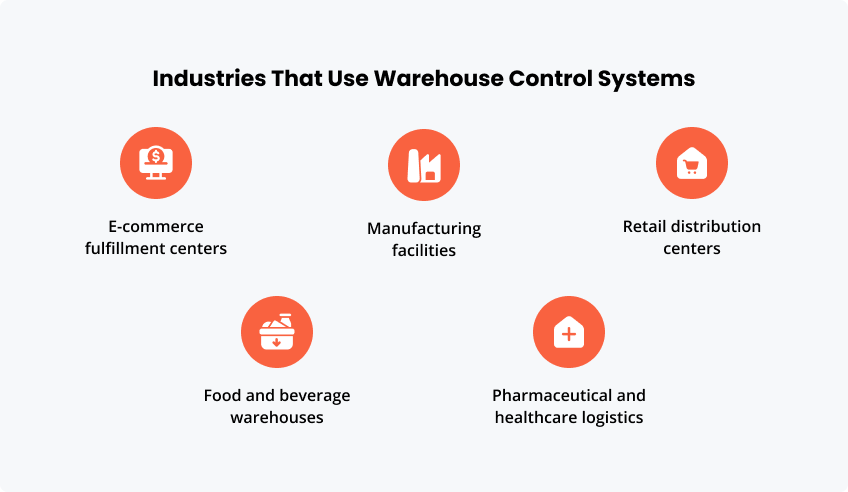
Which Industries Use Warehouse Control Systems?
WCS technology appears wherever automated movement has become too interconnected to rely on informal coordination.
E-commerce fulfillment centers
E-commerce warehouse operations combine high order volumes, short dispatch windows, and constantly changing item combinations.
A WCS coordinates picking, consolidation, packing, routing, and parcel sortation without assuming that today’s workload will resemble yesterday’s.
Manufacturing facilities
Manufacturers use WCS technology to connect component storage, production supply, work-in-progress buffers, and finished-goods handling.
Broader friendlyway solutions for manufacturing can support the people around these automated processes through digital communication, visitor handling, access workflows, and workplace information.
Retail distribution centers
Retail distribution centers must support store replenishment, promotional peaks, returns, and direct-to-consumer orders — sometimes within the same building.
A WCS helps different flows share equipment without becoming tangled together.
Food and beverage warehouses
These facilities may need to coordinate batches, pallets, production schedules, expiry requirements, and temperature-controlled areas.
Fast movement matters, but so does moving the correct product through the correct environment.
Pharmaceutical and healthcare logistics
Pharmaceutical and healthcare operations depend on traceability, accurate routing, product integrity, and reliable execution.
Here, a “small” routing error may carry consequences well beyond a missed productivity target.
Best Practices for Implementing a Warehouse Control System
A sound implementation begins by studying where work hesitates, not where software looks impressive.
Analyze warehouse processes before implementation
Follow goods through the real facility.
Observe peak periods, blocked routes, unusual packaging, replenishment conflicts, operator interventions, and workarounds that did not appear in the original process map.
Those details contain the true requirements.
Integrate seamlessly with WMS and ERP
Every critical decision needs a clear owner.
Document which system controls inventory, destination, priority, task status, and exception recovery. “Both systems know” is rarely a safe design principle.
ISA-95 provides a useful framework for structuring communication between enterprise and control layers.
Monitor warehouse KPIs continuously
Useful indicators include throughput, cycle time, queue depth, recirculation, equipment availability, route utilization, exception frequency, and mean time to recovery.
Read them together. High throughput may hide growing queues; excellent equipment availability may hide poor flow.
Maintain automation equipment proactively
Repeated minor alarms are often advance notice rather than background noise.
Trend data can reveal sensor weakening, mechanical wear, communication instability, and gradual performance loss before they trigger a major stop.
Design for future scalability
Future scalability is not simply the ability to process more volume.
The system may also need to accommodate another robot supplier, a new mezzanine, different carton sizes, extra workstations, or an entirely new operating model.
Common Mistakes When Implementing a Warehouse Control System
WCS projects often go wrong quietly, one assumption at a time.
Choosing software without analyzing warehouse processes
A polished demonstration proves that demo software works.
It does not prove that it understands the awkward corners, mixed priorities, seasonal surges, and inherited constraints of a specific warehouse.
Underestimating integration requirements
Interfaces must handle more than successful tasks.
They must also survive duplicate messages, missing confirmations, delayed responses, partial movements, connection loss, and conflicting system states.
Ignoring future scalability
Excessive customization can make the first deployment feel precise, and every later change feel dangerous.
A system should fit the operation without becoming trapped inside its current layout.
Failing to train warehouse employees
When training arrives just before launch, employees learn screens rather than the system’s logic.
Involve operators and maintenance teams earlier. They often recognize failure scenarios that process documents overlook.
Not measuring operational performance
Without a baseline, improvement becomes a matter of opinion.
Measure the operation before implementation, during stabilization, and after changes. Otherwise, a bottleneck may disappear from one area only to reappear somewhere less visible.
Coordinate arrivals, driver communication, gates, dock appointments, and yard movements before outside congestion reaches warehouse operations.
Conclusion
A warehouse control system gives an automated facility something machinery alone cannot provide: shared awareness.
It understands that a route is only useful when the destination is ready. That a fast machine can still damage throughput. That a minor delay, repeated often enough, becomes the day’s defining problem.
WCS software turns separate actions into coordinated warehouse execution. When integration, maintenance, training, and measurement are handled well, the result is not merely more automation. It is an operation that can sense pressure, make adjustments, and keep moving without waiting for disorder to become obvious.
Sources
- ISA-95 Standard: Enterprise-Control System Integration
- Oracle Warehouse Management Implementation Guide
Frequently Asked Questions
A WMS manages inventory and warehouse processes, including receiving, storage, replenishment, picking, and shipping. A WCS manages how automated equipment physically carries out those processes. The WMS establishes the requirement; the WCS coordinates the movement.
A WES typically orchestrates work across people, automation, inventory, and workstations. A WCS operates closer to the equipment, making real-time routing and control decisions. Some platforms combine WES and WCS functions, so the division varies by vendor and facility design.
Yes. A WCS can receive tasks from an ERP, production system, or another host application. However, complex warehouses typically integrate WCS and WMS platforms so that inventory information, task status, priorities, and physical execution remain synchronized.
A WCS can coordinate conveyors, sorters, lifts, carousels, shuttles, AS/RS cranes, robotic cells, automated guided vehicles, and autonomous mobile robots. Some equipment receives instructions directly, while other devices are coordinated through PLCs, local controllers, or fleet-management systems.
Important KPIs include throughput, cycle time, queue depth, recirculation rate, route utilization, equipment availability, exception frequency, manual interventions, and mean time to recovery. These figures should be reviewed by zone and process stage, as facility-wide averages can conceal the point at which flow starts to weaken.