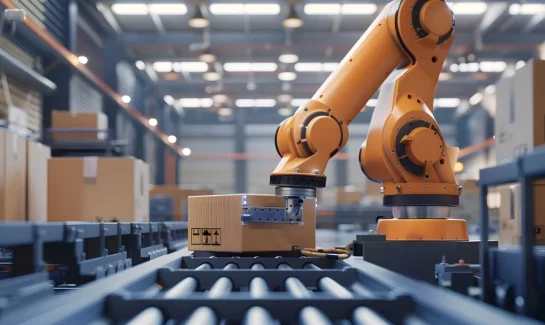

A warehouse can contain robots and still run badly.
That is the uncomfortable part of the conversation about automation. Machines move quickly. Processes do not always follow. One system knows that a shipment has arrived; another still shows it on the road. A picking robot finishes early, only to wait beside an overloaded packing station. The gate is backed up, the dock is empty, and somebody is calling a driver who checked in twenty minutes ago.
Warehouse automation trends in 2026 increasingly focus on fixing those gaps.
Yes, the hardware is becoming more capable. Artificial Intelligence (AI) is appearing in daily workflows. Autonomous vehicles are getting easier to deploy. Yet the bigger change is coordination: software, warehouse robotics, people, inventory, docks, and yard activity need to begin to operate from the same picture.
What Matters in 2026
- Connected beats isolated: A fast machine has limited value when the surrounding process cannot keep up.
- AI is getting specific: Slotting, maintenance, sequencing, forecasting — not vague “digital transformation.”
- Flexibility is winning: Businesses need systems that can bend when order profiles, products, and volumes shift.
- People remain in the loop: Exceptions, judgment, maintenance, safety, and improvement still need human attention.
Why Warehouse Automation Is Evolving Faster Than Ever
Three forces keep colliding: rising service expectations, a difficult labor market, and technology that is finally practical enough to leave the pilot zone.
Rising customer expectations
Customers rarely see the warehouse. They notice its failures immediately.
A missing item, an inaccurate delivery promise, a stock figure that changes after checkout — small operational cracks become visible at the customer’s door. Warehouses are being pushed to process more varied orders in less time, often with later cut-offs and thinner margins for error.
Labor shortages and operational efficiency
The issue is not simply headcount. It is where skilled employees spend their time.
Walking several kilometres per shift, repeating scans, moving empty carts, or copying information between screens does not make good use of experience. Automation can absorb that work. The harder decisions stay with people.
The impact of AI and digital transformation
AI in warehousing has become quieter and more useful. Machine learning models are adjusting pick sequences, anticipating replenishment, flagging unusual delays, and spotting equipment behaviour that deserves attention.
The 2026 MHI Annual Industry Report places AI-driven operations, workforce strategy, visibility, and resilience near the centre of current supply-chain investment. That is a long way from the experimental chatbots and prediction demos that once dominated the discussion.
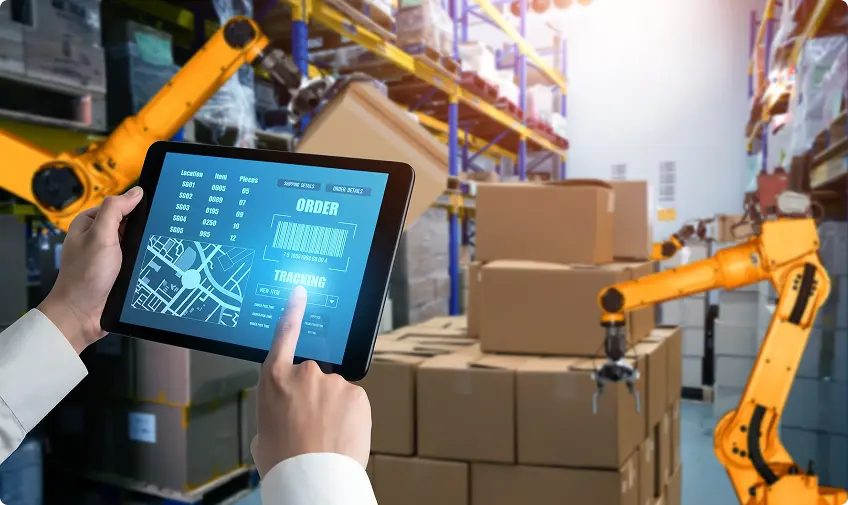
15 Warehouse Automation Trends in 2026
Not all of these warehouse technology trends will suit every facility. Nor should they.
A cold-storage warehouse, a spare-parts operation, and a high-volume e-commerce site do not need the same machinery. What they do share is a growing dependence on live data and clean hand-offs.
1. AI-powered warehouse optimization
AI is being inserted between the plan and the shift itself.
A rush order arrives. Replenishment is late. Two employees move to another zone. Instead of waiting for tomorrow’s report, optimization software can reshuffle priorities while the situation is still recoverable.
2. Warehouse orchestration platforms
A warehouse management system (WMS) knows what must be done. A warehouse control system (WCS) speaks to equipment. A warehouse execution system (WES) sequences active work.
Warehouse orchestration watches the whole room.
It may slow one process to prevent another from drowning. Counterintuitive? Sometimes. Useful? Very.
3. Autonomous mobile robots (AMRs)
An autonomous mobile robot (AMR) can alter its route when an aisle is blocked or traffic changes. An automated guided vehicle (AGV), by contrast, generally operates within a more fixed navigation structure.
AMRs are spreading because warehouses rarely stay still for long.
4. Collaborative robots (cobots)
A collaborative robot (cobot) does not need to own an entire process. It might present cartons, stack cases, or hold an item in place.
That modest role is often the point. Cobots accounted for 10.5% of industrial robot installations worldwide in 2023, according to the International Federation of Robotics, and their share has likely grown since then.
5. Goods-to-person automation
Walking is expensive.
Goods-to-person automation reverses the traditional picking journey: inventory travels to the employee. The result can be faster work and a smaller training burden, though poor workstation design can quickly reduce those gains.
6. Automated storage and retrieval systems (AS/RS)
An automated storage and retrieval system (AS/RS) can squeeze far more inventory into a building by using cranes, shuttles, lifts, or robots.
Density attracts attention. Recovery deserves equal attention. How does the operation continue when one component stops?
7. AI vision systems for quality control
A camera does not get bored halfway through a shift.
Computer vision can catch torn packaging, incorrect labels, missing items, unstable loads, or dimensional errors as products move. Still, the system must be trained carefully. Constant false alarms turn sophisticated technology into background noise.
8. Digital twins for warehouse operations
A digital twin gives planners somewhere safe to be wrong.
Teams can test a layout, simulate a peak, remove a conveyor, add a picking station, or change staffing assumptions without disrupting the live facility. The point is not a beautiful 3D model. It is fewer expensive surprises.
A polished internal process can still lose time at a crowded gate. Bring appointment planning, driver arrival, yard status, and dock activity into one operational flow.
9. Predictive maintenance
A bearing rarely checks the maintenance calendar before failing.
Predictive maintenance uses vibration, heat, runtime, power draw, and recurring errors to find equipment that is beginning to behave differently. Maintenance teams get a warning — not a guarantee, but often enough breathing room to act.
10. Industrial IoT (IIoT)
The Industrial Internet of Things (IIoT) connects machinery that once worked in silence.
Conveyors report stoppages. Doors report cycles. Sensors track temperature. Vehicles share position. Industrial IoT makes a smart warehouse observable, although collecting every possible signal is not the same as understanding it.
11. Real-time warehouse analytics
A dashboard should make the next decision easier.
Real-time analytics can reveal a queue building at packing, a fall in pick speed, an empty replenishment location, or a trailer sitting too long. When everything flashes red, however, nothing has priority.
12. Hyperautomation in warehouse workflows
Some of the slowest warehouse work happens without a pallet in sight.
Hyperautomation tackles approvals, document checks, order updates, carrier exceptions, and repetitive data entry. It connects AI, workflow engines, robotic process automation, and business rules — the administrative machinery behind physical flow.
13. Sustainable warehouse automation
Sustainable warehouse automation is becoming less ceremonial.
Shorter travel routes, intelligent charging, denser storage, better trailer planning, and reduced idling can lower energy and resource use. But a new machine is not “green” by default. Its full operating life matters.
14. Cloud-native warehouse platforms
Cloud-native warehouse automation solutions make multi-site management easier. Updates can be deployed centrally. Performance becomes comparable. Support teams gain remote visibility.
Then the connection drops.
That is why fallback procedures, permissions, data governance, and resilient infrastructure belong in the design, not in a post-launch meeting.
15. End-to-end system integration
This may be the least glamorous trend — and the most important.
Modern warehouse automation systems rarely come from a single supplier. SAP, Oracle, Blue Yonder, or Manhattan Associates software may need to exchange events with technology from Dematic, Swisslog, KNAPP, AutoStore, Geek+, Locus Robotics, or Boston Dynamics. Add gates, kiosks, access systems, carrier tools, and digital displays. The interfaces multiply quickly.
| System layer | What it handles | The question it answers |
|---|---|---|
| Warehouse Management System (WMS) | Inventory, locations, and orders | What needs to happen? |
| Warehouse Control System (WCS) | Machine-level communication | How will the equipment do it? |
| Warehouse Execution System (WES) | Work release and sequencing | What should happen now? |
| Warehouse orchestration | People, software, machines, and exceptions | How should the operation respond? |
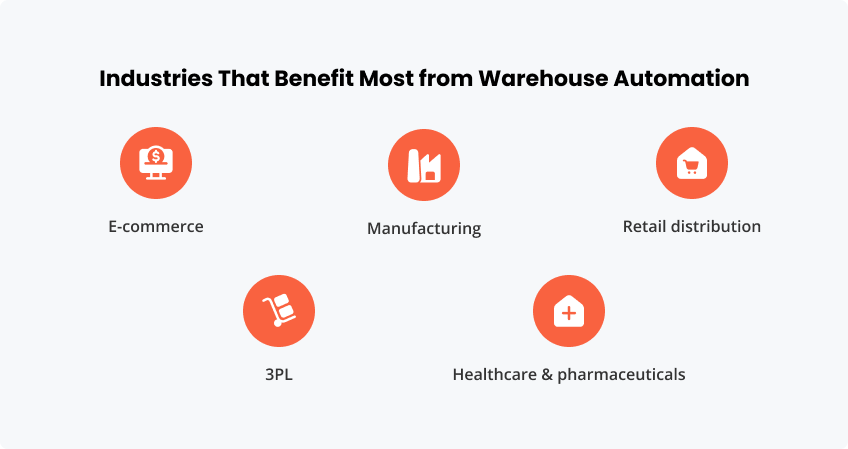
Which Industries Benefit Most from Warehouse Automation?
The strongest use cases tend to appear where volume changes quickly, mistakes are costly, or traceability is non-negotiable.
E-commerce
E-commerce warehouses face lopsided demand: ordinary mornings, sudden campaigns, seasonal surges. Flexible picking, sortation, and packing systems help absorb the shock without permanently designing the building around its busiest day.
Manufacturing
Manufacturing depends on timing. A component that arrives late can stop production; one that arrives too early becomes another obstruction.
friendlyway’s solutions for manufacturing support connected access, workforce, safety, and site workflows around these movements.
Retail distribution
Retail distribution mixes store replenishment, seasonal stock, promotions, returns, and increasingly fragmented order profiles. Better visibility matters almost as much as raw handling speed.
Third-party logistics (3PL)
A third-party logistics (3PL) provider cannot rebuild the warehouse every time a contract changes. Modular automation allows different customers, service levels, and product types to coexist — sometimes awkwardly, but profitably.
Healthcare and pharmaceuticals
Accuracy comes first. Healthcare and pharmaceutical operations need traceability, controlled access, dependable records, and careful handling. Speed matters. An undocumented shortcut matters more.
What Challenges Come with Warehouse Automation?
The robot is rarely the only difficult part. Sometimes it is the easy part.
Integration complexity
Legacy systems contain years of exceptions, local rules, and improvised workarounds. Those details surface during integration.
Data ownership, APIs, identifiers, timing, and error handling should be settled early. friendlyway’s integration framework supports connections to enterprise, security, access-control, and operational systems.
Investment costs
The proposal shows equipment and licences. The final cost also includes networking, building changes, testing, training, spare parts, support, maintenance, and the weeks when productivity dips during transition.
Budget for the messy middle.
Workforce transformation
Automation changes where judgment is needed. Employees may walk less but handle more exceptions. Supervisors may spend less time assigning tasks and more time interpreting system behaviour.
Training must follow the real job, not the sales demonstration.
Cybersecurity considerations
Every connected sensor, kiosk, robot, camera, and control system broadens the risk surface. In the US, NIST’s updated IoT and operational technology work stresses that connected products must be considered within the wider system risk — not treated as harmless standalone devices.
Change management
A technically correct rollout can still fail by lunchtime.
People need to know what is changing, why it is changing, and what happens when the new process does something unexpected. Trust is built during exceptions, not launch presentations.
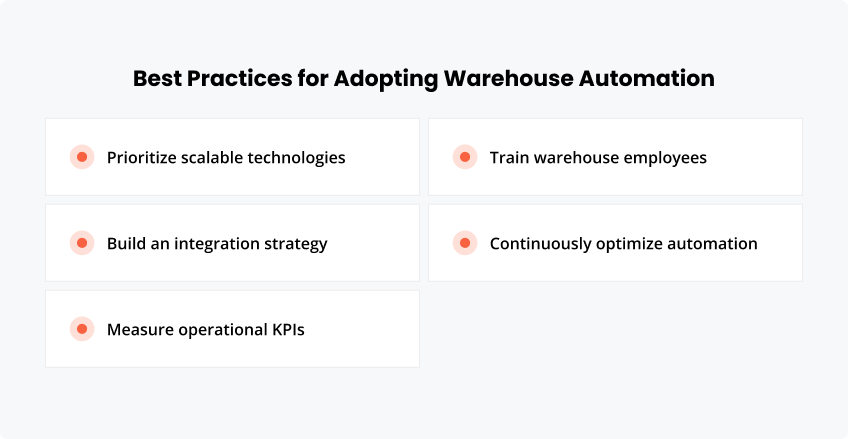
Best Practices for Adopting Warehouse Automation
Start with the bottleneck. Not the machine.
Prioritize scalable technologies
Choose systems that can expand by workflow, zone, or location. Modularity buys room to learn. It also reduces the temptation to predict the next ten years with false precision.
Build an integration strategy
Map the information journey before installation begins. Which system creates the order? Who confirms arrival? Where does an exception go? What happens when a message fails?
Boring questions. Expensive when ignored.
Measure operational KPIs
Track a focused set of operational KPIs: throughput, accuracy, cycle time, dwell time, equipment availability, safety, and adoption.
Avoid measuring only what improved. A faster picking zone is not a victory if dispatch becomes the new queue.
Train warehouse employees
Use real exceptions, not perfect scenarios. Let employees practise handling a blocked aisle, an unreadable label, an unavailable item, or a failed connection.
friendlyway digital signage can deliver live instructions, safety information, and operational updates across connected screens and kiosks.
Continuously optimize automation
An Industry 4.0 warehouse is never finished. Products change. Labor changes. Customers make new promises. The process that worked in January may be awkward by October.
Tune it.
Common Mistakes When Investing in Warehouse Automation
Warehouse innovation disappoints when businesses automate first and diagnose later.
Buying technology without clear objectives
“Modernize the warehouse” is not measurable.
Reduce pick travel. Shorten gate queues. Improve order accuracy. Increase storage density. Begin with a problem that can be observed before and after the investment.
Ignoring interoperability
A machine may perform beautifully on its own and create frustration everywhere else.
Ask what information it sends, what it receives, how quickly it responds, and what happens when either side goes quiet.
Automating inefficient processes
A needless approval remains needless when automated. So does a duplicate scan.
Simplify first. Otherwise, the warehouse only gets a faster version of the same old confusion.
Underestimating employee adoption
Frontline employees find weaknesses quickly. Listen to them.
A workaround is not always resistance; sometimes it is evidence that the official process does not survive contact with the shift.
Focusing only on short-term ROI
Labor savings and throughput are easy to place in a spreadsheet. Resilience, safety, adaptability, maintenance exposure, and better data are harder to document.
Harder does not mean irrelevant.
Connect driver check-in, controlled access, live status updates, notifications, and yard coordination without adding another isolated workflow.
Summing Up
Warehouse automation trends 2026 point in one direction: away from impressive islands of technology and toward connected decisions.
AI, AMRs, AS/RS, digital twins, predictive maintenance, IIoT, and real-time analytics all have a place. None can rescue a vague objective or a broken hand-off.
The better automated warehouse is not necessarily the one with the most machinery. It is the one that notices what is happening — and responds before the problem travels downstream.
Sources
- MHI and Deloitte: 2026 Annual Industry Report
- International Federation of Robotics: Collaborative Robots
- NIST: Foundational Cybersecurity Activities for IoT Product Manufacturers
Frequently Asked Questions
Coordination. Warehouses are connecting robotics, AI, inventory software, employees, docks, and yard activity so the entire operation can respond to live conditions. The shift is less about adding another machine and more about preventing systems from working against one another.
In some processes, AI reduces the amount of repetitive work required. It does not remove the need for maintenance, supervision, safety management, exception handling, and operational judgment. Roles change. Whether that change is positive depends heavily on training and implementation.
Typical technologies include WMS, WCS, WES, warehouse orchestration, AMRs, AGVs, cobots, conveyors, sorters, AS/RS, barcode and RFID systems, computer vision, IIoT sensors, digital twins, predictive maintenance, and real-time analytics.
There is no reliable universal figure. A limited software or scanning project may be relatively modest; a large AS/RS or facility-wide transformation can reach several million euros. Integration, infrastructure, training, support, maintenance, and building work all affect the real cost.
Yes, provided the scope is sensible. Smaller operations can automate one painful process — inventory capture, replenishment, check-in, internal transport, reporting — without having to recreate a global fulfillment centre. A clear constraint is a far better starting point than a large technology wish list.