
(Prefer videos? Watch a brief summary of this article below.)
A site can invest heavily in robotics and still spend half the day waiting.
Waiting for a tote. Waiting for a dock. Waiting for an operator to notice that one station is full while another is almost idle.
The problem is not always a lack of technology. Often, the pieces do not listen to one another.
Warehouse orchestration addresses that disconnect. It creates a live operating layer, so decisions are made with the state of the whole facility in mind — not one machine, queue, or department at a time.
Quick Takeaways
- Warehouse orchestration connects software, automation, robotics, equipment, and employees.
- It adjusts priorities as orders, capacity, and operating conditions change.
- It helps prevent congestion from spreading between processes.
What Is Warehouse Orchestration?
Think of it less as another system in the stack and more as the logic that keeps the stack moving together.
Definition and core concept
A warehouse orchestration system gathers information from inventory records, business applications, sensors, employees, automated machinery, and robots. It then determines what should happen next.
Not in theory. On the floor.
Should a priority order move ahead? Is the packing area able to absorb more work? Would an AMR be quicker than the available conveyor route? Has a temporary bottleneck made the original task sequence obsolete?
Warehouse orchestration software continuously weighs those conditions. That makes the operation less dependent on fixed task queues and manual intervention.
Why warehouse orchestration has become essential
Modern logistics environments rarely arrive as one neatly designed ecosystem. They grow.
A new sorter is added. Then mobile robots. Then another order channel. A legacy application remains because replacing it would be disruptive. Temporary employees use different interfaces from permanent teams. Each addition solves a problem, but it may also create another handoff.
Those handoffs are where time disappears.
Orchestration brings real-time visibility to the gaps between processes. It helps the digital warehouse function as a single operation rather than a collection of well-equipped islands. That is also why it has become closely associated with Industry 4.0: connected technology is useful, but coordinated technology is far more valuable.
How warehouse orchestration differs from WMS, WCS, and WES
The categories are not rigid. Vendors combine functions, rename modules, and draw boundaries differently. Even so, their central roles remain distinct.
| System | Primary role | Typical decisions |
|---|---|---|
| Warehouse Management System (WMS) | Manages orders, inventory, locations, and rules | What must be received, stored, picked, packed, or shipped |
| Warehouse Control System (WCS) | Controls automated machinery | How conveyors, sorters, cranes, and related equipment move goods |
| Warehouse Execution System (WES) | Releases and balances work | When a task should begin and which resource should complete it |
| Warehouse orchestration platform | Coordinates systems, people, and automation | How the overall operation should respond to changing conditions |
The WMS often remains the system of record. The WCS deals with physical movement. The WES sits closer to live execution.
Orchestration looks sideways as well as downward. It connects decisions that would otherwise be made separately.
How Does Warehouse Orchestration Work?
There is no dramatic moment when orchestration “happens.” It is a loop: observe, decide, act, check, adjust.
Then repeat.
Connecting warehouse systems and automation
Data moves through application programming interfaces, event streams, middleware, and Industrial Internet of Things (IIoT) devices. These connections allow WMS, WCS, WES, Enterprise Resource Planning (ERP), transport applications, sensors, and industrial automation to exchange status information.
This is where solid system integrations earn their keep. If updates arrive late — or describe the same order in incompatible ways — the decision layer is working from a distorted picture.
Coordinating robots, equipment, and employees
Robot orchestration is not merely traffic control.
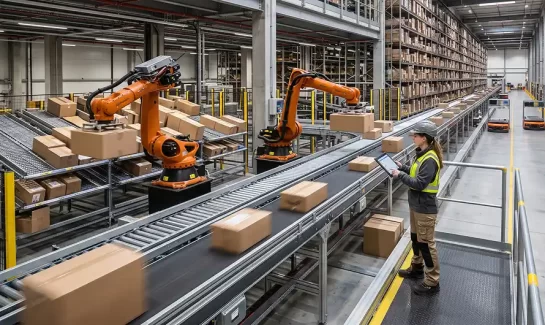
A tote might travel by conveyor when capacity is open, switch to an autonomous mobile robot (AMR) when the route becomes congested, or move to a manual station because the automated option is temporarily unavailable. An automated guided vehicle (AGV) may pause. A picker may be redirected. A replenishment task may leap ahead because several downstream orders depend on it.
The best resource is not always the fastest machine. Sometimes it is the employee standing closest to the exception.
Managing workflows in real time
Plans are tidy. Operations are not.
A truck arrives late. Inventory appears in the wrong location. A packing station slows. Three urgent orders enter the queue together.
Real-time coordination allows the system to make small corrections while the disruption is still small. It may delay upstream work, redirect an AMR, alter picking priorities, or distribute tasks across another zone.
Without that response, a five-minute delay in one area can become a two-hour queue somewhere else.
Optimizing operational decisions
Rules and warehouse optimization engines can simultaneously weigh throughput, deadlines, travel distance, labor availability, equipment load, energy use, and downstream capacity.
Artificial Intelligence (AI) may identify recurring congestion patterns or recommend better task sequences. A digital twin can test changes before anyone touches the live warehouse operations.
The point is not to chase an abstract “perfect” plan. It is to keep improving the next decision.
What Technologies Power Warehouse Orchestration?
Most sites already own many of the required components. Orchestration connects them and adds a shared decision layer.
Warehouse Management Systems (WMS)
Platforms from SAP, Oracle, Blue Yonder, and Manhattan Associates manage inventory, orders, storage locations, replenishment, and warehouse management rules. They provide the commercial and operational context behind each task.
Warehouse Control Systems (WCS)
A WCS communicates with material handling equipment such as conveyors, sorters, shuttles, cranes, lifts, and automated storage systems. Its focus is controlled, safe, and reliable movement.
Warehouse Execution Systems (WES)
A WES manages the release and sequencing of work. It can balance zones, regulate task flow, and prevent one process from drowning the next in unfinished work.
Robotics, AMRs, and AGVs
Warehouse robotics may include AutoStore systems, Geek+ fleets, picking arms, autonomous mobile robots, and automated guided vehicles.
Solutions from Dematic, Swisslog, and KNAPP may add software, controls, and automation around those technologies. In a mixed environment, orchestration keeps each tool from following its own narrow definition of priority.
AI, analytics, and real-time data
AI in warehousing can forecast congestion, detect abnormal delays, and improve resource allocation. Real-time analytics shows whether those recommendations are actually helping.
That last part matters. An impressive utilization figure means little if orders are still leaving late.
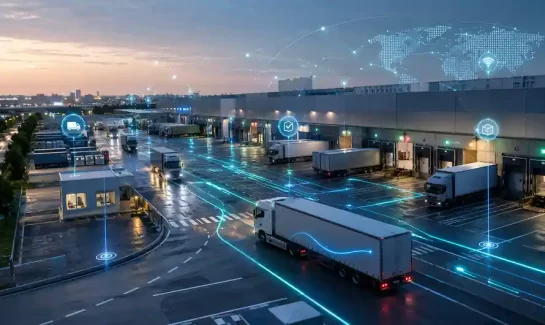
Bring driver arrivals, access decisions, dock assignments, and internal logistics into a clearer, more connected flow.
What Are the Benefits of Warehouse Orchestration?
The gains usually appear between processes, where nobody was previously measuring the lost minutes.
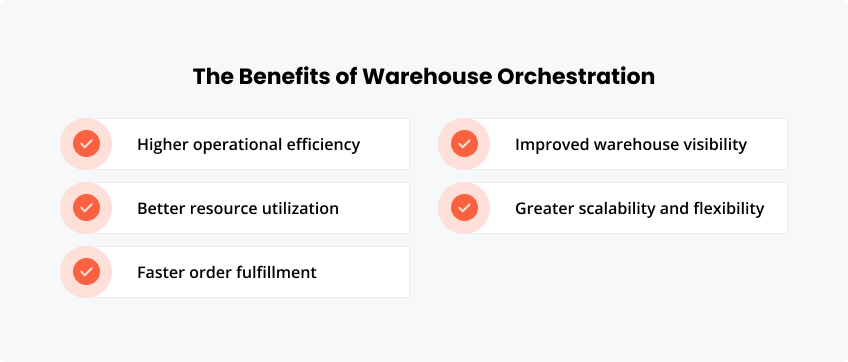
Higher operational efficiency
Dynamic task sequencing reduces idle time, repeated travel, unnecessary staging, and preventable waiting. That leads to higher operational efficiency without necessarily adding more equipment.
Better resource utilization
Robots, workstations, employees, and automated machinery are rarely available in perfect balance. Orchestration improves resource utilization by assigning work around actual capacity rather than yesterday’s assumptions.
Faster order fulfillment
Priority work can move forward without a supervisor manually rebuilding the shift plan. The result is faster, more predictable order fulfillment.
Improved warehouse visibility
A shared view of queues, task status, inventory movement, and equipment availability improves warehouse visibility. Managers can see not only that performance changed, but where the change began.
Greater scalability and flexibility
A coordinated architecture makes it easier to add a zone, a process, a robot fleet, or an order channel. That scalability and flexibility allow warehouse automation to grow without multiplying isolated control layers.
What Are the Challenges of Warehouse Orchestration?
Orchestration can simplify daily operations. Getting there may be anything but simple.
System integration complexity
System integration complexity increases when several vendors, databases, controllers, and naming conventions must exchange data immediately and reliably.
Legacy infrastructure limitations
Legacy infrastructure may struggle with real-time updates, modern interfaces, or the network availability required by connected processes. Sometimes replacement is necessary. Sometimes a carefully designed bridge is enough.
Data synchronization
Data synchronization is non-negotiable. If two systems disagree about a location, task state, or available resource, the orchestration layer may make the wrong decision very efficiently.
Change management and employee adoption
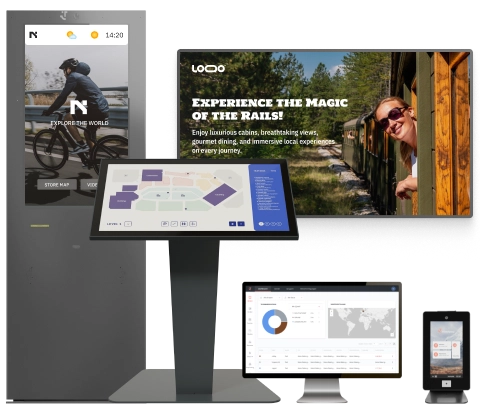
Dynamic instructions can feel unsettling to teams accustomed to fixed task lists. Clear interfaces, practical training, and targeted digital signage can improve employee adoption by showing updates at the point of work.
Initial implementation costs
Initial implementation costs extend beyond software licenses. Integration, process mapping, cybersecurity, network upgrades, testing, training, and support all belong in the business case.
Which Industries Benefit from Warehouse Orchestration?
The strongest candidates are operations where priorities shift often, and the cost of a poor handoff is high.
E-commerce and omnichannel retail
E-commerce and omnichannel retail sites may handle parcel orders, store replenishment, returns, and urgent shipments under one roof. Orchestration keeps those flows from competing blindly.
Manufacturing
In manufacturing environments, it can coordinate inbound materials, line-side replenishment, work in progress, finished goods, and outbound movement.
Third-party logistics (3PL)
A third-party logistics provider, or 3PL, must accommodate different customer rules, service levels, technologies, and product profiles. A coordinated execution layer reduces the need for manual workarounds.
Food and beverage
Food and beverage logistics adds expiration dates, temperature zones, batch controls, hygiene rules, and fast inventory rotation. Sequence matters — sometimes down to the minute.
Pharmaceutical logistics
Pharmaceutical logistics requires traceability, controlled access, validated procedures, and dependable exception handling. Orchestration can improve flow without weakening those controls.
Best Practices for Implementing Warehouse Orchestration
A strong implementation begins before the first integration is built.
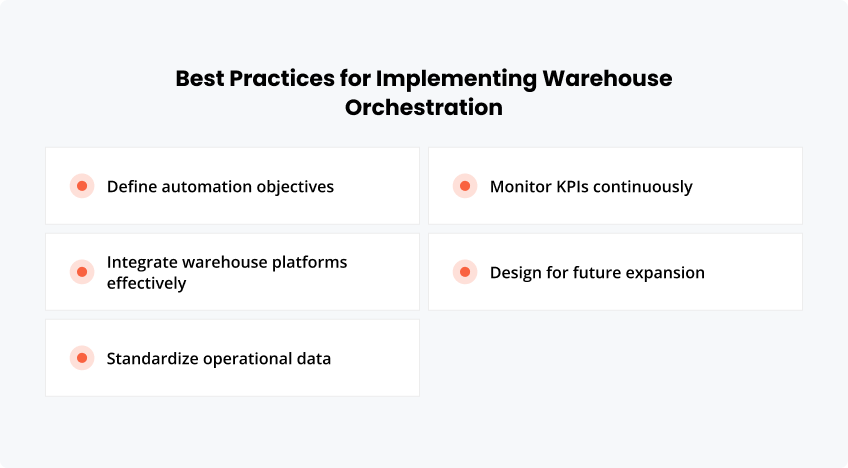
Define automation objectives
Define objectives in numbers: throughput, dwell time, cycle time, travel distance, utilization, or on-time completion. “Improve automation” is not a measurable target.
Integrate warehouse platforms effectively
Integrate platforms by first mapping system ownership, triggers, dependencies, and fallback actions. Otherwise, teams may hardcode an unresolved argument about which platform is in charge.
Standardize operational data
Standardize data across orders, locations, equipment states, employees, and exceptions. Shared definitions prevent quiet inconsistencies from becoming live operational errors.
Monitor KPIs continuously
Monitor KPIs after launch. Queue length, downtime, cycle time, throughput, travel distance, and completion rates reveal whether the new logic is improving flow.
Design for future expansion
Modular interfaces and portable data make it easier to introduce another system without having to rebuild everything around it.
Common Mistakes When Implementing Warehouse Orchestration
The most common failures are surprisingly ordinary:
- Automating inefficient processes: A poor process does not become sound simply because it moves faster.
- Focusing solely on technology rather than the warehouse workflow: Software cannot resolve unclear ownership or conflicting priorities on its own.
- Ignoring system interoperability: Closed interfaces make upgrades and multi-vendor coordination harder.
- Underestimating employee training: Teams need to understand routine work, overrides, and exceptions.
- Not measuring operational performance: Without a baseline, improvement becomes a matter of opinion.
Coordinate arrivals, access, yard movements, communication, and internal workflows around the realities of your site.
Conclusion
A WMS may know what must ship. A WCS may know how to move it. A WES may know when to release the task.
None of those views is complete.
Warehouse orchestration solutions connect these systems to the people, robots, equipment, and conditions shaping the work in real time. They make operations more alert. More adaptable. Better able to correct course before a small problem becomes an expensive one.
That is the lasting value: not automation for its own sake, but a facility that can sense what is changing and respond with less delay.
Sources
- SAP Extended Warehouse Management
- Oracle Warehouse Management
- International Federation of Robotics: World Robotics 2025 Report
- ISO 3691-4: Safety Requirements for Driverless Industrial Trucks
Frequently Asked Questions
Warehouse orchestration is the real-time coordination of software, automation, robots, equipment, and employees across a logistics operation. It uses shared data to assign work, adjust priorities, manage exceptions, and respond to changing conditions.
Warehouse management focuses mainly on inventory, orders, locations, replenishment, and operating rules. Orchestration focuses on how tasks are executed across connected systems and resources. A warehouse management system may include some orchestration capabilities, but the terms do not always describe the same scope.
Usually not. The WMS often remains the source of order, inventory, and location data. Orchestration adds dynamic sequencing, resource coordination, and robot orchestration above or alongside it.
A typical environment may include WMS, WES, WCS, ERP, middleware, sensors, analytics, and automation interfaces. More automated sites may also connect AMRs, AGVs, conveyors, sorters, robotic systems, and automated storage equipment.
Yes, when the operation is sufficiently complex. A smaller site with several order channels, variable staffing, mobile robots, tight delivery windows, or frequent exceptions may benefit considerably. A simple manual operation may gain more from process improvement first.