
(Prefer videos? Watch a brief summary of this article below.)
A warehouse can have world-class automation inside and still lose hours outside. One late truck, one missing trailer, one radio call nobody hears — and the dock plan collapses.
That is why yard operations in logistics are no longer a back-office detail. They are the hinge between transport, security, warehousing, and customer service.
At a Glance
- The yard is the buffer between incoming transport and warehouse execution.
- Gate check-in sets the tone for safety, timing, and access control.
- Trailer tracking prevents blind spots that lead to searches and late loading.
- Dock scheduling works best when linked to real-time site conditions.
- Digital workflows improve yard efficiency without adding pressure to teams.
What Are Yard Operations in Logistics
Before looking at daily tasks, it helps to define the space and its business value.
Definition in the supply chain context
Yard operations are the activities involved in controlling trucks, trailers, containers, drivers, parking slots, and dock scheduling, as well as movements outside a warehouse or production site. In simple terms, it is where transport plans become physical flow.
The role of the yard between transport and warehouse
The site acts as a handshake point. Carriers arrive with goods, warehouse teams prepare the doors, and security checks who should enter. When logistics yard operations work well, freight moves without drama. When they do not, everyone feels it.
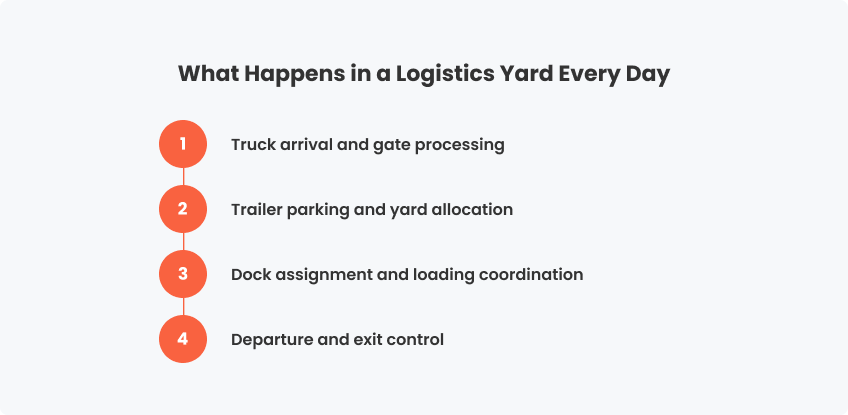
What Happens in a Logistics Yard Every Day
A normal day is a chain of small decisions. Each one affects the next.
1. Truck arrival and gate processing
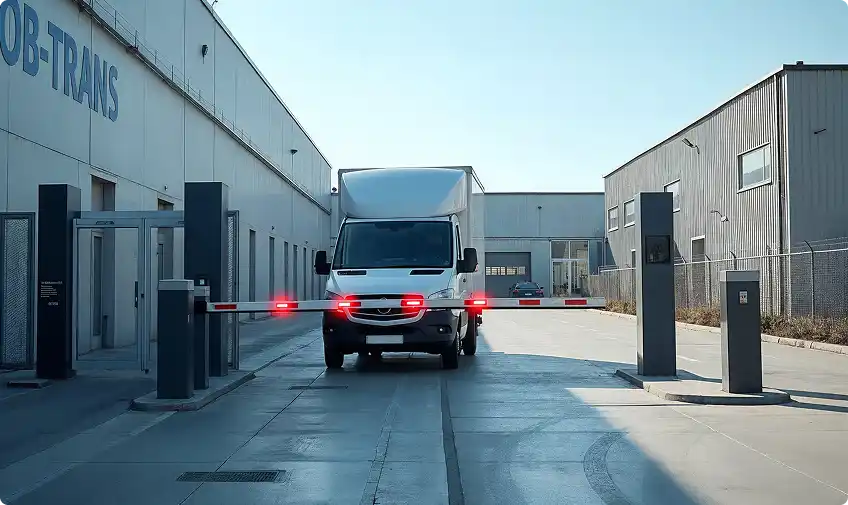
Drivers reach the gate, confirm their booking, share documents, and receive instructions. A digital front end helps reduce paper logs and manual calls at busy entry points.
2. Trailer parking and yard allocation
After entry, the trailer needs a location. Poor allocation creates long searches. A food distributor, for example, may need to place chilled loads near cold docks while keeping empty trailers away from high-traffic zones.
3. Dock assignment and loading coordination
Dock doors are limited assets. Teams must match trailers, labor, equipment, and order priority. A late inbound load can force planners to reshuffle three outbound waves.
4. Departure and exit control
The final check confirms that the right trailer leaves with the right documents. Exit control also supports security, billing, and audit trails.
Key Processes in Yard Operations
The best sites make each step visible, repeatable, and easy to adjust.
Carrier scheduling and arrival planning
Carrier scheduling sets appointment windows and avoids arrival peaks. Without it, 15 trucks may show up at 08:00 while the site has space for only six.
Gate check-in and driver registration
Gate check-in captures driver details, vehicle IDs, load references, safety acknowledgements, and visit purpose. This is where yard management operations start.
Yard movement and trailer positioning
Hostlers or shunters move trailers from parking to doors and back again. A simple rule helps: every move should have a reason, a destination, and a timestamp.
Dock door coordination
Dock scheduling links transport promises to warehouse reality. The plan should reflect door availability, labor, equipment, product type, and loading priority.
Communication between the yard and warehouse teams
Misalignment often starts with silence. Screens, alerts, and shared dashboards help the gatehouse, transport office, and warehouse floor act from the same picture.
| Process area | What to monitor | Why it matters |
|---|---|---|
| Gate | Check-in time | Reveals entry bottlenecks |
| Parking | Slot occupancy | Prevents yard congestion |
| Trailers | Location status | Improves trailer tracking |
| Docks | Door utilization | Protects loading plans |
| Exit | Dwell time | Shows total flow quality |
Streamline truck entry with digital self-service workflows.
Where Yard Operations Break Down
Most failures are not dramatic. They are small gaps that repeat.
Lack of real-time visibility
When teams cannot see what is on site, they guess. The result is duplicated work, missed priorities, and “Has anyone seen trailer 281?” conversations.
Yard congestion and delays
Congestion appears when arrivals, parking, shunting, and docks fall out of rhythm.
Miscommunication between teams
A planner may release a dock door while pallets are still staged there. A guard may admit a driver before the transport office is ready. These gaps slow logistics operations.
Inefficient use of space and resources
Yards often run out of “usable” space before they run out of physical space. Bad slotting, abandoned empties, and unclear priority lanes all reduce capacity.
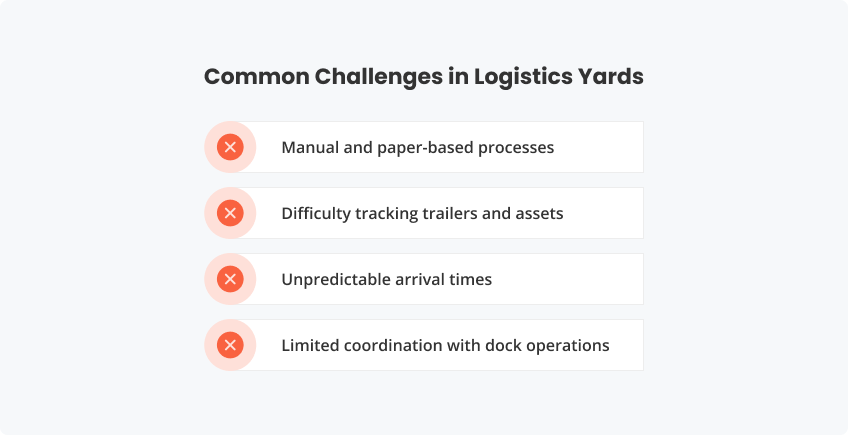
Common Challenges in Logistics Yards
The same patterns show up in manufacturing plants, retail DCs, and 3PL hubs.
Manual and paper-based processes
Paper logs are easy to start and hard to scale. They create handwriting errors, slow audits, and make supply chain visibility depend on someone walking to a binder.
Difficulty tracking trailers and assets
Trailer tracking becomes painful when IDs are typed differently across systems. One extra dash or missing digit can hide an asset in plain sight.
Unpredictable arrival times
Traffic, port delays, driver hours, and carrier changes all affect arrival windows. Strong yard processes logistics teams use should absorb variation without chaos.
Limited coordination with dock operations
The dock plan is only useful if it reflects the outside reality. A trailer cannot be loaded if it is still waiting at the gate.
How Companies Improve Yard Operations
Improvement starts with habits before software.
Standardizing yard processes
Create clear steps for arrival, parking, movement, loading, exception handling, and exit. Standard work makes performance measurable.
Improving planning and scheduling
Use appointment windows, load priorities, dwell thresholds, and escalation rules. A retailer handling seasonal peaks might reserve lanes for fast-turn promotional stock.
Using real-time data for decisions
Real-time tracking lets supervisors act early. If a priority trailer has not moved after 30 minutes, the system should flag it before the customer calls.
The Role of Technology in Yard Operations
Technology does not replace discipline. It makes discipline easier to maintain.
Digital check-in and gate systems
Self-service kiosks can guide drivers through registration, document capture, safety instructions, and next steps.
Tracking and visibility tools
Barcode scans, RFID, cameras, GPS, OCR, and mobile updates can all support yard visibility.
Logistics Management’s 2026 Automation Survey reported that nearly half of companies use mobile technologies for data collection, while 58% use barcode scanners — a practical signal that mobile data capture is now mainstream.
Integration with warehouse systems
Integration connects gate events, dock schedules, WMS tasks, and access control. The goal is not another screen. It is one version of the truth.
When Yard Operations Require a System Approach
Not every site needs a complex platform. But some signs are hard to ignore.
Growing yard complexity
Complexity rises with multiple gates, product zones, temperature areas, contractor flows, and mixed inbound/outbound traffic. At that stage, warehouse yard operations need rules built into the workflow.
High volume of trucks and trailers
High volume exposes weak processes quickly. A manual method that works for 20 arrivals may collapse at 120.
Need for centralized control
Multi-site operators need comparable data. Yard operations management becomes strategic when leaders can compare dwell time, gate time, dock use, and asset availability across locations.
Reduce waiting times, improve trailer visibility, and coordinate gates, docks, and yard movements with a digital yard management solution.
Great yard performance feels quiet. Trucks arrive, drivers know what to do, trailers are easy to find, and warehouse teams trust the plan.
The companies that get there do not treat the outdoor flow as “just the space outside.” They treat it as a managed process, with the same care given to production lines, inventory, and customer delivery.
FAQ
They are the processes used to manage trucks, trailers, drivers, gates, parking areas, dock doors, and the movement of things around a warehouse, plant, or distribution center.
They affect delivery speed, safety, dock productivity, carrier relationships, and inventory flow. A slow site entrance can disrupt the entire warehouse schedule.
The biggest challenges include limited visibility, manual check-in, poor trailer tracking, yard congestion, late arrivals, and weak coordination with dock teams.
Start with standard workflows, better scheduling, clear parking rules, real-time status updates, and shared communication among the gate, transport, and warehouse teams.
Small sites may manage with simple tools. Larger or busier sites usually need a structured system approach to control data, movement, access, and performance.