
(Prefer videos? Watch a brief summary of this article below.)
Transportation looks simple right up until it isn’t.
A carrier rejects a load. A driver arrives early, but the dock is still occupied. A customer changes the delivery slot. Then an invoice lands with three extra charges and no clear explanation.
A transportation management system (TMS) gives logistics teams a better way to handle that reality. It brings routes, rates, carriers, tracking data, documents, and costs into one place — so fewer decisions depend on spreadsheets, inbox searches, or somebody’s memory.
TMS in Brief
- A TMS helps plan, book, track, and review freight movements.
- It supports routing, load building, carrier selection, freight auditing, and reporting.
- It often connects with ERP, WMS, finance, carrier, yard, and gate systems.
- Manufacturers, retailers, distributors, and logistics providers use it.
- Its job is not merely to cut costs. It brings order to a process that is often fragmented.
What Is a Transportation Management System (TMS)?
A transportation management system is software used to manage the movement of goods between suppliers, factories, warehouses, stores, and customers.
It takes shipment requirements, carrier information, delivery rules, and cost data, then turns them into a transport plan people can actually execute.
Definition of TMS
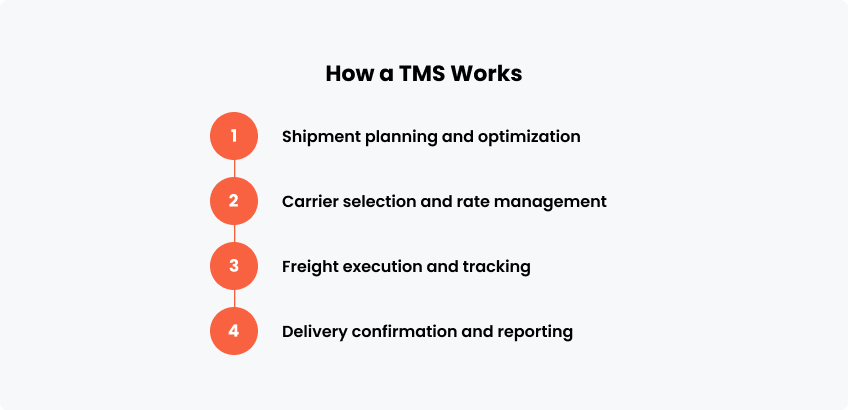
At its simplest, a TMS answers four questions:
How should the shipment move? Who should carry it? What should it cost? Did the delivery go as planned?
Some systems focus on road freight or parcel shipping. Larger platforms may handle air, ocean, rail, and multimodal transport across several countries.
Purpose within supply chain and logistics
A TMS is normally one part of a broader supply chain management technology stack. It sits between the order and the journey.
An ERP may hold the customer order. A warehouse management system (WMS) controls picking, packing, and staging. The TMS manages what happens next: carrier selection, routing, timing, shipment tracking, cost, and delivery performance.
Types of businesses that use TMS
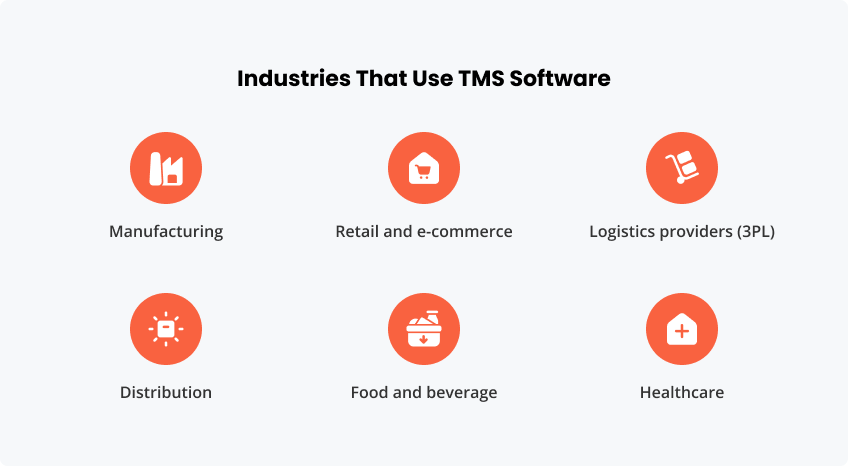
Transportation management software is widely used by:
- Manufacturers moving materials and finished goods
- Retailers and e-commerce companies
- Distributors with several warehouses
- Third-party logistics providers
- Food, beverage, healthcare, and pharmaceutical businesses
Company size is not the main factor. Complexity is. A regional distributor with six carriers and tight delivery windows may need a TMS more urgently than a much larger company with a simple network.

How Does a Transportation Management System Work?
A TMS receives shipment data, compares possible plans, books transport, follows the movement, and records what happened.
That is the clean version. Real logistics is less polite.
1. Shipment planning and optimization
Transportation planning starts with the basics: origin, destination, weight, dimensions, delivery window, product restrictions, and available capacity.
The logistics management system may combine orders, build fuller loads, resequence stops, or compare transport modes. The shortest route is not automatically the best one. Dock schedules, service commitments, driver hours, and vehicle limits all shape the final plan.
2. Carrier selection and rate management
Next comes the carrier decision.
Price matters. So do capacity, equipment, lane coverage, transit time, tender acceptance, and past performance. Once selected, the carrier receives the load through a portal, API, or Electronic Data Interchange (EDI) connection.
3. Freight execution and tracking
After booking, the TMS supports shipping instructions, transport documents, status updates, and alerts.
Tracking data may come from GPS devices, driver apps, telematics, or carrier systems. The point is not to watch every truck move. It is to spot the one that has stopped moving.
4. Delivery confirmation and reporting
Once the shipment arrives, the TMS records proof of delivery, actual transit time, final charges, and carrier performance.
That information feeds invoice checks, customer updates, scorecards, and future planning. Over time, the difference between “planned” and “actual” becomes impossible to miss.
What Are the Main Features of a TMS?
Most platforms share the same broad toolkit.
| Feature | What it manages |
|---|---|
| Route optimization | Stops, distance, timing, and constraints |
| Carrier management | Rates, contracts, capacity, and performance |
| Shipment visibility | Status, estimated arrival, and exceptions |
| Freight auditing | Invoice accuracy and agreed charges |
| Analytics | Cost, service, and network trends |
| Integration | Data exchange with connected systems |
Route optimization
Freight optimization compares possible paths and stop sequences.
It can account for mileage, tolls, delivery windows, vehicle restrictions, and service commitments. A tiny saving on one trip means little. Across thousands of trips, it does.
Carrier management
Carrier information tends to scatter across contracts, rate sheets, inboxes, and individual experiences.
A TMS gathers it in one place. Planners can compare options using shared rules instead of instinct alone.
Real-time shipment visibility
Real-time visibility shows what is moving, what has arrived, and what may be late.
The quality of the picture depends on the data feeding it. Still, one shared view beats ten carrier portals and a chain of unanswered emails.
Freight auditing and payment
Freight invoices are rarely just a clean base rate.
Fuel, detention, handling, re-delivery, and accessorial charges can all appear. Audit tools compare those costs with the contract and shipment record, flagging anything that looks wrong before payment.
Analytics and reporting
A TMS can measure cost per shipment, on-time delivery, load utilization, tender acceptance, invoice accuracy, and carrier performance.
The dashboard is not the interesting part. The useful question is why one lane keeps running late — or why one carrier keeps adding waiting-time fees.
Integration with ERP, WMS, and other systems
ERP integration supplies orders and financial data. WMS integration links transportation with picking, staging, and dispatch. Carrier and finance connections support booking, tracking, billing, and payment.
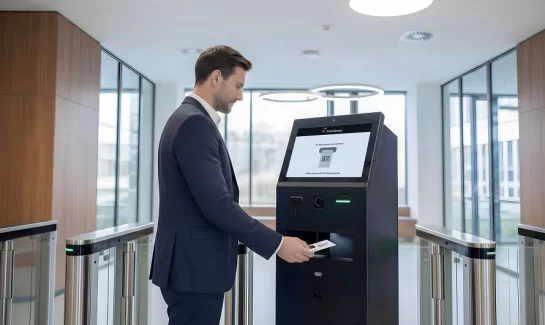
At the facility entrance, friendlyway integrations can connect digital check-in workflows with barriers, identity systems, and access-control technology.
What Are the Benefits of Using a Transportation Management System?
A TMS makes transportation decisions less improvised. It also strips away much of the routine coordination that quietly consumes a logistics team’s day.
Cost reduction
Savings can come from better routes, stronger carrier choices, fuller loads, fewer invoice errors, and less last-minute premium freight.
There is rarely one dramatic breakthrough. Waste disappears in smaller pieces.
Improved operational efficiency
Rate comparisons, tenders, documents, and alerts can be automated.
That leaves planners with more time for the awkward shipments — the ones that need judgment rather than another click.
Better customer service
Customers want two things: a reliable delivery and a reliable answer.
A TMS gives service teams access to shipment status without forcing them to chase transport colleagues. When something slips, the business can communicate early.
Increased shipment visibility
A shared view of planned, active, delayed, and completed freight reduces uncertainty.
Warehouses, transport teams, customer service, and management stop operating from separate versions of the truth.
Data-driven decision making
Transport data often exposes uncomfortable patterns.
The cheapest carrier may be habitually late. One warehouse may release orders too late for consolidation. A particular route may generate constant detention fees.
A TMS makes those patterns visible — and therefore harder to ignore.
EPA’s SmartWay program similarly emphasizes measuring and benchmarking freight efficiency as a basis for improvement.
Use shipment and appointment data to support driver check-in, access approval, and clearer on-site instructions.
What Are the Limitations and Challenges of a TMS?
A TMS cannot rescue bad data or vague processes. Automating confusion only makes it travel faster.
Implementation complexity
A single-site road operation may be fairly straightforward. A multinational, multimodal network is not.
Currencies, local rules, languages, business units, and older systems all add friction.
Integration issues
Transport data moves across several platforms. When those links fail, people start entering information twice.
Then come duplicate records, mismatched updates, and the quiet return of spreadsheets.
User adoption
A technically sound platform can still fail if employees see it as extra work.
Early involvement, role-based training, and practical workflows make adoption far more likely.
Data quality
Incorrect dimensions weaken load plans. Old rates distort carrier selection. Incomplete addresses damage routing.
Data cleanup is not a side task. It is part of the project.
Initial investment
The true cost may include software, integration, migration, testing, training, support, and internal project time.
The lowest subscription fee does not always produce the lowest overall cost.
Which Industries Use Transportation Management Systems?
The software is similar across sectors. The pressure points are not.
Manufacturing
Manufacturers use TMS software for inbound materials, plant transfers, and finished-goods deliveries.
A late component can halt production. An early truck can clog the yard. Timing matters at both ends.
Retail and e-commerce
Retailers manage replenishment, parcel carriers, returns, seasonal peaks, and narrow delivery windows.
Volumes shift quickly. Supply chain visibility becomes critical.
Logistics providers (3PL)
Third-party logistics providers need flexible workflows, broad carrier connections, customer-specific rates, and separate reporting for each client.
Distribution
Distributors coordinate frequent movements between suppliers, hubs, warehouses, and customers.
Once vehicles arrive at the site, a yard management solution can help organize check-in, waiting areas, dock assignments, and departure records.
Food and beverage
Short shelf life, temperature requirements, and fixed delivery slots leave little room for drift.
Fast exception handling protects both product quality and margin.
Healthcare
Healthcare and pharmaceutical shipments may be urgent, high-value, sensitive, or temperature-controlled.
Accurate tracking and documented handovers are not optional.
Best Practices for Successful TMS Implementation
A good rollout begins with a real business problem, not a catalogue of features.
Define business goals
Choose a few measurable targets: lower freight cost, better on-time delivery, shorter planning cycles, fuller loads, or faster invoice processing.
Keep the list short enough to matter.
Clean and standardize logistics data
Review addresses, carrier records, rates, dimensions, service codes, and delivery rules before migration.
Existing data is not automatically dependable data.
Integrate with existing systems
Map the journey from order creation to freight payment.
Then test the ugly cases:
- Rejected tenders
- Changed quantities
- Missed delivery slots
- Missing tracking events
- Disputed invoices
Perfect demonstrations prove very little.
Train employees
Training should reflect actual roles and real pressure.
Planners, warehouse supervisors, finance teams, and gate staff do not need the same workflow.
Monitor KPIs and optimize continuously
Rates change. Customers move. Carriers improve — or do not.
Review rules and KPIs regularly. Yesterday’s logic can become tomorrow’s expensive habit.
Common Mistakes When Choosing or Implementing a TMS
Most TMS projects do not fail because the logistics software lacks features. They fail because the fit was poor or the rollout was rushed.
Selecting software based only on price
Cheap software becomes expensive when it cannot support required modes, workflows, or integrations.
Fit matters more than the headline fee.
Ignoring scalability
The platform should handle more shipments, carriers, sites, users, and regions.
It also needs to handle more complexity, not merely more volume.
Poor integration planning
Integration belongs near the start of the project.
Leave it too late and manual workarounds begin to breed.
Lack of employee training
A polished demonstration is not training.
Users need realistic scenarios, time to practise, and clear ownership when the process goes off-script.
Not measuring ROI
Without baseline data, improvement becomes difficult to prove.
Record cost, delivery performance, planning time, invoice accuracy, and manual workload before launch.
Bring driver registration, vehicle access, self-service check-in, and on-site guidance into a single connected workflow.
Conclusion
A transportation management system gives logistics teams a firmer grip on freight.
It connects load planning, carriers, routes, tracking, invoices, and performance data. Used well, it cuts friction, exposes waste, and improves decisions.
The freight management software is only one piece. Clean data, sensible integration, trained users, and connected site operations are what make it useful.
Sources
- GS1: Electronic Data Interchange and logistics messaging standards
- US Environmental Protection Agency: Learn About SmartWay
Frequently Asked Questions
A TMS manages freight between locations. A WMS manages activity inside the warehouse, including receiving, inventory, picking, packing, staging, and loading.
Yes. A smaller company may benefit from a TMS when it uses several carriers, manages growing shipment volume, or faces complicated last-mile delivery requirements.
Yes. ERP integration allows order, customer, product, and financial data to flow into the TMS. Shipment status and freight cost data can then be returned to the ERP.
Cost depends on the number of users, shipment volume, transport modes, integrations, modules, and deployment model. Total cost matters more than the subscription price alone.
Useful KPIs include freight cost per shipment, on-time pickup, on-time delivery, tender acceptance, load utilization, invoice accuracy, and carrier performance.