
(Prefer videos? Watch a brief summary of this article below.)
A supply chain control tower is a connected software layer that gathers operational data, tracks events across the network, and helps teams respond when reality deviates from the plan. It brings orders, inventory, production, transport, suppliers, and facilities into a single, up-to-date view.
At a Glance
- One view of the moving plan: It combines order, inventory, transport, warehouse, supplier, and site data.
- Early notice: Live signals expose delays and constraints before the operational fallout becomes expensive.
- A clear next move: Analytics and workflows show which orders were affected, available options, and who needs to respond.
What Is a Supply Chain Control Tower?
A supply chain control tower gives teams a shared place to examine what is happening across a supply network and decide how to handle exceptions.
Definition and core purpose
The tower sits between planning and execution. It receives updates from operational systems, compares them with expected events, and reveals gaps that may affect service, cost, or production.
Picture a late component shipment. A basic tracking screen shows a new arrival time. A useful tower also reveals the production orders waiting for that component, the remaining stock at each plant, and whether another route could recover the delay.
That added context is the point.
A control tower supply chain model connects events and their consequences. It supports supply chain management (SCM) by giving planners more time and better evidence before they commit to a response.
Why businesses are adopting control towers
The modern digital supply chain is full of isolated signals.
A carrier updates one portal. Purchasing works in an enterprise resource planning (ERP) system. Warehouse staff use scanners and a separate application. Site security may still rely on phone calls, printed lists, or emails.
Industry 4.0 adds machinery, sensors, autonomous equipment, and faster production cycles to this already crowded picture. More data arrives. The connections between events become harder to follow manually.
Control towers provide a way to assemble those fragments without asking every department to abandon its established tools.
How a control tower differs from ERP, TMS, and WMS
A control tower reads across operational systems. It does not take over all their functions.
| System | Main job | Typical information |
|---|---|---|
| Enterprise Resource Planning (ERP) | Recording business transactions | Orders, purchasing, finance, materials |
| Transportation Management System (TMS) | Planning and executing freight | Routes, carriers, rates, shipments |
| Warehouse Management System (WMS) | Directing warehouse work | Receiving, storage, picking, loading |
| Supply chain control tower | Interpreting activity across systems | Exceptions, exposure, priorities, possible responses |
ERP integration supplies important order and material data. The wider picture emerges when that information is connected with transport, warehouse, partner, and facility events.
How Does a Supply Chain Control Tower Work?
A control tower collects updates, checks them against plans and rules, calculates their possible impact, and sends relevant information to the people who can act.
Collecting data from multiple systems
Inputs may arrive through APIs, partner feeds, cloud platforms, spreadsheets, telematics, scanners, and Internet of Things (IoT) devices.
The feeds are rarely uniform. One updates every few seconds. Another changes only when a supplier confirms a milestone. Product codes, timestamps, and status definitions may differ.
Before supply chain analytics can be trusted, those differences need to be reconciled.
Monitoring supply chain events in real time
Supply chain monitoring follows events such as order confirmation, vehicle departure, border clearance, gate arrival, unloading, production completion, and stock transfer.
Real-time dashboards bring these events into role-specific views. Logistics visibility shows where goods are moving or waiting. Inventory visibility shows what is available, reserved, delayed, or held elsewhere.
Real-time supply chain visibility is useful because the plan keeps moving after the morning report has been exported.
Detecting disruptions and bottlenecks
Exception management separates routine variation from changes that deserve attention.
Rules can flag a missed delivery window, an unusually long yard stay, an approaching stockout, or a supplier milestone that has slipped twice. Real-time analytics can connect several small deviations that would look harmless in isolation.
Machine learning can also identify recurring patterns. A route may become unreliable only on certain days. A minor supplier delay may regularly lead to premium freight later in the week.
Patterns like these are easy to overlook when each event lives in a different application.
Supporting faster operational decisions
Predictive analytics estimates what may happen next. A digital twin can model the likely effect of moving inventory, changing a route, reserving another dock, or resequencing production.
Artificial Intelligence (AI) may rank response options according to time, cost, capacity, and customer priority. AI in supply chain operations is most useful when the reasoning remains visible. Planners need to understand the assumptions behind a recommendation before acting on it.

What Are the Key Features of a Supply Chain Control Tower?
The key features combine network visibility, focused alerts, forward-looking analysis, and reliable connections to existing systems.
End-to-end supply chain visibility
End-to-end visibility links suppliers, manufacturing sites, carriers, warehouses, yards, distributors, and customers.
That broader frame matters. A warehouse may have enough stock for today’s orders while leaving tomorrow’s production exposed. A truck may be on schedule but heading toward a yard with no free dock.
Supply chain visibility becomes valuable when it reveals those collisions early.
Real-time dashboards and alerts
Different roles require different information.
A production planner needs component exposure. A transport manager watches missed milestones and carrier performance. Customer service needs to know which orders are genuinely at risk.
Alerts should reflect urgency and business impact. A screen filled with hundreds of equal-priority warnings quickly becomes digital wallpaper.
Predictive analytics
Predictive analytics turns current conditions into an estimate of what could happen next.
It may calculate the likelihood of a missed delivery, forecast when stock will run out, or identify orders exposed to a supplier delay. The prediction does not need to be perfect. It needs to arrive while the team still has useful options.
AI-powered decision support
AI-powered tools can compare large numbers of variables faster than a planner working across several spreadsheets.
Possible recommendations include shifting inventory, changing a carrier, splitting an order, or revising the production sequence. Human review remains important where safety, contractual commitments, or significant expense are involved.
Integration with enterprise systems
Supply chain control tower software must work with the organization’s existing technology landscape.
That may include SAP, Oracle, Blue Yonder, Kinaxis, o9 Solutions, Infor, and Microsoft Dynamics 365. Connections may also extend to access control, scheduling tools, carrier platforms, and on-site equipment.
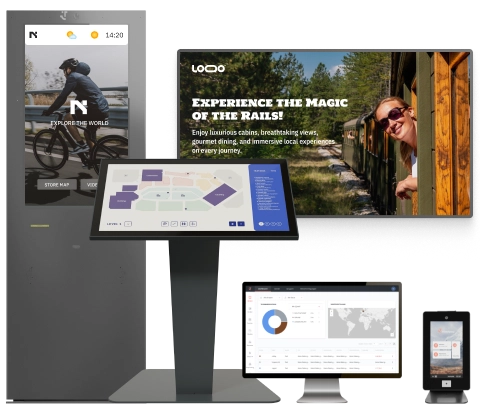
Flexible friendlyway integrations help connect arrival, check-in, security, and facility workflows with the systems already used by operations teams.
Give drivers, security teams, and yard personnel current instructions when schedules, dock assignments, or entry conditions change.
What Are the Benefits of a Supply Chain Control Tower?
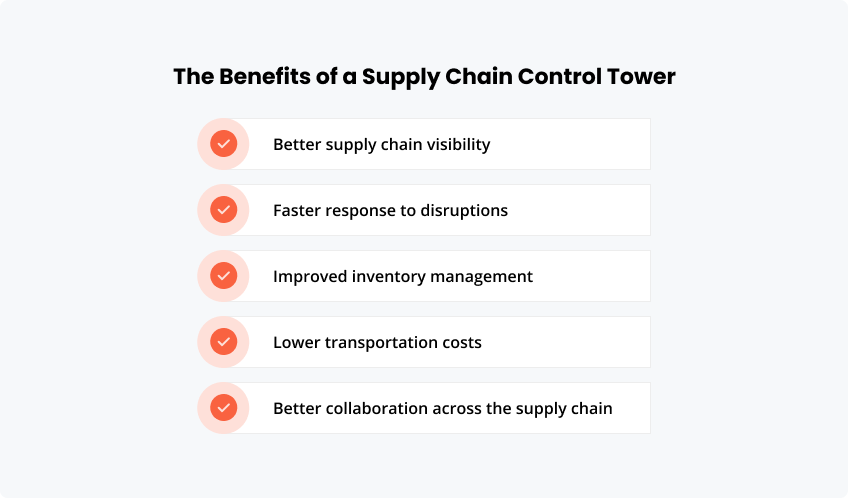
A control tower helps teams spot emerging problems sooner, preserve more response options, and coordinate decisions with a shared operational picture.
Better supply chain visibility
Better supply chain visibility reduces the time spent assembling updates from several departments.
Purchasing can see the impact of a supplier delay on transport. Warehouse teams can prepare for revised arrivals. Customer service can distinguish a genuine service risk from a status update that merely looks unusual.
Fewer people have to reconstruct the same incident from scratch.
Faster response to disruptions
The cost of a disruption often grows with every hour it remains unnoticed.
An early warning may allow inventory to be transferred between sites. Later, the same shortage could require emergency transport, overtime, or a missed customer commitment.
Early detection supports supply chain resilience by keeping more choices open.
Improved inventory management
A network-wide view gives inventory management teams a more accurate picture of what can actually be used.
Stock may exist but already be allocated. Another warehouse may hold surplus units, although transferring them would take too long. Incoming goods may appear on schedule in ERP while carrier data indicates a delay.
The tower exposes these qualifications before a planner treats every unit as equally available.
Lower transportation costs
For transport teams, control tower logistics functions can reveal repeated detention, poor vehicle utilization, unreliable lanes, and expensive last-minute bookings.
The savings are not always dramatic or immediate. Often, they come from identifying small leaks that have quietly become normal.
Better collaboration across the supply chain
A common event history gives suppliers, carriers, planners, warehouse staff, and customer-service teams the same starting point.
Disagreement may remain. The conversation is still faster when nobody has to start by proving their spreadsheet is the newest one.
What Are the Challenges of Implementing a Control Tower?
Implementation becomes difficult when unreliable data, unclear ownership, and loosely connected systems sit beneath an otherwise polished interface.
Data quality and consistency
Poor data quality can make a confident-looking dashboard wrong.
“Arrived” might mean entered the site in one application and reached the unloading area in another. Timestamps may use different time zones. Product identifiers may not match.
Critical definitions should be aligned before they influence automated decisions.
System integration complexity
Legacy applications and partner platforms often use different formats, update cycles, and error-handling rules.
A connection can work technically while producing misleading results. Integration planning must account for missing messages, duplicate events, interface changes, and conflicting terminology.
Organizational change management
A tower makes activity visible across departmental boundaries. It may also uncover workarounds and ownership gaps that were previously easy to ignore.
Teams need clear decision rights, escalation paths, and response playbooks. An alert that belongs to everybody usually belongs to nobody.
Scalability considerations
More locations and partners create more events.
The platform must grow without turning ordinary variation into constant alarm. Thresholds, filters, and role-specific views should evolve as event volume increases.
Cybersecurity and data protection
Control towers may process sensitive information about facilities, suppliers, transport routes, customers, and inventory.
Role-based access, encryption, audit records, retention policies, and supplier risk controls should be designed into the environment. In the US, NIST SP 800-161 Rev. 1 provides guidance for identifying, assessing, and mitigating cybersecurity risks across supply chains.
Which Industries Use Supply Chain Control Towers?
Control towers are especially relevant where inventory, physical movement, and precise timing depend on one another.
Manufacturing
Manufacturers track component availability, supplier milestones, production progress, and outbound commitments.
A low-cost part arriving late can interrupt an expensive production line. The tower helps teams see that exposure while alternatives still exist.
Retail and e-commerce
Retailers coordinate stores, distribution centers, online orders, promotions, returns, and delivery capacity.
A shared view shows whether a shortage is local or likely to spread across several locations.
Automotive
Automotive plants rely on carefully sequenced inbound deliveries.
Control towers connect parts availability, supplier performance, transport milestones, and production risk. Even a modest delay can matter when components are expected in a specific order.
Food and beverage
Food and beverage networks must consider shelf life, temperature, ingredient availability, and delivery timing.
A delayed refrigerated vehicle raises more than a scheduling issue. Teams need to know whether product quality, production, or a customer order is exposed.
Healthcare and pharmaceuticals
Healthcare and pharmaceutical operations require traceability, controlled storage, dependable delivery, and close oversight of critical inventory.
Here, visibility affects product integrity and continuity as well as cost.
At individual facilities, a connected yard management solution can translate network priorities into workflows for gate, parking, dock, and driver coordination.
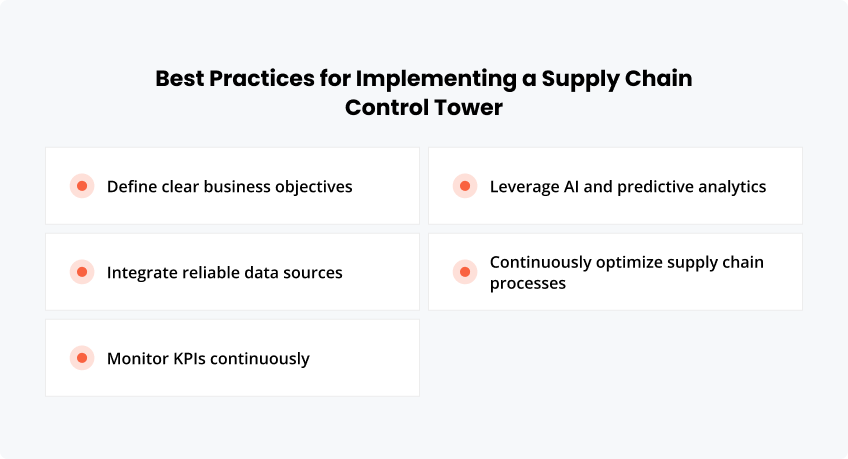
Best Practices for Implementing a Supply Chain Control Tower
A focused operational problem makes a stronger starting point than a broad promise of complete visibility.
Define clear business objectives
Choose a measurable target: fewer late inbound deliveries, lower detention costs, faster exception resolution, or more reliable inventory allocation.
“Improve visibility” needs a practical outcome attached to it.
Integrate reliable data sources
Document each source, its owner, update frequency, definitions, and known gaps.
Start with the data that changes decisions. Additional feeds can be added once the foundation is stable.
Monitor KPIs continuously
Useful measures may include:
- on-time and in-full delivery;
- inventory turnover and stockout frequency;
- transport and yard dwell time;
- forecast accuracy;
- exception-resolution time;
- premium freight use.
A KPI belongs on the dashboard when somebody knows what to do when it moves.
Leverage AI and predictive analytics
Apply advanced tools where earlier knowledge creates a genuine choice.
A delay forecast is useful while a shipment can still be rerouted. The same forecast is merely descriptive once all practical options have closed.
Continuously optimize supply chain processes
Review ignored alerts, rejected recommendations, recurring bottlenecks, and false positives.
Rules that worked during launch may become noisy as suppliers, routes, facilities, and priorities change. Continuous improvement keeps the tower relevant.
Common Mistakes When Deploying a Supply Chain Control Tower
Control-tower projects lose value when technology supersedes data governance, process design, and user adoption.
Focusing only on technology
Software cannot settle an ownership dispute or repair an undefined escalation process.
The operating model is part of the implementation.
Ignoring data quality
Connecting unreliable data at scale creates a larger pool of uncertainty.
Validate the identifiers, dates, quantities, and status definitions behind the most important decisions first.
Poor system integration planning
Quick point-to-point connections often become fragile as applications and partners change.
Plan for failed transmissions, interface updates, duplicate messages, and new sources from the beginning.
Underestimating employee adoption
Users need to understand why an alert appeared, what it may affect, and what authority they have to respond.
Otherwise, the platform becomes another screen opened for review meetings and ignored during the working day.
Not tracking performance improvements
Record a baseline before deployment.
Measure current dwell time, delay costs, stockouts, service levels, and exception-handling speed. Without those figures, the value of the project remains difficult to demonstrate.
Coordinate carrier appointments, available docks, driver communications, and entry instructions before vehicles reach the facility.
Conclusion
A supply chain control tower cannot remove uncertainty from a complex network. It can reveal where uncertainty is building and give teams more time to respond.
Its value appears in the choices that remain available. Stock can still be moved. Production can still be resequenced. A dock can still be reassigned. A customer can still receive an accurate update before a promise is missed.
Reliable data, thoughtful integration, clear ownership, and continuous improvement turn the tower from a reporting screen into a useful part of daily operations.
Frequently Asked Questions
A supply chain control tower is a connected software environment that combines information from logistics, inventory, suppliers, production, warehouses, and enterprise platforms. It identifies meaningful exceptions and shows what they may affect. Teams use that context to coordinate responses before delays, shortages, or capacity constraints spread into other parts of the network.
A transportation management system (TMS) focuses on freight planning and execution, including routes, carriers, rates, and shipments. A control tower has a wider field of view. It can combine TMS information with inventory, warehouse activity, production, supplier events, customer orders, and external risks to explain the broader effect of a transport event.
Typical technologies include APIs, cloud platforms, ERP integration, artificial intelligence (AI), machine learning, Internet of Things (IoT) devices, real-time analytics, predictive analytics, and digital twin models. The exact architecture depends on existing systems, data quality, event volume, security requirements, and the operational decisions the tower is expected to support.
Yes. A smaller organization can begin with one contained problem, such as supplier delays, shipment tracking, inventory exceptions, or dock scheduling. A global platform is not always necessary. The appropriate scope is the one that reduces manual checking, prevents avoidable costs, or gives teams enough warning to protect customer service.
Useful KPIs include on-time delivery, order cycle time, inventory turnover, stockout frequency, forecast accuracy, supplier reliability, transport cost, dwell time, and exception-resolution time. The selection should follow the business objective. A compact dashboard tied to clear actions is generally more useful than a crowded collection of every available measure.