
(Prefer videos? Watch a brief summary of this article below.)
Warehouse asset management is the day-to-day discipline of knowing what equipment a facility owns, where it is, whether it works, and what it costs to keep running. It replaces scattered spreadsheets, radio calls, and educated guesses with a reliable operational record.
That record matters. A missing scanner can slow one picker. An unavailable forklift can disrupt an entire outbound wave.
The Essentials at a Glance
- Identify each resource: Give equipment a unique, permanent digital identity.
- Record meaningful events: Capture movement, use, inspections, faults, and repairs.
- Act on the evidence: Use accurate data to schedule service, rebalance equipment, and avoid unnecessary purchases.
What Is Warehouse Asset Management?
It is a coordinated method for controlling the location, condition, use, and working life of physical resources inside a facility.
Definition and core objectives
A warehouse asset management system combines identity, ownership, location, service history, and cost into a single record. Operationally, the aim is simple: keep essential resources ready for work.
Types of warehouse assets
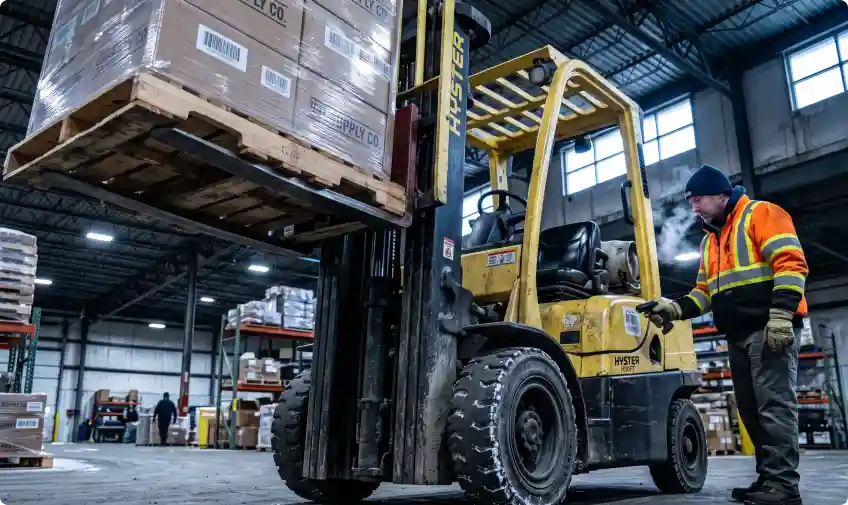
The scope reaches far beyond lift trucks. Typical warehouse assets include:
- Forklifts, pallet jacks, conveyors, robots, and charging units
- Racking, dock equipment, safety barriers, and facility machinery
- Handheld scanners, printers, radios, tablets, and shared tools
- Pallets, cages, totes, containers, and other returnable equipment
Why asset management matters in modern warehouses
Warehouse equipment management prevents small visibility gaps from becoming expensive delays. It also exposes a quieter problem: equipment that was purchased, parked, and barely used.
How Does Warehouse Asset Management Work?
The process connects a physical item to a digital record, then updates that record whenever something important happens.
Asset identification and tracking
Each item receives a serial number, label, tag, or other identifier. Warehouse asset-tracking software connects that identifier to its owner, status, home zone, and maintenance history.
Monitoring asset location and utilization
A scan, reader event, beacon signal, or sensor update reveals movement. Warehouse equipment tracking then shows which units are busy, stranded, available, or sitting in the wrong area.
Maintenance scheduling and lifecycle management
Operating hours, inspections, fault codes, and condition readings can trigger preventive maintenance. Asset lifecycle management extends the view from purchase and commissioning through repair, reassignment, and replacement.
Performance reporting and analytics
Useful reports answer practical questions: Which forklifts fail repeatedly? Which shift loses scanners? Where is equipment utilization low? A dashboard should lead to action, rather than merely decorate a screen.
Which Technologies Support Warehouse Asset Management?
Technology choices depend on movement frequency, item value, environment, and the precision teams actually need.
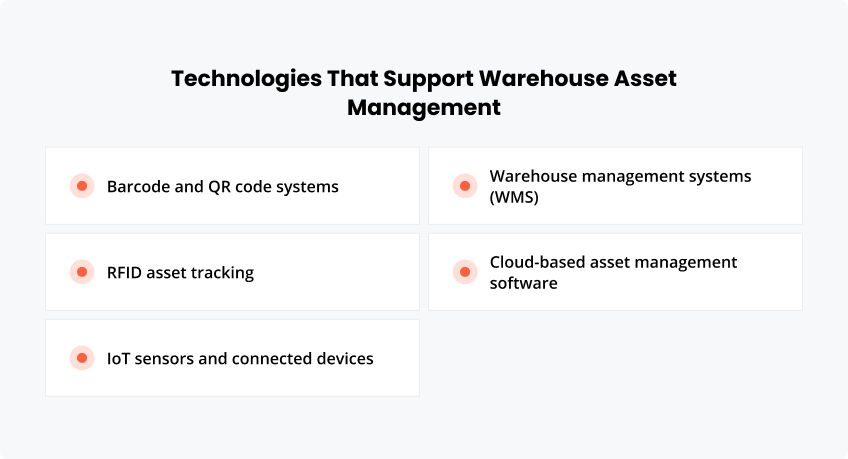
Barcode and QR code systems
Barcode tracking is inexpensive and easy to introduce. A barcode or QR code still requires a deliberate scan, so workflow discipline matters.
RFID asset tracking
RFID tracking can register several tagged items without direct line of sight. Readers positioned at doors, tool rooms, or transfer points create automatic movement records.
Zebra Technologies and Honeywell supply devices used in identification and data-capture environments.
IoT sensors and connected devices
Internet of Things (IoT) devices can report temperature, impact, vibration, battery level, or runtime. IoT sensors may be paired with Bluetooth Low Energy (BLE) for indoor zones and GPS tracking for outdoor vehicles.
Connected devices also enlarge the security surface. NIST advises US organizations to address IoT cybersecurity through risk-based requirements, guidelines, and device controls.
Warehouse Management Systems (WMS)
A Warehouse Management System (WMS) directs receiving, storage, picking, and shipping. Enterprise Resource Planning (ERP) software holds broader financial and business records.
ERP integration can transfer equipment, purchasing, work-order, and cost data between platforms such as SAP, Oracle, Microsoft Dynamics 365, and IBM Maximo. Oracle and Microsoft both document warehouse modules connected to broader manufacturing, transportation, inventory, and fulfillment processes.
Cloud-based asset management software
Warehouse asset-tracking software hosted in the cloud gives authorized teams access across locations. Cloud asset management also simplifies updates, reporting, and multi-site administration.
| Technology | Practical fit | Watch for |
|---|---|---|
| Barcode or QR code | Routine scans and low-cost labeling | Missed scans |
| RFID | Frequent movement through known points | Reader placement |
| BLE | Indoor zone awareness | Battery management |
| GPS | Outdoor mobile equipment | Weak indoor accuracy |
| IoT telemetry | Condition and runtime monitoring | Security and connectivity |
What Are the Benefits of Warehouse Asset Management?
The clearest benefit is dependable information at the moment a decision must be made.
Improved asset visibility
Real-time asset visibility reduces the time employees spend walking aisles, calling another shift, or opening several files to locate a single item.
Reduced equipment downtime
Timely inspections and preventive maintenance address deterioration earlier. Predictive maintenance goes further by using condition and performance signals to flag emerging trouble.
Lower operating costs
Accurate records reveal duplicate purchases, unnecessary rentals, repeated repairs, and equipment that can be reassigned before ordering more.
Better inventory accuracy
Inventory management becomes more dependable when containers, scanners, handling equipment, and physical transactions use consistent identifiers and locations.
Increased warehouse productivity
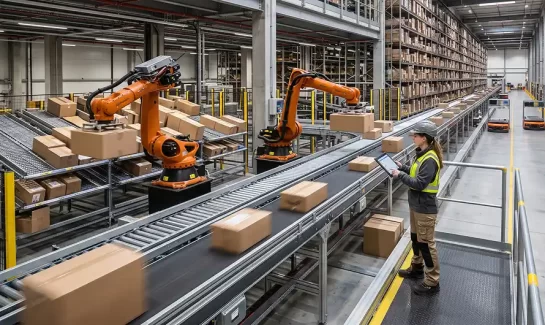
Automated capture removes clerical steps. Warehouse automation also works better when connected machinery, shared devices, and human-operated equipment have trustworthy status data.
A yard management solution coordinates arrivals, gates, docks, trailers, and on-site movements around the warehouse.
What Are the Challenges of Warehouse Asset Management?
Most problems arise from weak process design, incomplete records, or tools that employees find awkward during a busy shift.
Data accuracy
One duplicate label or skipped scan can produce two versions of reality. Clear ownership and validation rules keep warehouse asset monitoring credible.
System integration
Identifiers, timestamps, locations, and work orders must be aligned across all connected applications. Otherwise, integration only moves bad data faster.
Asset maintenance planning
Fixed service intervals can be too early for lightly used units and too late for heavily used ones. Runtime and condition offer better context.
Employee adoption
The asset tracking system should fit receiving, handover, maintenance, and dispatch routines. Extra taps and unclear screens invite workarounds almost immediately.
Scalability
A pilot may succeed in one zone yet stumble across multiple facilities. Naming rules, permissions, connectivity, and support processes must scale with it.
Which Industries Benefit from Warehouse Asset Management?
Facilities with mobile, shared, regulated, or maintenance-intensive equipment usually gain the most.
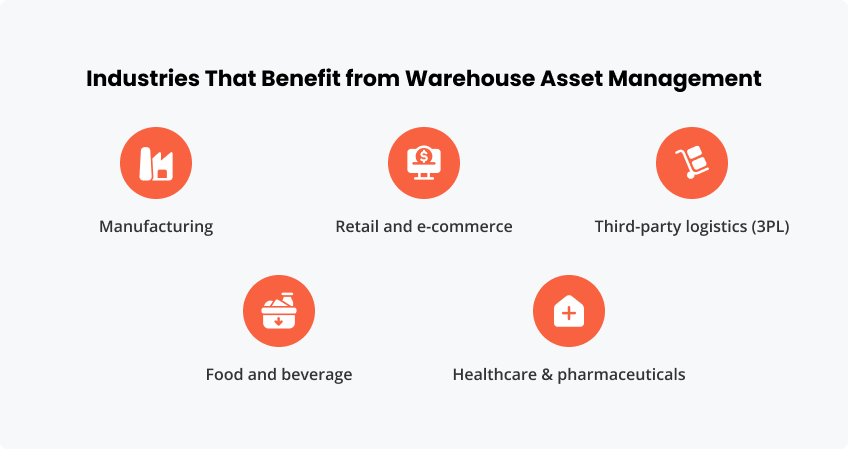
Manufacturing
Industry 4.0 plants track tools, fixtures, spare parts, handling units, and production equipment. friendlyway also provides manufacturing solutions for connected on-site processes.
Retail and e-commerce
Fulfillment operations need scanners, carts, printers, conveyors, and packing equipment available during peak order volume.
Third-party logistics (3PL)
A 3PL may share equipment across customers, contracts, and buildings. Clear custody records prevent ownership and billing disputes.
Food and beverage
Condition monitoring supports cold storage, sanitation schedules, reusable container control, and timely inspection of handling equipment.
Healthcare and pharmaceuticals
Traceable records help manage calibrated instruments, mobile technology, controlled-storage equipment, and resources subject to strict handling procedures.
Best Practices for Warehouse Asset Management
A strong implementation starts with one costly operational problem, clean data, and a workflow employees can follow under pressure.
Standardize asset identification
Use one identifier format, equipment hierarchy, status vocabulary, and location structure. Avoid local nicknames inside the master record.
Automate asset tracking
Match the technology to the movement. A stationary ladder rarely needs the same tracking method as a forklift crossing zones all day.
Integrate with WMS and ERP
Decide which system owns each field before integration begins. Ownership rules prevent conflicting updates and endless reconciliation.
Monitor asset KPIs
Track availability, utilization, inspection compliance, downtime, repair frequency, missing-item rates, and maintenance cost by equipment class.
Perform regular asset audits
Short cycle audits catch drift early. Waiting for an annual count allows errors to settle into everyday operations.
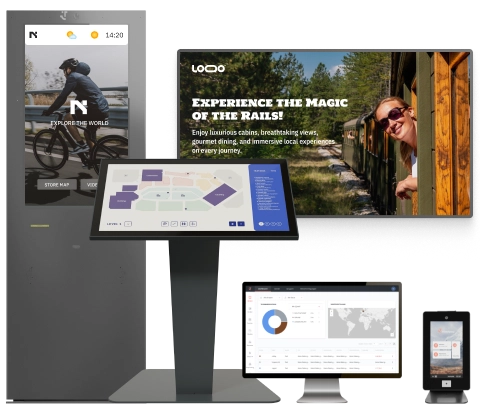
Digital signage software can help manufacturing and logistics sites distribute operational information across connected touchpoints.
Common Mistakes in Warehouse Asset Management
A new label or software subscription cannot rescue a process whose responsibilities remain vague.
Relying on manual asset tracking
Spreadsheets age quickly when resources move between people, shifts, buildings, and temporary work areas.
Ignoring preventive maintenance
Postponed inspections often surface later as emergency repairs, interrupted work, and rushed parts orders.
Poor data quality
Missing serial numbers, vague locations, and duplicate records weaken every report built from them.
Failing to integrate systems
Disconnected maintenance, purchasing, warehouse, and finance applications leave employees re-entering data and resolving contradictions by hand.
Not measuring asset performance
Knowing location is useful. Knowing availability, condition, cost, and productive use is what supports a sound replacement decision.
Conclusion
Warehouse asset management gives operations teams a grounded view of equipment location, condition, use, and cost. The best setup is rarely the most elaborate. It is the one people use consistently: clean identifiers, sensible automation, timely maintenance, measured performance, and reliable links to the systems already running the facility.
Frequently Asked Questions
Warehouse asset management is the organized control of equipment, tools, technology, containers, and infrastructure used inside a storage or distribution facility. It covers identification, location, condition, maintenance, utilization, cost, and replacement. The purpose is to keep operational resources available while limiting loss, avoidable downtime, and unnecessary spending.
Inventory management controls goods that are stored, consumed, assembled, or sold. Equipment management handles the resources used to move, store, inspect, or process those goods. A case of products is inventory; the forklift carrying it is equipment. Both disciplines depend on accurate identifiers, locations, transactions, and system records.
Common options include barcodes, QR codes, RFID, BLE beacons, GPS, mobile scanners, connected sensors, and cloud software. Selection depends on the item value, how often it moves, the required location precision, environmental conditions, connectivity, and budget. Many facilities use several methods together.
Yes. A small operation can begin with serialized labels, a simple equipment register, mobile scanning, and scheduled inspections. It does not need readers at every doorway or sensors on every tool. Even a modest system can reduce search time, improve service records, and stop duplicate purchases.
Useful KPIs include availability, equipment utilization, planned and unplanned downtime, maintenance cost, repair frequency, inspection compliance, missing-item rate, and mean time between failures. Choose measures tied to a specific decision and assign an owner to that. A large dashboard without responsibility behind it rarely changes operational behavior.