
(Prefer videos? Watch a brief summary of this article below.)
A trailer does not have to be stolen to disappear. In a busy warehouse yard, it only has to be parked in the wrong lane, logged under the wrong reference, or moved without a status update. Then the shift starts chasing metal instead of moving freight.
At a Glance
- Trailer tracking reduces search time by showing where trailers are, what they contain, and whether they are ready.
- Visibility is not only about location. Status, availability, load condition, and dock readiness matter too.
- Manual methods fail under volume because paper, radios, and spreadsheets drift from reality.
- Technology works best with process. RFID, GPS, QR codes, and cameras need clear rules.
- A YMS connects the yard with gate registration, dock scheduling, access control, and live yard operations.
Europe’s road freight market is too large for guesswork. Eurostat reports that EU road freight reached more than 13.1 billion tonnes in 2024, so even small yard delays multiply fast across networks.
Why Trailer Tracking Is a Problem in Many Warehouse Yards
Most yards look orderly from the fence. The trouble starts inside the handoffs.
Trailers get lost more often than expected
A trailer may be “on site” in the transport system, but not where the warehouse team expects it to be. A shunter moved it. A driver parked it in overflow. A gate clerk mistyped a digit.
Now an urgent outbound load is somewhere in row C or D, or maybe behind maintenance.
Lack of real-time visibility
Yard visibility depends on live updates. Without them, teams work with yesterday’s map and today’s pressure.
One retailer may know a chilled load arrived at 06:20. That does not help if no one knows whether it is sealed, unloaded, waiting, or already empty.
The cost of searching for the right trailer
Searching feels harmless. It is not.
It burns labour, delays dock doors, frustrates drivers, and creates detention risk. Worse, it steals attention from exceptions that really need management.
What Trailer Tracking Really Means in Yard Operations
Tracking is not a dot on a map. It is an operational context.
Location vs status vs availability
Trailer location tracking answers “Where is it?” Status answers “What is happening?” Availability answers “Can we use it now?”
Those three answers must stay together.
Why knowing “where it is” is not enough
A trailer at door 12 may still be locked. One in bay 40 may be loaded but is waiting for paperwork. Another may be empty but blocked by two later arrivals.
Good yard trailer tracking turns location into action.
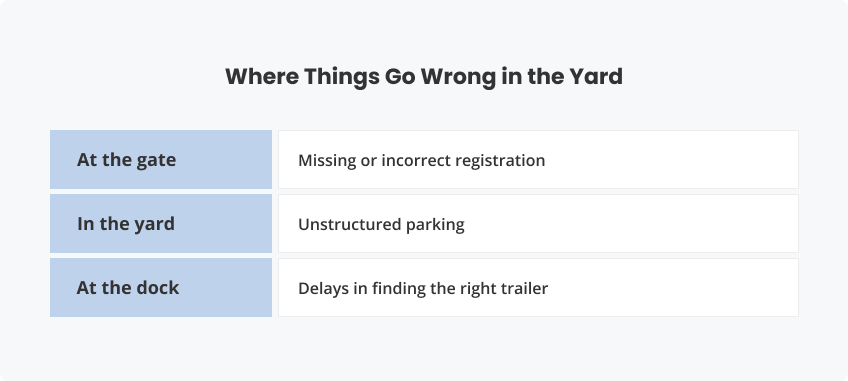
Where Things Go Wrong in the Yard
Errors rarely arrive alone. They travel through the site.
At the gate: Missing or incorrect registration
A wrong plate, a missing number, or an unclear shipment ID creates a weak record. Every later decision inherits that weakness.
Self-service check-in and access workflows can help standardize registration. friendlyway’s integrations support connections with barriers, license plate recognition, and access systems.
In the yard: Unstructured parking
When parking is informal, “put it near the back” becomes a process. That may work for 20 trailers. It breaks at 200.
At the dock: Delays in finding the right trailer
The dock team calls the yard. The yard calls security. The driver calls dispatch.
Meanwhile, the door is free, the labour is booked, and the product is not moving.
How Trailer Tracking Works in Practice
A reliable flow starts before the trailer reaches the first barrier.
Identifying trailers on arrival
The site captures the trailer number, carrier, appointment, plate, seal, load type, and arrival time. Camera-based recognition or QR check-in can reduce typing.
Assigning yard locations
The trailer is assigned to a slot, a waiting zone, a dock queue, or a priority lane. Rules may depend on temperature, shipment urgency, or unloading team.
Tracking movements across the yard
Each move updates the record. A shunter confirms the pickup and drop-off locations and times. This is trailer movement tracking in its simplest, most useful form.
Linking trailers to loads and shipments
The system links the physical asset with the business reason it is there. That is where supply chain visibility becomes practical, not theoretical.
Replace scattered updates with structured coordination of gates and docks.
Manual Trailer Tracking: Why It Breaks at Scale
Manual control is familiar. Familiar is not the same as scalable.
Paper logs and human error
Paper logs work until rain, handwriting, shift changes, or pressure intervene. One missed line can render a trailer operationally inoperable.
Radio communication and misalignment
Radio is fast but temporary. Unless someone records the move, the update disappears as soon as the next urgent call arrives.
Spreadsheet tracking limitations
Spreadsheets are useful for planning. They are poor as live yard control tools.
Multiple copies, delayed updates, and no field validation create chaos.
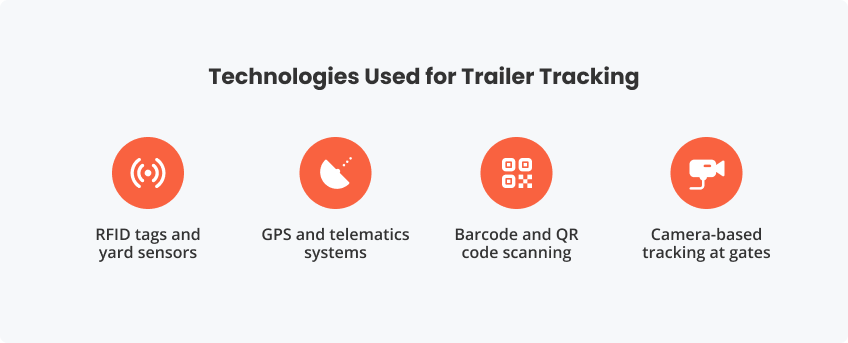
Technologies Used for Trailer Tracking
Technology choice depends on yard size, traffic, security level, and budget.
RFID trailer tracking can identify assets at gates or control points. It is strong where trucks return often, and tags can be maintained.
GPS and telematics systems
GPS trailer tracking is useful across transport networks and large sites. It may be less precise around dense buildings, covered areas, or tight dock zones.
Barcode and QR code scanning
QR codes are simple and affordable. Staff can scan them at check-in, parking, dock movement, and exit.
They require discipline, but not heavy infrastructure.
Camera-based tracking at gates
Cameras can read plates and support audit trails. They work especially well when linked to appointment data and access rules.
Real-Time Trailer Visibility in Modern Yards
Real-time trailer tracking is most valuable when it changes decisions in the present.
Tracking trailer status (empty, loaded, waiting)
Loaded, empty, waiting, on hold, at dock, checked out: these statuses prevent bad assumptions.
A manufacturing site, for example, can prioritize inbound components over packaging empties during a production risk window.
Connecting yard and dock operations
Dock scheduling only works when the yard can feed the door. If the trailer is not ready, the perfect schedule collapses.
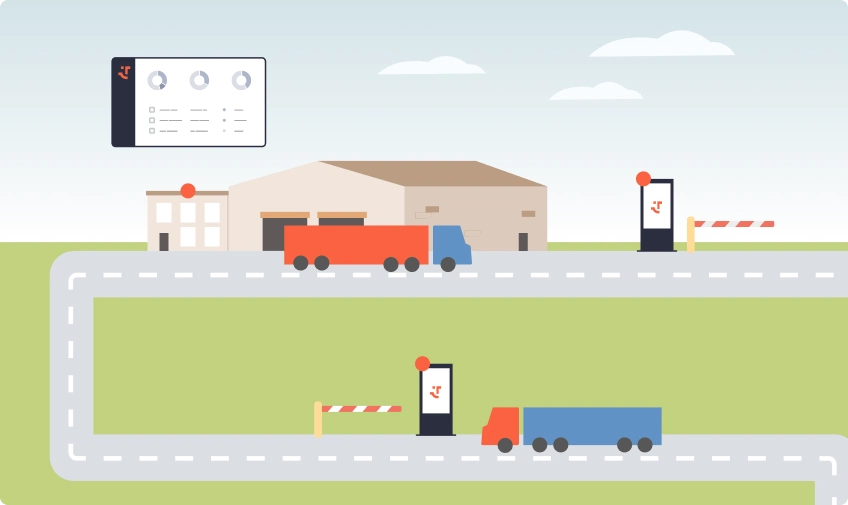
friendlyway’s yard management solution connects gate management, dock scheduling, and real-time yard coordination.
Using data for faster decisions
Data shows dwell time, bottlenecks, late carriers, repeated search zones, and poor parking patterns.
Where Yard Management Systems Fit In
At some point, tracking becomes too complex for disconnected tools.
Centralizing trailer data
A trailer tracking system within a YMS provides a single operating view. Gate, yard, dock, carrier, and warehouse teams stop debating which list is right.
Coordinating the gate, yard, and dock
A YMS supports the full flow: arrival, registration, parking, movement, dock call, unloading, departure, and reporting.
When tracking becomes too complex without software
The trigger is not only yard size. It is complexity.
Multiple carriers, mixed loads, high dock pressure, cold chain rules, contractor traffic, and security checks all increase the need for logistics yard management.
Benefits of Effective Trailer Tracking
The gains are operational, financial, and human.
Faster trailer retrieval
Staff find the right trailer faster. Drivers receive clearer instructions. Yard jockeys stop circling.
Reduced yard congestion
When trucks go to designated zones, traffic flows better. Overflow becomes controlled, not improvised.
Better dock scheduling
Warehouse teams can trust that the next truck is ready. That improves labour planning and door utilization.
Fewer delays and operational errors
Accurate warehouse yard trailer tracking reduces wrong pulls, missed loads, duplicate moves, and late departures.
Common Mistakes in Trailer Tracking
Even good tools fail when the basics are weak.
No standard yard layout
Every slot needs a name. Every zone needs a purpose. “By the fence” is not a location strategy.
Lack of process discipline
If staff update only some moves, the system loses trust. Clear rules matter as much as sensors.
Overreliance on manual methods
Manual methods can support exceptions. They should not run the yard.
Use digital workflows, kiosk-based registration, and live communication to reduce avoidable delays.
Trailer tracking is not about watching trailers for its own sake. It is about making the yard predictable. When teams know what arrived, where it is, what it holds, and what should happen next, the yard stops being a blind spot between transport and the warehouse. It becomes a controlled part of the supply chain.
FAQ
Trailer tracking in warehouse yards is the process of identifying, locating, and monitoring trailers from arrival to departure. It includes position, status, load link, dock assignment, and movement history.
The common problems include weak gate registration, unstructured parking, manual logs, radio-only updates, and missing movement confirmations.
The best way depends on the yard. RFID, GPS, QR codes, cameras, and YMS software can all help. The strongest setup combines technology with clear yard processes.
Small yards may manage with simple tools. High-volume or multi-site yards usually need a YMS to centralize data, coordinate dock scheduling, and maintain real-time visibility.
Accuracy varies. RFID is strong at fixed points. GPS works well across networks. QR scanning depends on user discipline. Camera-based systems are effective at gates. A YMS brings these signals together for better control.