
(Prefer videos? Watch a brief summary of this article below.)
The most expensive part of a delivery is sometimes the part nobody sees on a route map. It happens after a truck arrives at the site but before the freight reaches the dock.
A driver waits for instructions. A trailer sits in the wrong row. A loading crew loses its rhythm. The role of yard management is to stop that quiet drift and turn the space outside a facility into a controlled, visible, and useful part of logistics operations.
At a Glance
- The facility exterior matters: It is the live handoff between transport planning and warehouse execution.
- Yard visibility prevents guesswork: Teams can see arrivals, trailers, docks, and exceptions before they become delays.
- Dock scheduling needs real inputs: A time slot only works when the gate, trailer, and loading status are connected.
- Trailer tracking saves motion: Staff spend less time searching and more time moving freight.
- Cost pressure is rising: The May 2026 Logistics Managers’ Index showed transport prices expanding sharply while capacity stayed constrained, making avoidable waiting harder to absorb.
What Is Yard Management in Logistics?
Think of this area as an air traffic zone for road freight. It needs rules, timing, and clear signals.
Definition in the supply chain context
Yard management in logistics is the coordination of trucks, trailers, drivers, gates, dock doors, staging lanes, and site movements around a warehouse, factory, or distribution center.
It covers the practical details that decide whether freight flows or stalls:
- Driver arrival and release
- Carrier scheduling
- Trailer tracking
- Door assignment
- Shunter moves
- Safety checks
- Exception handling
Yard operations management is not glamorous work. It is the discipline that keeps practical promises intact.
Where yard management fits between transport and warehousing
The site exterior sits between two systems that often speak different languages.
Transport teams think in arrival windows, carriers, routes, and departure times. Warehouse teams think in labor, doors, picking waves, forklifts, and load sequence.
This middle zone translates both sides into action. When that translation is weak, trucks are “on time” but still late in practice.
Why Yard Management Plays a Critical Role
The value is not only in moving vehicles. It is in protecting tempo.
The yard is a link between inbound and outbound flows
Inbound freight brings parts, stock, packaging, returns, and raw materials. Outbound freight carries finished goods, store orders, customer shipments, and replenishment loads.
The importance of yard management becomes obvious when one flow interrupts the other.
Picture a beverage plant on a hot Friday. Empty trailers are needed for outbound loads. Inbound ingredients are arriving. A maintenance contractor also needs access. Without a clear outside process, the plant does not have a transport problem. It has a choreography problem.
How yard operations affect the entire supply chain
Small frictions travel fast.
| What happens outside | What happens inside | What the business feels |
|---|---|---|
| The driver enters late | Dock plan changes | More overtime |
| Trailer status is unclear | Loading waits | Lower throughput |
| The door has been occupied for too long | Next carrier queues | Missed appointment |
| Teams use separate notes | Decisions slow down | Poor service reliability |
This is why logistics teams now treat exterior flow as part of supply chain efficiency, not just site housekeeping.
The Role of Yard Management in Daily Operations
The work happens minute by minute. A good process feels calm because the decisions are already structured.
Managing truck arrivals and departures
The gate is the first operational handshake.
A strong arrival process confirms who is there, why they are there, what they carry, and where they should go. It also checks safety rules, appointment data, and access permissions without turning every visit into a manual interview.
A gate management system helps facilities digitize that first touchpoint, guide drivers, and connect entry events with logistics teams.
Give drivers clearer instructions and give operations cleaner arrival data from the first minute.
Coordinating trailer movements
A trailer is not just a box on wheels. It can be empty, sealed, staged, loaded, rejected, inspected, urgent, or forgotten.
The danger is not always a missing asset. Sometimes the asset is visible, but its status is wrong.
Better coordination helps teams decide what should move now, what can wait, and what needs escalation before it blocks the next task.
Supporting dock scheduling and loading processes
Dock scheduling is where the plan meets the clock.
A slot may look perfect in the system. Then a driver arrives early, a previous load runs long, or the product is not ready. The question is not whether disruption will happen. It will.
The question is whether people can adjust without a storm of calls.
How Yard Management Impacts Efficiency
Efficiency here is not about rushing. It is about removing repeated waste.
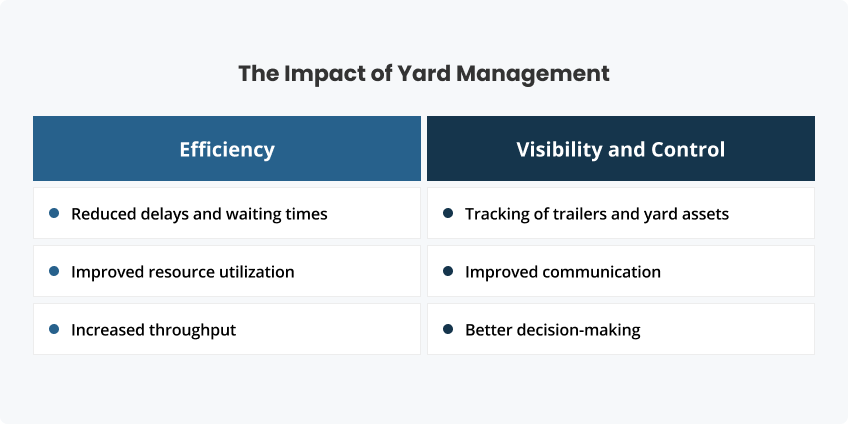
Reducing delays and waiting times
Most lost time is ordinary: ten minutes at entry, a short search for the right trailer, a driver sent to the wrong door, a supervisor walking outside to verify what should already be known.
Better site control reduces delays through:
- Earlier arrival data
- Clear traffic instructions
- Live door status
- Faster exception handling
- Shared updates across teams
The gain is simple: fewer unplanned pauses.
Improving resource utilization
Every logistics site runs with limits. Doors are limited. People are limited. Space is limited. Shunters, forklifts, and patience are limited, too.
Yard visibility helps managers use those limits better.
If a door opens early, the next unit can be brought forward. If an urgent trailer is already staged, labor can be prepared. If a carrier arrives too soon, the team can hold the vehicle without disturbing the dock plan.
Increasing throughput in logistics facilities
Throughput improves when motion becomes more deliberate.
A furniture distributor handling 70 truck movements a day may not need more asphalt. It may need fewer blind spots, fewer duplicated checks, and cleaner handovers between gate, transport, and warehouse teams.
That is where yard management logistics earns its keep.
The Impact on Visibility and Control
Control does not begin with a report. It begins when teams stop asking the same basic questions.
Tracking trailers and yard assets
Real-time tracking gives each trailer a known place and state.
Is it loaded? Empty? Waiting for a door? Ready to leave? Held for inspection?
For logistics yard management, that shared picture is powerful. It turns outside space from memory-based work into fact-based work.
Improving communication between teams
Many delays are communication failures in operational roles.
Security sees the driver. Transport sees the appointment. The warehouse sees the dock. The carrier sees the clock.
When those views stay separate, friction grows. Shared workflows reduce the need for radio calls, hallway checks, and “let me ask someone” replies.
Enabling better decision-making
Once events are captured, patterns become visible.
Maybe one door causes repeated delays. Maybe one carrier arrives early every Tuesday. A shift change may create a gap in trailer search. These are fixable issues, but only if leaders can see them.
There is also a sustainability case. In 2025, the World Economic Forum and McKinsey & Company reported that freight logistics accounts for 7–8% of global greenhouse gas emissions, and estimated that AI-enabled logistics improvements could reduce freight carbon footprints by 10–15% through better routing, capacity use, and modal choices.
What Happens Without Proper Yard Management
Without structure, the outside of the facility becomes a network of rumors.
Congestion and operational bottlenecks
Yard congestion rarely arrives dramatically. It builds from small misplacements.
One truck stops in the wrong lane. Another waits behind it. A shunter cannot reach the trailer it needs. A driver walks to security for a second explanation.
The site looks active, but movement is poor.
Lack of visibility across yard operations
When visibility is weak, every answer takes effort.
- Has the driver checked in?
- Which door is available?
- Where are the empty units?
- Which trailer leaves next?
- Why is the carrier still waiting?
This is the warning sign for warehouse yard operations: simple facts require a search party.
Increased costs and delays
Poor outside control creates costs that appear under different names.
| Cost area | How it appears |
|---|---|
| Carrier charges | Detention, demurrage, missed slots |
| Labor | Overtime costs, idle dock teams, and manual checks |
| Service | Late delivery, poor ETA accuracy |
| Safety | More reversing, walking, and pressure |
| Energy | Idling, extra shunter movements |
The problem may sit outside the building. The bill does not.
The Growing Importance of Yard Management
Logistics networks are becoming less forgiving. More flows share the same gates and doors.
Increasing complexity of logistics networks
A modern site may handle full truckloads, parcels, containers, returns, contractors, maintenance teams, and intercompany transfers on the same day.
Each flow has its own timing and paperwork. Each one needs access, direction, and status.
That is why many companies now view a yard management system as a control layer rather than a niche tool.
Higher expectations for speed and accuracy
Customers expect precise windows. Carriers expect fast turns. Warehouse teams expect plans they can actually execute.
Strong outside coordination helps all three. It does not eliminate disruption. It gives the operation a better way to absorb it.
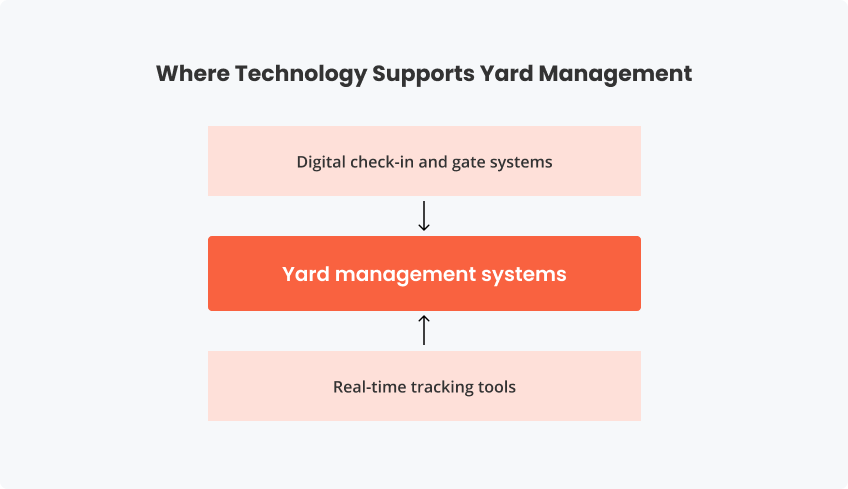
Where Technology Supports Yard Management
Technology should not make the process heavier. It should remove uncertainty.
Digital check-in and gate systems
Digital check-in creates a consistent arrival path.
Drivers can confirm appointment details, receive instructions, accept site rules, and move forward with fewer manual steps. A gate management system supports this controlled-entry experience for logistics facilities that need clearer communication between the gate and operations.
Real-time tracking tools
Tracking tools make the physical site easier to read.
They help teams locate trailers faster, prioritize movements, update carriers, and avoid unnecessary walking or radio traffic.
The real benefit is confidence. People act sooner because they trust the information.
Yard management systems as a central layer
A yard management system integrates arrival, trailer status, dock planning, movement tasks, and exceptions into a single operating picture.
The software supports this by helping sites coordinate trucks, trailers, docks, and gate processes through digital workflows.
It becomes the missing layer between transport planning and warehouse execution.
Improve visibility, reduce waiting, and coordinate trucks, trailers, docks, and drivers with a smarter operating process.
The role of yard management is not to make the area outside a building look neat. It is to protect the business rhythm.
When arrivals are clean, trailer status is trusted, docks are coordinated, and teams share the same facts, logistics feels less like firefighting. Freight moves with less drama. People waste fewer steps. Customers hear fewer excuses.
FAQ
It coordinates trucks, trailers, drivers, gates, docks, and site movements between transportation and warehousing, enabling freight to move safely and predictably.
Yard management’s importance comes from its impact on cost, labor, safety, carrier performance, and delivery reliability.
It improves efficiency through digital check-in, dock scheduling, trailer tracking, carrier scheduling, real-time tracking, and clearer team communication.
It helps solve queues, misplaced trailers, slow gate entry, dock conflicts, manual searches, poor visibility, and delayed departures.
Companies need yard management systems when traffic volume grows, manual coordination becomes unreliable, detention costs rise, or teams lack a shared view of logistics operations.