
(Prefer videos? Watch a brief summary of this article below.)
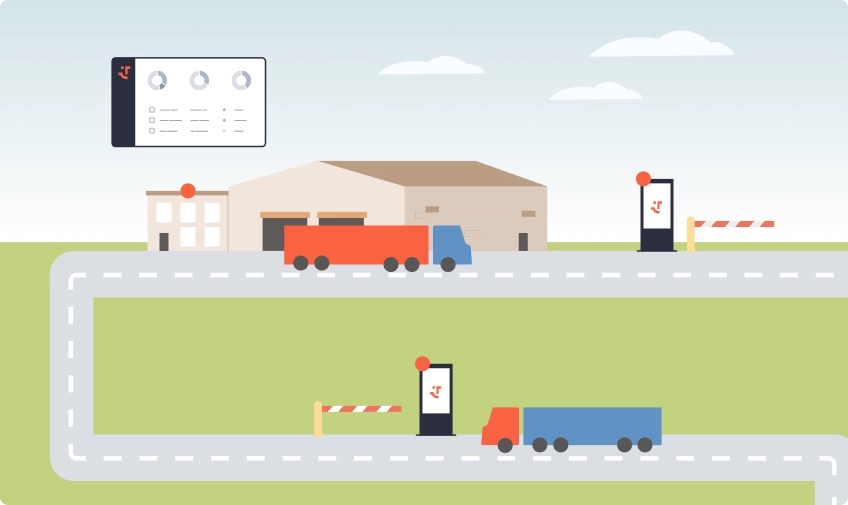
A truck arrives 40 minutes early. Another misses its slot. A driver waits at the window while security calls the warehouse, the dispatcher, and the shift lead. Five vehicles idle behind him.
This is not a traffic problem. It is a process problem — and the right gate management system can turn that messy first touchpoint into a controlled, data-driven workflow.
Key Facts at a Glance
- Primary purpose: automate arrival, verification, access, and exit for trucks, visitors, and contractors.
- Biggest operational win: shorter queues, cleaner dock handoffs, and better yard visibility.
- Core technologies: self-service kiosks, ANPR, QR codes, barriers, alerts, and integrations.
- Best first step: map today’s check-in flow before buying hardware.
What Is a Gate Management System?
Start with the basics: the entrance is not just a door. It is the point where transport plans meet reality.
Definition in logistics and yard operations
A gate management system is a digital workflow for controlling who enters a logistics site, when they enter, why they are there, and where they should go next.
It connects truck entry management, identity checks, appointments, access permissions, and exit records.
The role of gate control in supply chains
Logistics gate control protects the flow. It stops unplanned arrivals from flooding the yard and helps approved vehicles move faster.
That means fewer calls, fewer handwritten notes, and fewer “Who is this truck for?” moments.
How gate management improves yard efficiency
Good yard gate management captures data once and shares it everywhere. Security sees approvals. Warehouse teams see arrivals. Carriers receive instructions.
That is how the entrance becomes a coordination point rather than a bottleneck.
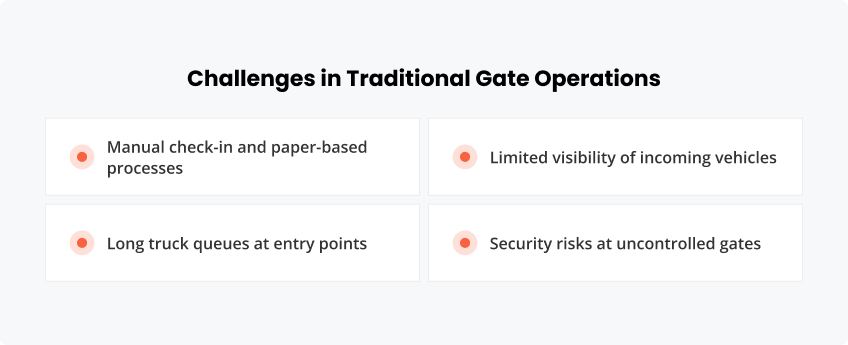
Challenges in Traditional Gate Operations
Many delays start small. A missing reference number can become a 20-minute queue.
Manual check-in and paper-based processes
Paper logs are slow and easy to misread. They also create weak audit trails.
A digital gate check-in system records time, driver, vehicle, host, load type, and exit status in one place.
Long truck queues at entry points
Queues build when every driver needs personal attention. A guard has to ask the same questions again and again.
Limited visibility of incoming vehicles
Without pre-registration, the yard only learns about a truck when it appears. That hurts dock planning, labor allocation, and carrier communication.
Security risks at uncontrolled gates
Open entrances invite tailgating, wrong-door deliveries, and undocumented visitors. Yard security systems reduce that risk with verification, policy rules, and digital logs.
How Gate Management Systems Work
The strongest setups follow a simple idea: handle predictable work before arrival.
Pre-registration and appointment scheduling
Carriers receive a time slot and upload the required details in advance. The system checks the appointment, load reference, and site rules.
Automated gate check-in and check-out
Upon arrival, the driver scans a QR code or enters a PIN at a kiosk. At departure, the exit event closes the visit record.
Driver identification and verification
The workflow can include ID capture, document checks, safety instructions, and digital signatures.
Real-time vehicle tracking
Real-time vehicle tracking begins with clean timestamps: expected, arrived, approved, docked, loaded, and exited. These events turn guesswork into operating data.
Integration with yard and warehouse systems
A modern setup provides YMS, WMS, ERP, access system, and dock scheduling integration. That prevents double entry and keeps every team aligned.
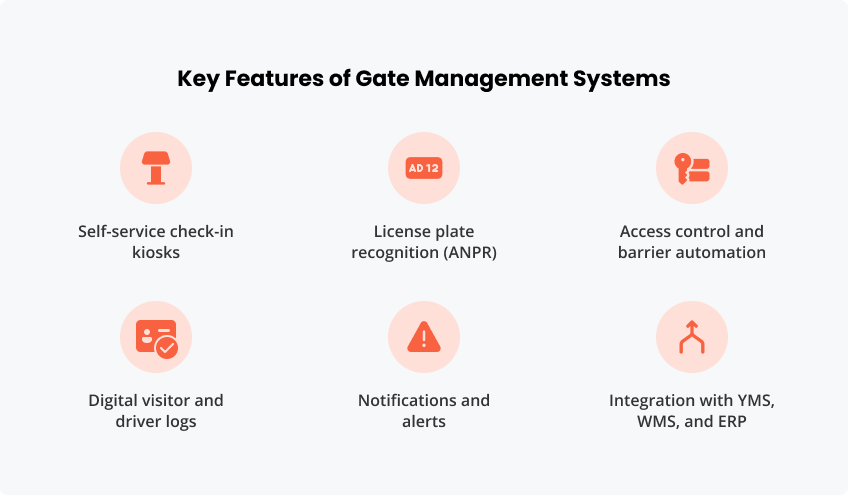
Key Features of Gate Management Systems
Not every site needs every feature. The right mix depends on traffic, risk, and process maturity.
Self-service check-in kiosks
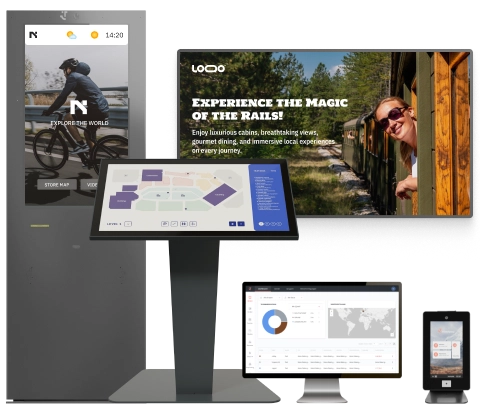
Kiosks let drivers register without tying up security staff. They can show safety notices, print badges, or route drivers to a staging lane.
License plate recognition (ANPR)
Logistics workflows match plates to appointments. ANPR is helpful for repeat carriers, high-volume yards, and unmanned lanes.
Access control and barrier automation
A gate automation system can open barriers only after approval. At friendlyway, we integrate parking gates, turnstiles, smart locks, license plate recognition, and alarm systems.
Digital visitor and driver logs
Digital logs support audits, incident reviews, and compliance checks. They also make evacuation lists more reliable.
Notifications and alerts
Alerts notify warehouse teams when a carrier arrives. They can also warn security about missing documents or denied access.
Integration with YMS, WMS, and ERP
The system should automatically pass data to operational tools. That is where carrier check-in automation becomes more than a front-desk upgrade.
Benefits of Gate Management Systems
The value is practical: fewer interruptions, safer access, and cleaner yard execution.
Reduced waiting times at gates
Automation removes repetitive questions. Pre-registration removes surprises.
Faster truck processing
A truck gate management system can turn a long conversation into a scan-and-go process. That matters most during shift changes and inbound peaks.
Improved yard visibility
With live status data, teams know what is expected, what is waiting, what is staged, or what’s completed.
| Metric | Manual process | Digital process |
|---|---|---|
| Arrival status | Phone calls | Live dashboard |
| Driver records | Paper log | Searchable file |
| Access decision | Manual approval | Rule-based workflow |
| Dock handoff | Radio update | Automated alert |
Enhanced security and access control
A yard access control system applies the same rules every time: no badge, no approval, no entry.
Reduced manual workload
Security teams spend less time typing names and more time managing exceptions. That improves both speed and control.
Better coordination with carriers
Carriers receive clearer instructions. Drivers know where to go. Dispatchers get fewer calls.
Replace clipboards with self-service check-in, automated alerts, and controlled access.
Gate Management and Yard Optimization
The entrance should work as part of the yard, not beside it.
Synchronizing gate and yard operations
When arrivals trigger yard tasks, spotters and dock teams can act sooner.
Improving dock scheduling efficiency
Appointment data helps prevent too many trucks from reaching the same dock window.
Reducing yard congestion
Controlled entry keeps the yard from filling faster than it can load, unload, or stage.
Enabling real-time decision making
Live data helps supervisors decide whether to open another lane, shift labor, or delay a slot.
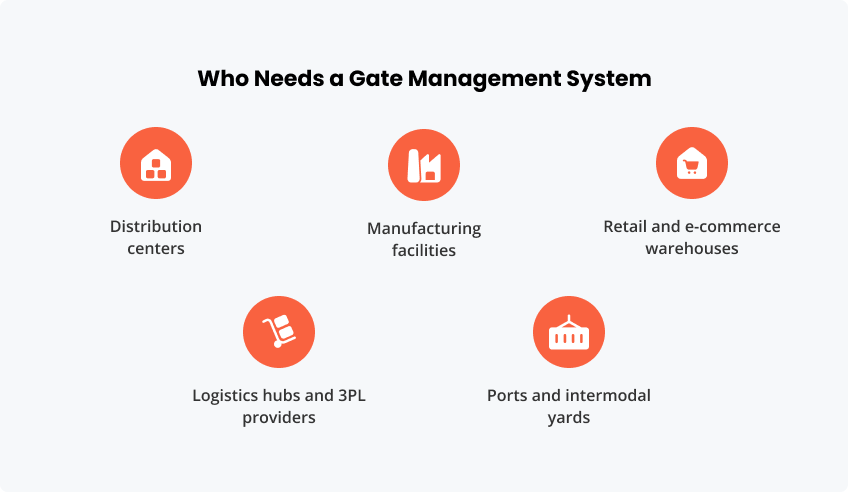
Who Needs a Gate Management System?
The higher the traffic volume, the faster manual work breaks down.
Distribution centers
DCs benefit from standardized check-in, trailer tracking, and carrier visibility.
Manufacturing facilities
Plants use controlled entry for suppliers, contractors, finished goods, and hazardous zones.
Retail and e-commerce warehouses
Fast peaks demand fast validation. Holiday surges make automation especially valuable.
Logistics hubs and 3PL providers
3PLs need repeatable workflows for many customers, carriers, and access rules.
Ports and intermodal yards
Ports rely on appointment discipline, identity verification, and vehicle flow control at scale.
How to Choose the Right Gate Management System
Choose software for the site you will run next year, not only the site you run today.
Scalability and multi-site support
A multi-site platform keeps rules consistent while allowing local variations.
Integration capabilities
Check APIs, security system compatibility, and ERP or WMS data exchange.
Automation and self-service features
Look for QR codes, kiosk workflows, ANPR, automated approvals, and exception handling.
Security and compliance requirements
Confirm audit logs, data retention, permissions, badge rules, and emergency reporting.
Ease of use for drivers and staff
Drivers need seconds, not training sessions. Staff should be able to adjust workflows without having to call IT for every change.
Implementation Best Practices
Implementation succeeds when it starts with process design rather than hardware placement.
Assessing gate and yard processes
Map the current flow:
- Who arrives?
- What must be checked?
- Who approves entry?
- Where does the vehicle go?
- What closes the visit?
Defining access and control rules
Create clear policies for carriers, contractors, visitors, employees, and denied entries.
Training staff and drivers
Train guards on exceptions. Train carriers on pre-registration. Use digital signage at the lane.
Monitoring performance and KPIs
Track turnaround time, queue length, check-in duration, no-shows, denied entries, and dock delays.
Connect self-service kiosks, access control, driver workflows, and real-time notifications.
A gate management logistics project is not about adding screens to a guardhouse. It is about removing friction in the first and last miles within your facility.
When check-in, access, yard movement, and dock coordination share the same data, the whole site feels calmer. Trucks move with purpose. Staff trusts the process. Visitors and drivers know what to do next.
FAQ
It is a software and hardware solution that manages vehicle arrival, driver check-in, access approval, routing, and exit records for logistics yard operations.
It moves data collection before arrival, automates verification, and lets drivers use kiosks, QR codes, or ANPR instead of manual paperwork.
Yes. Many platforms connect with YMS, WMS, ERP, dock scheduling tools, barriers, and access control systems.
Yes. Smaller sites can start with pre-registration, digital logs, and a self-service kiosk, then add automation as traffic grows.
A simple setup can be launched quickly after process mapping. More complex sites with barriers, ANPR, ERP connections, and multi-site rules need a phased rollout.