
(Prefer videos? Watch a brief summary of this article below.)
Industrial sites run on discipline. Timing matters. Access matters. Safety matters even more.
Yet the moment a visitor arrives — a contractor, supplier, auditor, technician, or delivery partner — that controlled environment can become less predictable. One missed instruction. One wrong turn. One person stepping into an active zone without the right gear. That is often all it takes.
This is why visitor safety screening deserves more attention than it usually gets. In manufacturing plants, warehouses, and logistics centers, it is not a box-ticking exercise. Done properly, it is the first practical step in protecting people, operations, and the site itself.
At a Glance
- Visitor safety screening helps industrial sites verify that visitors are authorized, informed, and prepared to enter safely.
- A strong process can include digital forms, kiosks, PPE acknowledgment forms, and visitor pre-screening software.
- For manufacturers and logistics operators, it improves compliance, speeds up the factory visitor check-in process, and strengthens visitor risk management.
Why Visitor Safety Screening Matters in Industrial Environments
Industrial sites are built for output, movement, and tightly managed processes. That makes the visitor journey different from what you would expect in an office, a hotel, or a retail space.
Hazards in factories, warehouses, and logistics centers
A front desk at an industrial site is not just a reception point. It is a control point. In factories, warehouses, and logistics hubs, visitors may encounter forklifts, high-noise areas, loading bays, energized equipment, chemical zones, or tightly controlled production areas within minutes of arrival.
That is why visitor safety screening should sit at the start of the arrival journey, not as an afterthought once someone is already inside. For many organizations, it is now a core part of industrial site visitor management.
Legal and compliance obligations
No regulation says every facility must use the same form or kiosk. Still, employers in the U.S. are required to assess workplace hazards, determine needed PPE, and maintain emergency procedures, all of which point toward controlled entry for non-employees in higher-risk environments.
That is where structured screening supports both manufacturing-site compliance and practical OSHA safety compliance. A risk-based management approach aligned with OSHA PPE requirements and ISO 45001 strengthens the case.
Protecting employees, visitors, and infrastructure
Good screening protects more than the visitor. It protects employees who share the space, security teams who need visibility, and operations leaders responsible for continuity. It also improves emergency readiness: if an alarm sounds, you need a reliable view of who is on-site and where they are expected to be.
That is one reason modern check-in is increasingly tied to emergency mustering and evacuation tracking.
What Is Visitor Safety Screening?
Before discussing the process itself, it helps to clarify what visitor screening is — and what it is not.
Definition and purpose
Visitor safety screening is the process of confirming that a guest can enter a site safely and in line with company policy. That usually means checking identity, visit purpose, destination, host details, required acknowledgments, and access conditions before entry is granted.
The purpose is simple: reduce avoidable risk before it becomes a real-world problem.
In other words, screening is part of prevention. It supports digital safety screening, stronger visitor risk management, and a more controlled arrival experience from the very first interaction.
Screening before entry: health, PPE, safety knowledge
On industrial sites, screening often goes beyond basic contact details. Visitors may be required to confirm their understanding of local hazards, agree to route restrictions, acknowledge PPE rules, or verify whether they require an escort. In some settings, visitor health checks may also be included when site policy calls for them.
This is where digital tools start to make a real difference. Instead of relying on verbal instructions that may be missed or paper forms that get lost in a drawer, site teams can deliver the right information in a structured, repeatable way.
Pre-registration vs on-site screening
The best systems do not force companies to choose between speed and control. They combine both.
Pre-registration allows teams to collect details in advance, send site instructions early, and flag issues before the visitor even arrives. On-site screening then confirms the final details, completes any required declarations, and triggers the next step, whether that is badge printing, host notification, or access approval.
That makes the factory visitor check-in process faster and smarter. With friendlyway’s visitor management solution, pre-registration and on-site workflows can work together rather than sitting in separate silos.
Bring pre-registration, digital screening, and visitor access into one seamless workflow for industrial sites.
Key Elements of an Effective Screening Process
A good screening process should be simple for the visitor and reliable for the operator. Behind the scenes, though, it needs structure, flexibility, and enough intelligence to adapt to different site risks.
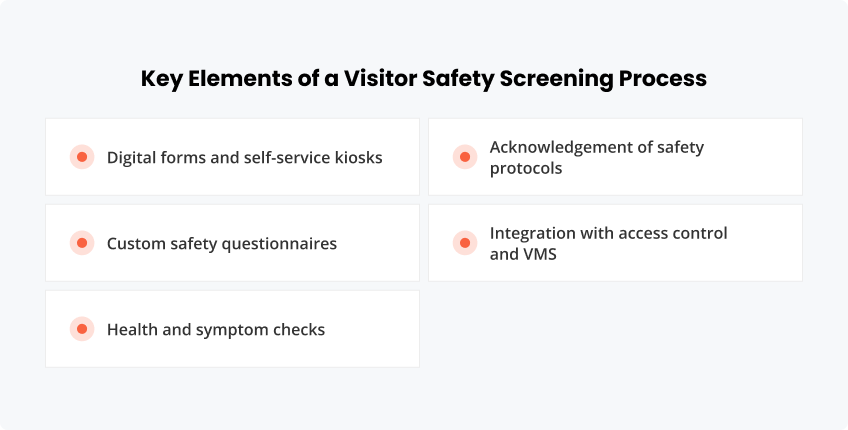
Digital forms and self-service kiosks
Paper forms create friction. They slow people down, introduce errors, and make documentation harder to manage later. Digital forms solve that immediately. They standardize the process, keep records in one place, and help teams maintain consistency across shifts and locations.
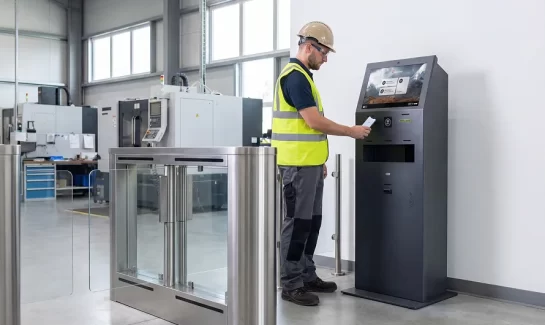
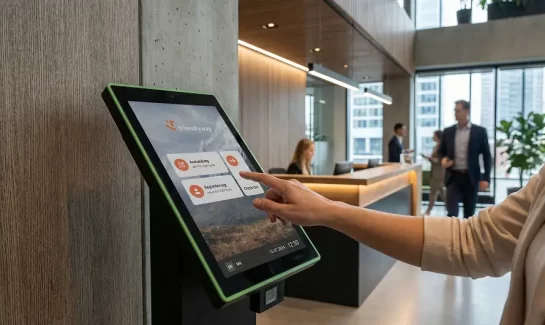
For busy entrances, a health and safety screening kiosk or other self-service check-in terminals can also reduce congestion. That matters in facilities where multiple contractors, suppliers, and delivery partners may arrive at once. friendlyway kiosks are designed for exactly that kind of environment.
Custom safety questionnaires
Not every guest carries the same level of risk. A maintenance contractor entering a restricted production area should not move through the same workflow as a short-term visitor heading to a meeting room.
That is why custom questionnaires matter. Good visitor pre-screening software allows teams to tailor screening questions for factory guests based on visitor type, area access, job role, or visit purpose. The result is a process that feels more relevant and performs better in practice.
Health and symptom checks
In some facilities, health-related prompts still have a place. The scope depends on site policy, customer expectations, and the nature of the operation. The important part is proportionality. Questions should be specific, justified, and handled carefully.
When those checks are digitized, they become easier to manage consistently and far less disruptive than ad hoc manual reviews.
Acknowledgement of safety protocols
This step is easy to overlook, but it matters. Visitors should not enter active industrial environments without clearly acknowledging the rules that apply to them.
That may include route restrictions, restricted-area notices, escort rules, and PPE acknowledgment forms. Digital acknowledgments provide teams with a clear record of what was shown, accepted, and when.
Integration with access control and VMS
Screening becomes much more valuable when it connects to the rest of the security process. Once approved, a visitor can receive a badge, trigger a host notification, or pass approved data to connected systems.
Through friendlyway integrations, organizations can connect screening with access control, notifications, and broader visitor workflows. That creates a more comprehensive system for automated visitor vetting and greater oversight through connected visitor tracking systems.
Benefits for Manufacturers and Logistics Operators
The strongest case for screening is not just safety in theory. It is the everyday operational payoff.
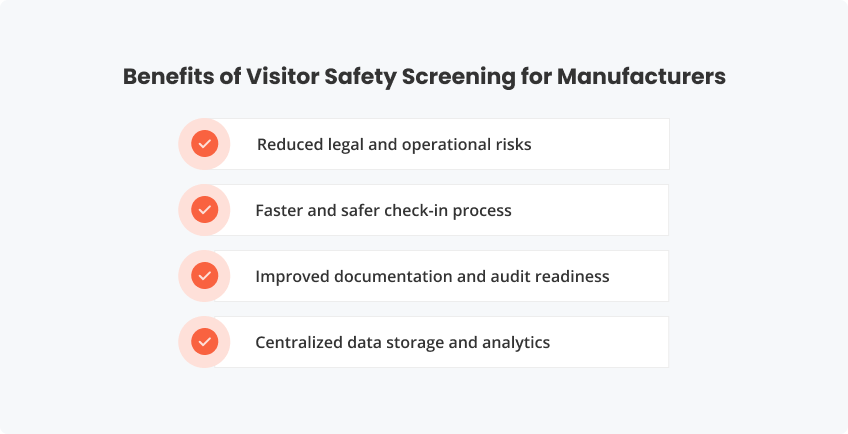
Reduced legal and operational risks
A structured process reduces inconsistency, where risk usually grows. Screening helps ensure that visitors do not miss critical instructions, enter the wrong area, or bypass key safety steps.
For industrial operators, this supports stronger warehouse security screening, better industrial site hazard control, and more defensible compliance practices.
Faster and safer check-in process
A digital process can actually feel lighter, not heavier. Visitors who pre-register can move through check-in quickly, complete any final steps, and receive clear next instructions without delays at reception.
That means the arrival experience becomes more efficient without losing control.
Improved documentation and audit readiness
Paper logs tell only part of the story. Digital records tell the whole story. You can see who arrived, when they checked in, what they acknowledged, and whether their access was approved.
That is extremely useful for audits, incident reviews, and internal reporting. It also eliminates the guesswork that comes with scattered manual records.
Centralized data storage and analytics
Once screening data is centralized, it becomes useful beyond the front desk. Teams can spot trends, compare locations, identify bottlenecks, and improve policies over time.
That is where screening shifts from a basic safety measure into a tool for continuous improvement.
Implementation Best Practices
The technology matters, but the setup matters just as much. A screening workflow works best when it reflects the actual site, the actual risks, and the people expected to use it every day.
Tailoring screening forms to specific risks
A warehouse does not need the same screening flow as a chemical facility. A contractor working near machinery does not need the same path as a visitor attending a meeting.
Screening should be tailored to the environment. That is how companies make the process more precise, more relevant, and easier to defend. Manufacturing access solutions help teams create the right balance between standardization and local flexibility.
Multilingual support for international visitors
Industrial sites often welcome suppliers, drivers, auditors, and technicians from different countries. If safety instructions are not easy to understand, screening loses much of its value.
Multilingual workflows reduce confusion and help visitors complete the process with confidence. More importantly, they increase the chances that critical information is actually understood.
Staff training and onboarding
Even the best digital system needs human support. Reception teams, security staff, and EHS leaders should all know how to handle failed screenings, exceptions, and escalations.
This becomes even more important when visitor workflows overlap with contractor management processes or local induction requirements.
Integrating screening into overall security workflows
The best results come when screening is not treated as a standalone task. It should connect to invitations, approvals, check-in, badge issuance, access control, and evacuation procedures.
That is how organizations build a safer, more coherent arrival experience instead of a patchwork of disconnected steps.
Give your manufacturing or logistics teams better control, cleaner documentation, and a faster path from arrival to authorized entry.
Use Cases and Industry Examples
The exact questions and controls will vary by site, but the use cases are easy to recognize. Different industrial environments require different workflows, which is precisely why digital screening is so useful.
Chemical plants requiring PPE acknowledgements
A chemical facility may require visitors to confirm PPE use, learn about escort rules, and demonstrate awareness of restricted areas before granting access. In that setting, digital acknowledgment is not a nice extra. It is a practical necessity.
Warehouses screening for recent illnesses or travel
Some warehouses and logistics operators still use targeted health-related screening when operational policy or customer requirements require it. Digital workflows keep that process more consistent and easier to audit.
Factories checking contractor certifications
Factories often need to validate more than identity. Contractors may need to confirm completed training, valid authorization, or local induction status before entering active work zones. That makes screening useful not only for visitors, but also for contractor safety training checks and broader site readiness.
FAQ
Typical questions cover host information, destination area, induction status, PPE needs, escort requirements, and site-specific safety rules. Depending on policy, the process may also include targeted health-related questions.
It should be stored in a centralized system with controlled permissions and clear access rules. That is one of the biggest advantages of digital screening compared with paper-based processes.
Much of it can. Invitations, approvals, badge printing, notifications, questionnaires, and access triggers can all be automated, while staff intervene only when needed.
They should not move into the relevant area until the issue is resolved. Depending on policy, this may require additional review, a mandatory escort, extra instruction, or denial of entry.
No single regulation demands a specific visitor screening process. Instead, organizations use screening to support broader safety obligations tied to hazard awareness, PPE, emergency preparedness, and risk-based compliance.