
(Prefer videos? Watch a brief summary of this article below.)
Manufacturing sites don’t just manage production. They manage the flow of people: employees, contractors, staffing agency workers, drivers, vendors, auditors, and visitors moving through gates, lobbies, and restricted zones across multiple shifts.
When that flow relies on paper logs, spreadsheets, and disconnected tools, the impact shows up quickly: bottlenecks at shift change, inconsistent safety steps, weaker access control, and records that are hard to produce when needed.
Modern visitor and workforce access management replaces that friction with repeatable processes, real-time visibility, and stronger compliance without slowing operations.
Executive Summary
- Visitor and workforce access management in manufacturing is an operational control layer that connects security, EHS, HR, and plant leadership.
- Manufacturers need to process people at scale (employees and non-employees) while maintaining consistent safety and compliance processes.
- The highest-risk moments are often the busiest: shift starts, contractor surges, and delivery waves. That’s when manual exceptions tend to become the default.
- Centralized administration supports multi-site consistency, audit readiness, and faster policy updates.
- Strong programs combine self-service check-in with centralized governance, reporting, and enforcement, including access control integration where it matters.
Manufacturing Access Is Bigger Than Visitor Sign-In
Manufacturing doesn’t have one predictable “front door.” Many facilities manage entry through a mix of reception desks, gatehouses, employee entrances, contractor check-in points, and shipping/receiving controls. Even within a single site, “who enters where” can differ by shift, project work, and the zones a person needs to access.
That’s why a manufacturing-ready access strategy must cover more than occasional office visitors. A typical site needs structured workflows for:
- Contractors arriving for maintenance, installation, utilities, or service work
- Temporary staffing arrivals at shift change
- Drivers and couriers with high-frequency, short-duration visits
- Vendors and suppliers
- Auditors and inspectors
- Customers, partners, and corporate visitors
Each group comes with different requirements: safety briefings, PPE rules, NDAs, escort policies, zone permissions, time windows, and reporting expectations. Treating them all as the same “visitor” creates either bottlenecks (too many steps for low-risk arrivals) or risk (too few steps for high-risk arrivals).
Modern access management is the discipline of making structured flows repeatable and enforceable while maintaining high throughput.
Why the Pressure Has Increased
Access workflows have always mattered in manufacturing, but several forces are converging today: workforce availability, compliance expectations, and multi-site standardization. And they all show up at the point of entry.
Workforce volatility is now an operating assumption
Many manufacturers are balancing shifting demand with tighter labor markets. That often means more contractors, more staffing agency workers, and more frequent onboarding cycles, especially in multi-shift, high-volume environments.
In the US, NAM’s Q4 2025 data provides a clear snapshot of ongoing hiring needs across production and technical roles (72% for skilled and 60% for core production workers), underscoring why onboarding and access processes must work reliably every day. When hiring is persistent, access processes can’t be “manual, when we have time.” They need to run consistently across every shift.
Compliance expectations don’t pause for peak volume
Manufacturing’s busiest moments are often its riskiest: shift start, contractor surges during maintenance windows, and delivery waves. If compliance steps depend on staff availability, exceptions become common precisely when you least want them.
Digital workflows help by enforcing required steps in the same order every time without relying on the memory, availability, or workload of the person at the desk or gate.
Multi-site operations require consistency
Many manufacturers operate multiple plants or warehouses. Inconsistent access rules across sites can create exposure: different safety steps, different documentation standards, different badge controls, and varying levels of reporting readiness.
Centralized governance, while still allowing site-level customization, is a major driver behind cloud-based approaches.

Where Manual Processes Break Down in Manufacturing
Paper logs and disconnected tools can appear “good enough” until the conditions that define manufacturing show up: volume, speed, zoning, and compliance requirements. The breakdowns are predictable and tend to get worse over time.
Queues form at shift change because check-in depends on a single point of staffing. Documentation becomes incomplete because forms are distributed inconsistently across departments. Badge rules drift because exceptions are handled informally. Reporting becomes a scramble because the data lives in binders, inboxes, and spreadsheets.
The operational cost shows up in several places:
- Lost time at the start of shifts
- Supervisors pulled into administrative exception handling
- Security teams forced into ad hoc enforcement
- Audit readiness that depends on “finding the paperwork”
- Weak real-time visibility into who is on-site
There’s also a hidden cost: manual processes encourage workarounds. If people learn that arriving unscheduled or skipping steps is tolerated during busy windows, those behaviors become normalized, and security and compliance teams end up repeatedly fighting the same preventable issues.
What Modern Visitor and Workforce Access Management Includes
In manufacturing, access management works best as a set of connected processes, each designed for a specific type of person and risk level, rather than a single generic check-in flow. The goal is to keep throughput high while ensuring the right steps happen every time.
Visitor workflows
A strong visitor workflow supports:
- Pre-registration (by hosts, departments, or through invitations)
- Approval routing (for restricted or regulated sites)
- Policy acknowledgements and NDAs
- Safety briefings and questionnaires tailored to visitor type
- Host notifications on arrival
- Badge printing with the right labels and expiration rules
- Check-out and visit history reporting
The manufacturing difference is specificity. A visitor entering offices only may require a lighter process than someone visiting production areas or controlled zones that have stricter PPE and escort requirements. friendlyway’s visitor management solution is built around configurable workflows so manufacturers can align check-in with site policy rather than adapting policy to the tool.
Contractor and contingent workforce workflows
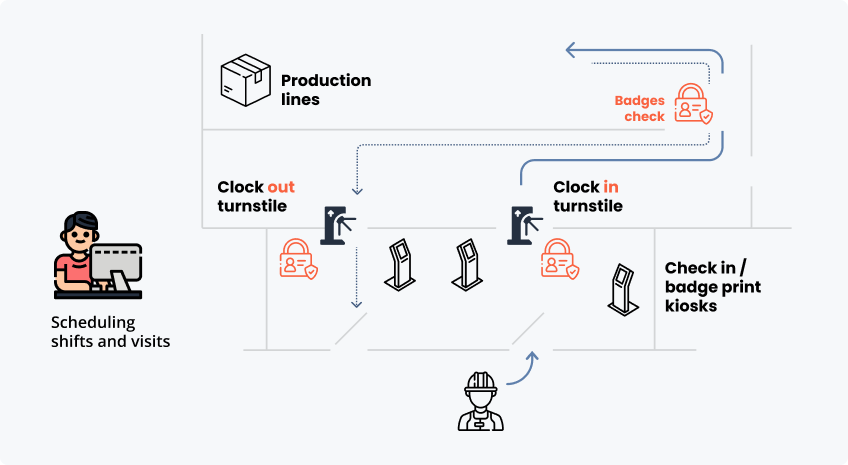
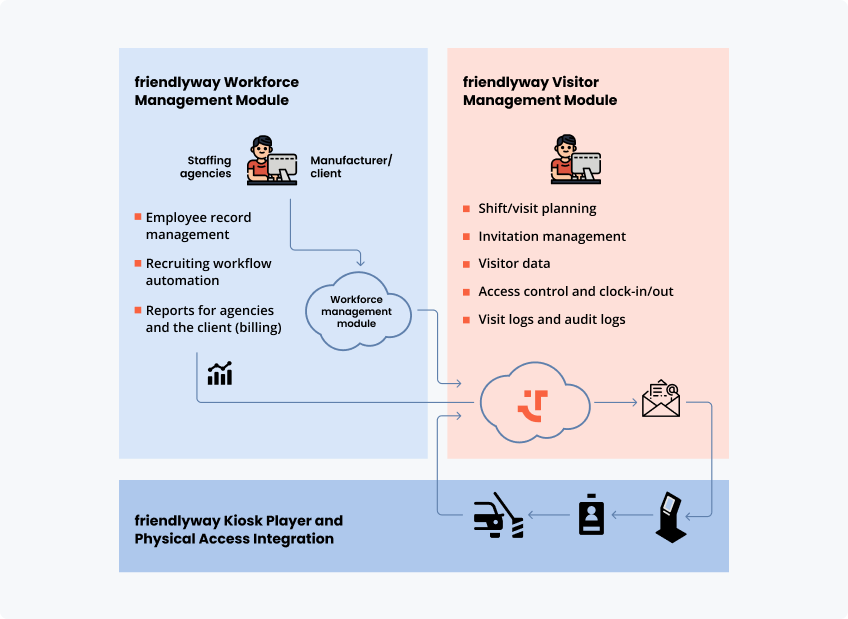
Once contractors and temporary workers are part of the flow, access management becomes operational. Workforce-related processes commonly include:
- Scheduling and roster management
- Multi-agency collaboration with controlled visibility
- Clock-in/clock-out capture (where needed)
- Role- and zone-based access rules
- Timesheets, approvals, and reporting for billing accuracy
Manufacturing teams often hire contingent labor for speed and flexibility. The risk is losing control across staffing partners. friendlyway supports contingent workforce management designed for multi-vendor environments, helping plants maintain governance while enabling agencies to contribute within defined permissions.
Physical access integration
Manufacturing is zoned by nature. Offices, production lines, restricted storage, utilities, and R&D may require different permissions. Integration with access control helps ensure “approved” also means “allowed,” automatically and consistently, especially when staffing levels and arrival volumes fluctuate.
Emergency accountability
In an incident, “Who is on-site right now?” becomes a safety-critical question. Modern systems provide real-time occupancy visibility and can feed into emergency mustering processes that include employees, contractors, and visitors.
Why Self-Service Works in Manufacturing
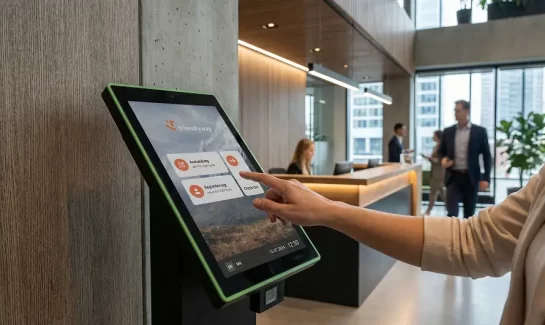
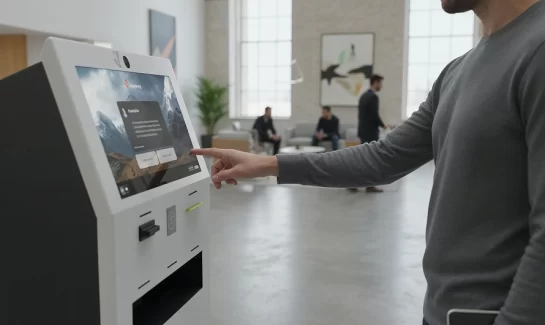
Self-service kiosks are not about removing people from the process; they’re about keeping the process consistent and fast, especially during peaks, so that staff can focus on exceptions and higher-risk situations.
Throughput without losing control
Self-service kiosks are valuable in manufacturing because they handle high volumes while enforcing consistent steps. A well-designed workflow can:
- Verify arrival against a schedule or invitation
- Capture required details and validate key fields
- Display site rules and safety instructions
- Collect acknowledgements and signatures digitally
- Print a badge automatically
- Trigger host or supervisor notifications
This reduces queues and helps avoid the “wave-through” behavior that often appears during busy windows.
Repeatability is operational maturity
Manufacturing teams value repeatability on the shop floor; entry processes deserve the same discipline. Kiosk-based check-in helps ensure required steps happen in the same order every time, regardless of shift, staffing levels, or volume.
That repeatability also supports training and governance. Once the process is defined, it can be rolled out consistently across entrances and sites instead of relying on local interpretation.
Better experience for legitimate visitors
A clear, guided check-in experience reduces confusion and wrong turns in large facilities. That improves safety and professionalism, especially for audits, customer visits, and vendor appointments.
Why Cloud Administration Matters at Scale
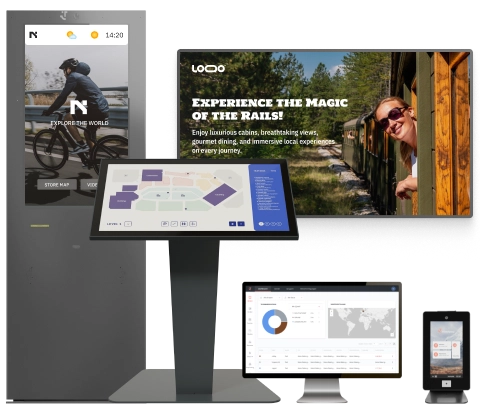
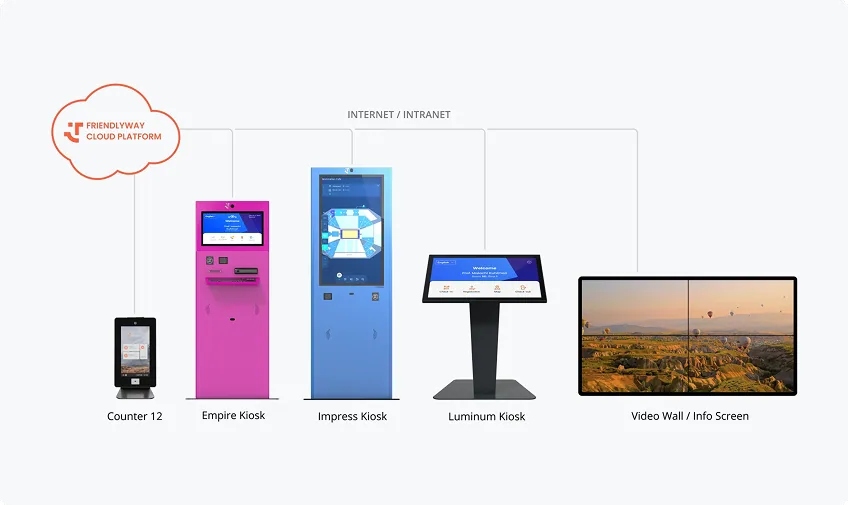
Self-service devices solve the point-of-entry execution problem. The cloud layer solves the governance problem: how workflows are configured, updated, reported on, and standardized across entrances and sites. This is where the friendlyway Cloud Platform supports consistency across shifts and locations.
With centralized administration, manufacturers can:
- Keep processes consistent across plants while allowing site-specific variations
- Update safety steps and documentation requirements without local rework
- Control badge templates and expiration rules centrally
- Generate audit-ready reports quickly
- Reduce on-site maintenance overhead compared to fragmented tools
Cloud control also reduces “process drift.” If policy changes require a chain of emails and manual updates across locations, older versions of the process tend to linger. Central administration helps prevent that and makes it easier to demonstrate consistency during audits.
Traditional visitor management vs. friendlyway
| Traditional Visitor Management | friendlyway Cloud Platform |
|---|---|
| Paper logs, spreadsheets, and manual approvals | Centralized workflows with configurable approvals and rules |
| One-size-fits-all check-in flow | Visitor-type and role-based check-in (visitors, contractors, contingent labor) |
| Limited real-time visibility into who is on-site | Live dashboards for occupancy, expected arrivals, and on-site status |
| Inconsistent compliance steps (forms, safety briefings) | Repeatable digital compliance steps with stored acknowledgements and signatures |
| Manual badging with limited time/zone control | Automated badging with configurable validity and optional access control integration |
| Separate systems for staffing agencies and time tracking | Multi-vendor contingent workforce workflows, rostering, and reporting in one platform |
| Audit logs are slow to compile | Searchable, exportable reporting for audits and investigations |
| Emergency headcounts rely on paper lists | Emergency mustering support using real-time on-site data |
Managing Contingent Labor Across Multiple Staffing Partners
Multi-agency staffing programs tend to expose the weakest points in manufacturing access workflows. If your site depends on staffing partners, you need a system that preserves speed while restoring governance.
Common issues include inconsistent worker records, last-minute roster changes that don’t reach the gate, disputes over hours, and unclear offboarding timelines. Even when each agency is doing its best, fragmented processes make it harder for the manufacturer to maintain control.
What a manufacturing-ready multi-vendor model needs
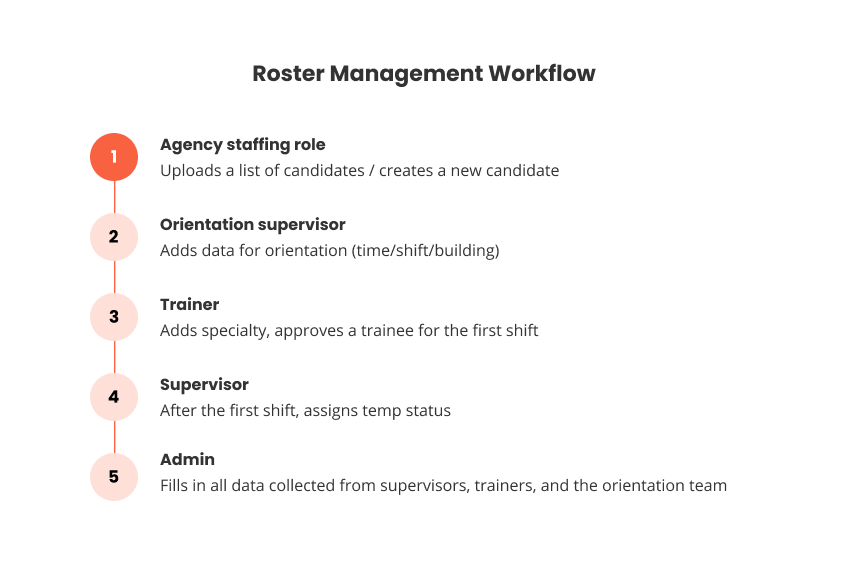
A reliable approach typically includes:
- Standardized roster submissions and approvals
- Controlled agency access to only their own worker data
- Schedule-based credentialing, so access is time-bound
- Attendance and time tracking aligned with scheduled roles
- Reporting that supports billing validation and workforce planning
friendlyway’s multi-vendor staffing solution is designed around these realities, supporting multi-agency collaboration with controlled visibility and consistent execution.
Integrating Digital Workflows With Access Control
Access control integration is where “process” becomes “enforcement.” For manufacturing sites with restricted areas, high-value assets, regulated environments, or safety-critical zones, it’s not enough to record that someone arrived. The system must help ensure they can only enter what they’re authorized to enter and only when they’re authorized to do so.
Integration matters most when it reduces exception handling during busy times. It helps close common gaps such as tailgating through secured entrances, credential reuse beyond approved windows, and informal approvals that don’t create a reliable record.
Examples of enforceable manufacturing workflows
- A contractor checks in, completes the required safety steps, and receives a credential that only works for approved doors and the approved time window.
- A temporary worker’s badge stops working outside the scheduled shift, reducing the risk of credential reuse.
- An unscheduled arrival is routed into an approval workflow instead of receiving a badge “just this once.”
friendlyway supports integrations with access and related infrastructure to connect check-in to enforcement where policy requires it.
Safety, Compliance, and Audit Readiness
Compliance in manufacturing isn’t about collecting forms. It’s about proving that the required steps were enforced consistently, even under pressure. The stronger your discipline at the point of entry, the fewer unknowns you face during audits, incident reviews, or customer inspections.
What regulators expect
OSHA’s emergency action plan materials include “accounting for all employees after an emergency evacuation has been completed” as a minimum requirement element.
How digital workflows support audit readiness
Digital access processes support these expectations by making key steps repeatable and traceable:
- Safety briefings and policy acknowledgements delivered the same way every time
- Signatures stored consistently for audit readiness
- Visitor type rules enforced automatically (escort rules, restricted areas, PPE reminders)
- Time-bound credentials and clear check-in/check-out records
- Reporting that can be produced without manual reconciliation
Manufacturing Scenarios and Example Workflows
The easiest way to evaluate an access management approach is to map it to real conditions: peak volumes, mixed visitor types, restricted zones, and multi-agency staffing. Below are common manufacturing scenarios and what modern execution typically looks like.
High-volume shift change with contingent labor
At shift start, plants may process large numbers of arrivals within a narrow window. Manual check-in creates predictable delays and exceptions. A modern workflow improves throughput and control:
- Workers are scheduled and appear on an expected roster
- Workers check in at kiosks using an invitation code or roster match
- Required acknowledgements are presented and captured
- Badges print automatically with the correct validity period
- Supervisors see real-time arrival visibility and can react faster
The operational benefit isn’t just speed. It’s fewer interruptions, less ad hoc enforcement, and clearer visibility when staffing levels don’t match the plan.
Contractor onboarding for maintenance and shutdown periods
Shutdown windows concentrate risk: high contractor volume, unfamiliar hazards, and time pressure. A structured digital workflow can include trade-specific briefings, required forms, and zone-based access rules tied to time windows. That improves safety discipline while keeping the experience efficient.
It also helps reduce administrative churn. Instead of repeating the same manual steps for every contractor group, the process runs consistently, and exceptions can be escalated to the right approvers.
Gatehouse visitor check-in for factories and warehouses
For many sites, “reception” is a gatehouse. Drivers, vendors, and contractors need speed and clarity. Digitized check-in reduces radio calls, paper logs, and repeated staff instructions, while improving record quality.
This scenario is also where clear instructions matter. Even a simple “where to wait / where to go / who to contact” workflow can reduce wrong turns and unsafe movement, especially on large sites.
Audits, inspections, and customer visits
These visits require professional experience without losing control. Pre-registration, host notifications, clear badging, and consistent NDA and safety steps make the visit smoother and reduce distractions for operational staff.
In regulated environments, the ability to quickly produce visit logs, signed documents, and access history can be as important as the on-site workflow itself.

What to Measure
Access management becomes easier to scale when outcomes are measurable across security, EHS, HR, and operations. Useful KPIs include:
- Average check-in time by visitor type
- Peak-time throughput (check-ins per hour)
- Percentage of visits pre-registered vs. walk-ins
- Completion rates for required documents and briefings
- Exception rate (manual overrides, reprints, unscheduled arrivals)
- Staffing hours saved at reception or gatehouse
- Contingent workforce attendance accuracy (and billing dispute reduction)
- Time to produce audit-ready logs
- Emergency roster completeness and mustering performance (where applicable)
These metrics also help teams align internally. Security may prioritize exception reduction and access enforcement, while operations may focus on throughput, and HR may focus on timekeeping and workforce visibility. A shared KPI set keeps the program coherent.
Implementation Roadmap
Most manufacturers don’t modernize access in a single rollout. The most successful programs start with one high-impact area, prove value quickly, and then standardize across entrances and sites.
- Map current flows honestly. Document peak arrival windows, exception paths, and where manual workarounds happen. Include gatehouse and contractor entrances, not just the office lobby.
- Standardize by visitor type. Define visitor and worker categories and attach rules: required documents, approval routes, badge templates, escort policies, and access permissions.
- Pilot one high-impact entry point. Choose where volume and risk are highest: shift-change entry, contractor check-in, or the main gatehouse.
- Integrate where it matters most. Start with key entry points or restricted zones, then expand integration once the process is stable. Integration should reduce exceptions, not create new manual tasks.
- Expand across sites with centralized governance. Standardize policies and reporting while keeping local configuration options for hazards and layouts. Central governance helps prevent drift and improves audit readiness.
Why Manufacturers Choose friendlyway
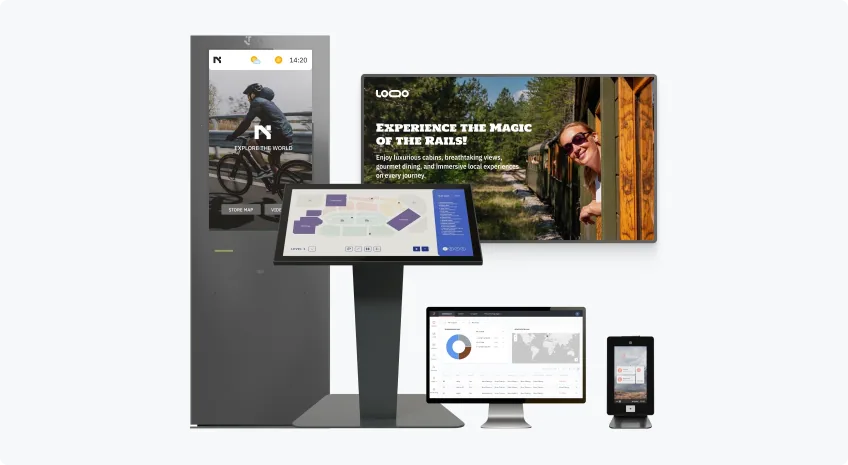
Manufacturers typically want fewer gaps. That means a solution that can scale across entrances and sites, handle high throughput, manage the complexity of contingent labor, and connect to existing infrastructure.
friendlyway supports this through the friendlyway Cloud Platform and connected modules for visitor management, multi-vendor contingent workforce management, access integrations, and emergency mustering and evacuation tracking.
See how friendlyway can help you standardize visitor and contractor access workflows.
Next Steps
If you’re modernizing visitor and workforce access management, start with one operational objective: reduce friction at check-in while increasing confidence in security and compliance.
A strong first evaluation focuses on the realities of your site:
- Shift-start throughput requirements
- Contractor and staffing agency onboarding volume
- Zone-based access and time-window controls
- Audit and reporting needs
- Emergency accountability expectations
From there, build a phased rollout plan that starts where the pain is highest and expands into standardization across entrances and facilities, using the friendlyway Cloud Platform as the backbone for governance, execution, and reporting.