


Key Facts
- Paper Waste Reduction: Digital signage in government can significantly reduce paper use, with one study showing an 89% reduction in paper waste.
- Environmental Impact: By reducing paper consumption, U.S. businesses could save 1.2 million trees annually, contributing to major reductions in CO2 emissions.
- Real-Time Updates: Government offices can quickly edit digital messages to ensure that content is always relevant and up-to-date without the environmental cost of printing.
- Cost Savings and Efficiency: The return on investment (ROI) for digital signage is often achieved within 12-24 months.
- Smart City and Green Initiatives: Many cities incorporate digital signage in their sustainability plans, helping to meet eco-regulations like the EU Green Deal and the U.S. Paperwork Reduction Act.
Government offices have traditionally relied on mountains of paper — from printed forms and memos to bulletin board announcements. However, this paper-intensive approach comes with hidden environmental and financial costs. In this article, we explore how digital signage in government helps cut down on paper use, save resources, and align with green public sector tools.
Streamline communication and improve efficiency with a best-in-class platform.
The Environmental Cost of Paper in the Public Sector
Government administration is often paper-heavy, and that reliance has significant implications. The environmental impact the government faces due to excessive paper consumption is immense, not only in financial terms but also in the degradation of natural resources.
Paper consumption in government administration
Public agencies handle vast amounts of paperwork. Although many tasks go digital, paper remains ingrained in bureaucracy — from multi-page application forms to meeting minutes that are printed for distribution. The high paper consumption in the public sector comes at a high cost to both taxpayers and the environment, and paperless government solutions offer a promising way forward.
Printing waste and outdated communication methods
Much of the government’s paper waste stems from obsolete communication practices. Often, printed materials become outdated almost as soon as they’re posted, which leads to constant re-printing and disposal. Today, when emails, intranets, and digital displays can disseminate information instantly, the reliance on paper memos is not only slow but also wasteful.
Hidden costs: storage, shredding, recycling
Government agencies must allocate space for filing cabinets and archives of paper records. For this purpose, sometimes entire rooms full of documents are needed. All these rooms require heating, cooling, and maintenance. It’s also costly to shred and recycle the paper after it has served its purpose.

Digital Signage as a Paperless Communication Channel
With eco-friendly government technology, you can keep your content timely and relevant without generating physical waste.
Replacing posters, flyers, and memos with screens
Digital signage is easily standardized: you can manage the content centrally and push it to all the screens. Given this, there will now be no more need for each department to print its own flyers. This approach frees staff from the manual labor of swapping out paper posters on dozens of bulletin boards.
Updating information instantly without reprints
Digital signage allows messages to be edited on the fly, whereas printed materials would require overnight print jobs. And environmentally, it means that no paper, ink, or fuel (for delivery) is consumed each time information changes. This is a huge win for sustainable digital communication.
Multi-purpose use: alerts, info, schedules, announcements
A single screen in a government office can cycle through a variety of content: general announcements, meeting schedules, event posters, public service reminders, and even live news or emergency alerts. For example, the same digital notice board in the office might display a slide about an upcoming community meeting, then rotate to the day’s queue ticket numbers, then to a weather alert — all within just a minute.

Practical Applications in Government Settings
Digital signage is being put into practice across various government settings with great success. Let’s look at a few concrete examples of how agencies are deploying municipal signage systems in daily routine operations.
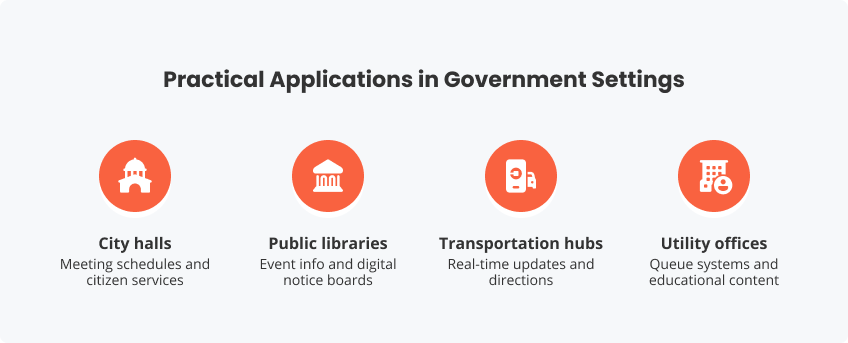
City halls: meeting schedules and citizen services
Digital signage displays in a municipal service center in Munich help guide citizens to the right offices, replacing paper directories and signs. The facility deployed nearly 300 displays throughout a 43,000 sq. ft. building to help 5,000+ daily visitors find their way and access services seamlessly.
Public libraries: event info and digital notice boards
Libraries are community hubs that often have rich calendars of events — from author talks to reading programs and public notices. Now, many libraries are turning to digital notice boards to serve as green communication tools that catch readers’ eyes. Libraries also can benefit from the centralized control of content if they’re part of a larger system: the main branch can instantly push an announcement to all the library screens.
Transportation hubs: real-time updates and directions
During emergencies that happen at the transportation hubs, displays can immediately show alerts like “Service suspended due to weather” or direct people to alternate routes. These smart city visual communication tools provide instant updates that significantly reduce paper waste in these high-traffic areas.
Utility offices: queue systems and educational content
Many utility offices now use digital screens to display the current ticket number and direct the next customer to a specific window. With digital signage, it is also possible to share tips on saving energy or water, to explain new online services, or to advertise local community programs.
Measurable Environmental Benefits
Adopting eco-digital signage in place of paper posters and printouts delivers tangible, measurable results. Let’s explore these major benefits in more detail.
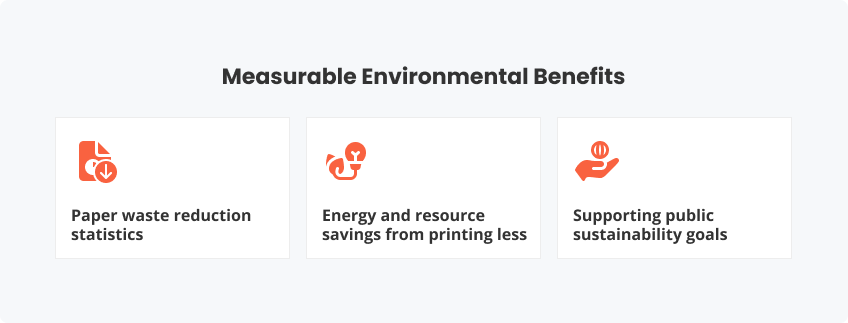
Paper waste reduction statistics
The most direct metric is the drop in paper waste. According to a study, campus digital signage cut paper use by 89%, which saves universities up to $45,000–$180,000 a year that would have been spent on printing event flyers and announcements.
Energy and resource savings from printing less
Today’s LED-based screens use 70% less energy than older fluorescent-backlit models did. If you cut office paper use by just 20%, you will save an estimated 1.2 million trees annually in the U.S. and avoid substantial CO2 emissions, supporting government sustainability initiatives.
Supporting public sustainability goals
Citizens increasingly expect their governments to lead on environmental issues. A survey found that 77% of consumers perceive companies that use digital signage as more environmentally friendly than those that plaster paper posters.
Implementation and ROI
Switching to digital signage solutions in government offices can eventually pay off through cost savings and efficiency gains.
Low-maintenance hardware and CMS platforms
One concern many have is the upkeep of a digital signage network, but today’s hardware is quite low-maintenance and built for longevity. Modern CMS platforms are cloud-based, user-friendly systems. This means that an authorized staff member can easily update the text or graphics on a sign from their office computer.
Centralized content control across locations
With the right setup, one department can push content to screens in every building at once. This will help ensure that the same message reaches all citizens uniformly, which is especially useful for things like policy announcements or emergency alerts.
Cost savings over traditional printing in 12—24 months
Investment in digital signage and software has upfront costs, but numerous analyses show that the return on investment (ROI) is quite fast, often within 12-24 months. The savings come from eliminating the cost of paper printing and increasing staff efficiency.

Alignment with Green Government Strategies
Digital signage doesn’t exist in a vacuum; it dovetails neatly with broader initiatives that governments are pursuing to be smarter, more efficient, and more sustainable. This is a clear demonstration of green public sector tools.
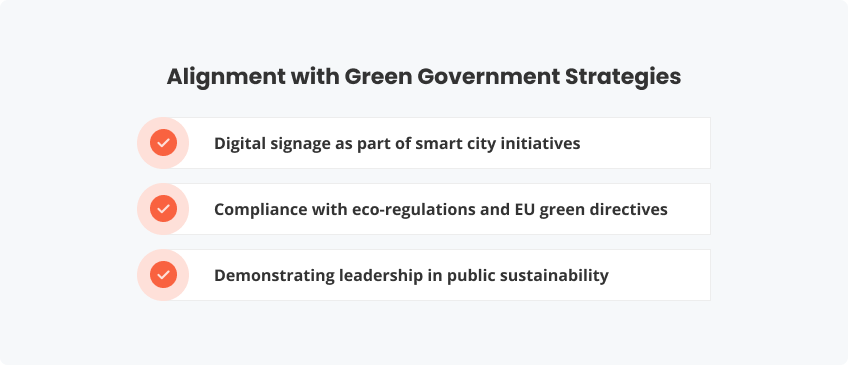
Digital signage as part of smart city initiatives
When a city commits to being “smart,” that usually includes a communication layer. It comes as no surprise that cities known for innovation are rolling out interactive bus shelter displays, digital notice boards in government buildings, and open-data-driven public dashboards.
Compliance with eco-regulations and EU green directives
In many jurisdictions, policies encourage reduced paper use and electronic recordkeeping. For instance, the U.S. has the Paperwork Reduction Act and various executive orders directing federal agencies to minimize waste and support recycling. In the European Union, the push for digital public services is tied to the EU Green Deal’s objectives of a resource-efficient economy.
Demonstrating leadership in public sustainability
Digital signage offers a highly visible way for governments to demonstrate environmental leadership. The decision to move forward with paperless communication is another checkbox on the sustainability scorecard, which contributes to qualifications like LEED certification for buildings or ISO 14001 environmental management standards.
Conclusion
Digital signage offers a win-win for government offices: both enhanced communication capabilities and significant reductions in paper waste. It transforms the way public information is delivered, making it faster, more flexible, and eco-conscious. Switching to digital signs may be a smart idea for government agencies that aim to serve the public and comply with environmental responsibilities.
friendlyway will create a tailored solution to keep everyone safe and informed at your facility.
FAQ
Yes. While digital signage does consume electricity, it is far more sustainable than using paper, especially when you consider the full lifecycle of paper disposal. The reduction in paper use also means fewer trees are cut down.
Virtually any government facility that communicates with staff or the public can benefit, but the impact is greatest in high-traffic and information-intensive buildings.
There are several ways to ensure digital signage systems are as green as possible. First, agencies can choose energy-efficient display hardware. Then, the rise of solar-powered signage is a true game-changer. It is also possible to integrate signage into smart building systems — e.g., tie the screen operation into motion sensors so that a display only fully powers on when people are nearby.
Yes, there are often grants available to help government entities implement sustainable technologies. For example, in the United States, the federal government launched the SMART Grants Program, which funds advanced smart city projects.