
(Prefer videos? Watch a brief summary of this article below.)
As businesses enter 2026, understanding the latest digital signage trends is crucial for adapting strategies and seizing new opportunities.
Digital signage is no longer “screens + playlists.” In 2026, it’s an operational channel that shapes employee experience, visitor flows, customer service, compliance messaging, and revenue, with higher expectations for security and reliability than ever.
At friendlyway, decades of real-world deployments across locations and stakeholders — plus recent conversations at events like GSX, New York Build Expo, American Manufacturing Summit, and EuroCIS — have helped us pinpoint what’s next. Here’s a business-first look at the top digital signage trends defining 2026.
Key Takeaways
- Cloud-first is the default — but resilience wins. Central control matters, yet offline playback and edge stability are what keep operations calm when networks wobble.
- Self-service keeps expanding. Not just for ordering; think check-in, wayfinding, internal service desks, and queue management.
- AI’s real value is speed and consistency. Faster content production, localization, smarter scheduling, and less manual busywork without turning privacy into a liability.
- Mobile handoffs are now expected. QR codes still matter, but the bigger story is frictionless movement from screen → phone → action.
- Immersive formats are becoming practical. Ultra-wide “stretch” screens, video walls, and selective AR are moving from novelty to targeted use cases.
- Peripherals unlock context. Sensors, NFC, printers, scanners offer great power with greater responsibility (privacy + governance).
- Integrations are what turn signage into infrastructure. If it doesn’t connect to identity, scheduling, visitor management, data sources, or workflows, it will eventually get replaced.
The Industry’s Steady Growth Continues
Digital signage isn’t riding a temporary wave. It’s riding a structural shift: organizations are modernizing how they communicate, guide people through spaces, and automate routine interactions.
Market at a glance
The numbers still point up and to the right. Grand View Research estimates the global digital signage market at USD 28.83B (2024) and projects it will reach USD 45.94B by 2030, growing at a CAGR of 8.1% (2025–2030).
And for teams with a marketing lens — especially in retail and public venues — out-of-home continues to show momentum. In the U.S., OAAA reported Q3 2025 OOH revenue of $2.13B, the highest Q3 on record, with digital OOH (DOOH) accounting for roughly a third and being the strongest growth driver for the category (up 11.6% in the third quarter).
Signals shaping 2026
A few “tells” keep showing up across industries:
- Signage is increasingly treated like enterprise IT. Security guides and best practices are no longer optional reading, as any connected screen can become a target, and reputational damage can spread quickly.
- Buyers want proof, not vibes. Internal comms teams want engagement signals; operations teams want throughput improvements; marketing teams look for measurable lift. The expectation is measurement, even if the exact KPI differs by use case.
- The experience layer is converging. Screens, kiosks, mobile, and workplace tools are being stitched into one journey: arrive → authenticate → navigate → self-serve → follow up.
- Hardware formats are diversifying. The market is responding with more specialized display shapes and deployment options built for tight spaces and unusual placements.
Challenges and opportunities
Here’s where the real-world friction lives and where smart teams win:
- Content governance at scale: Who can publish? Who approves? How do you prevent “well-meaning chaos” across locations?
- Security and patching: Screens sit in public, semi-public, and distributed environments. They need real endpoint discipline.
- Privacy in a sensor-rich world: If you’re measuring interactions or using cameras/sensors, privacy-by-design isn’t a slogan, it’s risk management.
- Integration debt: Standalone signage networks age poorly. The moment you need real-time data, the “simple setup” becomes a bottleneck.
What this means for businesses
If you’re planning signage for 2026, don’t start with “how many screens.” Start with what you want the screens to do.
A solid approach:
- Pick 1–2 high-impact journeys (employee comms, visitor guidance, queue reduction, safety messaging, retail promos).
- Define outcomes and owners (Marketing? Facilities? IT? Security? HR? Operations?). Get them aligned early.
- Demand IT-grade basics (SSO/roles, audit trails, encryption, monitoring, update strategy).
- Pilot → measure → scale (and bake content governance into the pilot, not after).
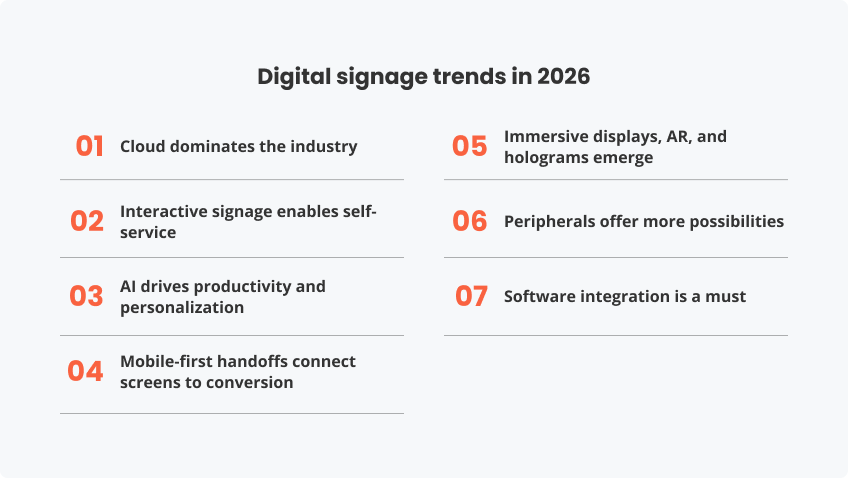
Key Digital Signage Trends for 2026
Trend 1: Cloud dominates the industry — now with “edge resilience” as the differentiator
Cloud has become the control center: centralized publishing, multi-location management, faster rollouts, and simpler collaboration. That hasn’t changed.
What has changed in 2026 is the buying mindset: cloud is assumed. The question is whether the system behaves gracefully when reality happens — spotty connectivity, site outages, bandwidth limits, or a location that simply can’t go dark during business hours.
What you should look for:
- Offline playback and local caching so screens keep working when the network doesn’t.
- Central governance (roles, permissions, approvals) without slowing the business down.
- Fleet visibility: health monitoring, alerts, remote troubleshooting (because “drive out and reboot it” is not a strategy).
Cloud isn’t just about convenience anymore. It’s about operational confidence.
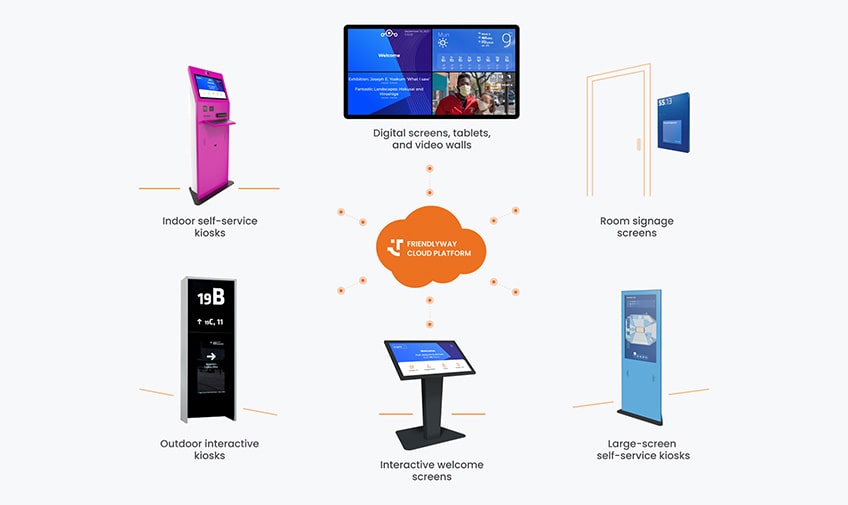
Example of a digital signage and self-service cloud platform
Trend 2: Interactive signage enables self-service across customers, visitors, and employees
Self-service has moved far beyond the “nice kiosk in the lobby.”
In 2026, interactive signage is being deployed to remove friction in everyday moments:
- Corporate / campus: visitor check-in, badge printing, wayfinding, meeting-room guidance, HR/IT service intake
- Healthcare: directions, queue guidance, appointment flow support (with appropriate privacy safeguards)
- Manufacturing / industrial: safety messaging, production dashboards, internal communications near the point of work
- Retail / QSR: ordering, returns support, product discovery, loyalty onboarding
The payoff is often immediate and practical: shorter lines, fewer repetitive questions, more consistency, and better throughput when staffing is tight.
And for teams thinking about experience: self-service isn’t just “automation.” Done well, it feels like hospitality at scale.
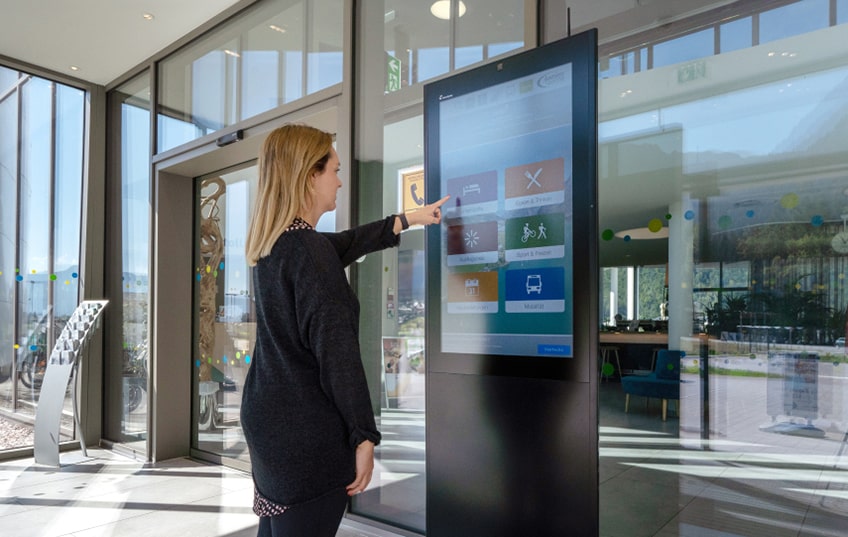
friendlyway Impress 43 kiosk with self-service options
Trend 3: AI drives productivity and personalization — without turning your signage into a privacy headline
AI is in its “useful era.”
The most valuable AI wins in 2026 aren’t gimmicks. They’re the ones that quietly reduce workload:
- Faster content creation: first drafts, variations, summaries, and layout suggestions
- Localization at scale: translating and adapting messaging across regions and facilities
- Smarter scheduling: optimizing what runs where and when based on context (time of day, location, audience intent)
- Operational support: spotting anomalies, reducing downtime, and easing routine admin tasks
Personalization can be powerful, but only when it’s appropriate for the environment, transparent, and compliant with your policies and local regulations. The best enterprise deployments make privacy a design constraint, not a footnote.
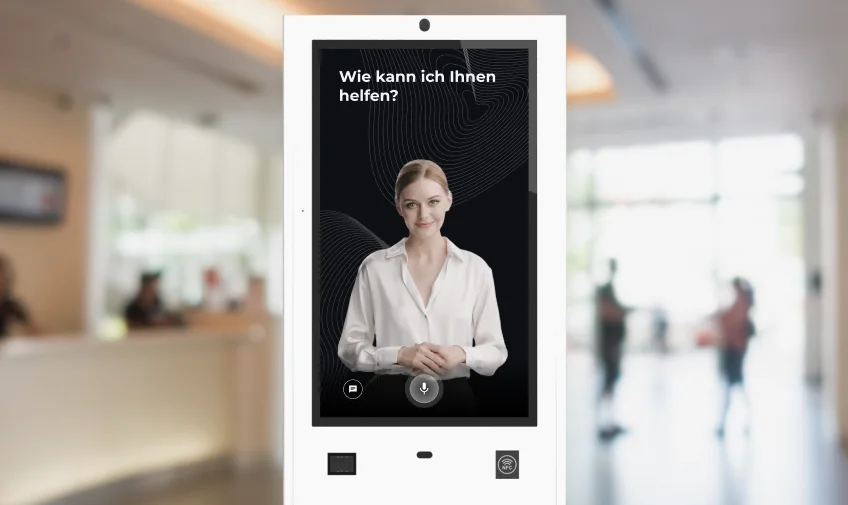
friendlyway AI Assistant offers personalized live advice in any language
Trend 4: Mobile-first handoffs connect screens to conversion (QR codes and beyond)
QR codes still do a beautifully simple job: scan → act.
However, the bigger 2026 trend is this: screens spark attention; phones complete the journey.
That journey might look like:
- scanning a QR code to pre-register as a visitor
- saving a wallet pass for an event, appointment, or building access flow
- tapping NFC (where supported) for ultra-low friction
- grabbing a short link to continue on a personal device without standing in front of a screen
Why it matters: mobile handoffs turn signage from a broadcast tool into an action channel — one you can measure, attribute, and improve.
It also keeps experiences cleaner. Let the big screen do what it’s best at: visibility and clarity. Let the phone handle what it’s best at: personal, persistent interaction.
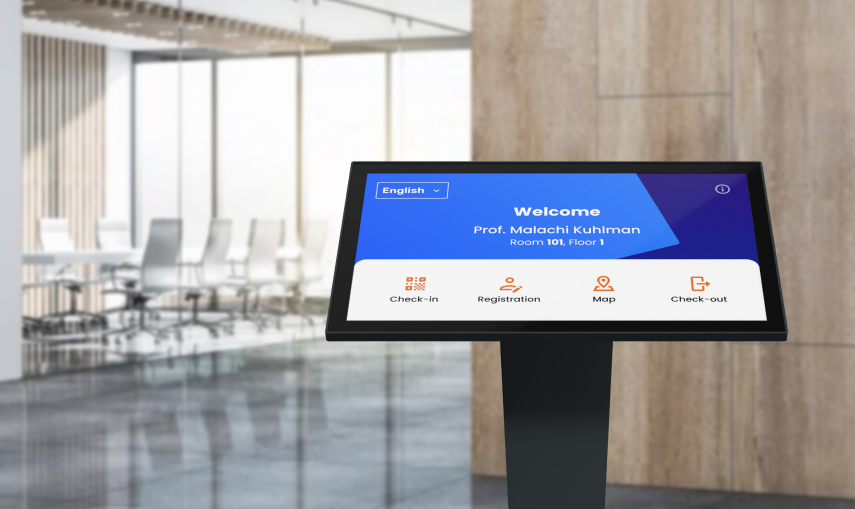
friendlyway Luminum 43 kiosk with a check-in option via a QR code
Trend 5: Immersive displays, AR, and holograms emerge — selectively, where they truly earn their keep
Immersive tech is maturing, but the smartest 2026 deployments are targeted.
You’ll see immersive formats used where attention is scarce and impact matters:
- flagship lobbies and brand centers
- innovation hubs and customer briefing rooms
- trade shows, events, and public venues
- retail “moment” zones and premium product storytelling
Hardware innovation is also making immersive experiences less exotic. For example, manufacturers are shipping more specialized display formats designed for constrained spaces and creative installs.
The practical 2026 lens: immersive isn’t there to impress your internal team. It’s there to change visitor behavior, increase comprehension, or improve conversion, and you should define which one before you buy anything.
The Las Vegas Sphere uses immersive signage capabilities. Source: Insider News
Trend 6: Peripherals offer more possibilities — especially for context-aware experiences
Peripherals are what turn a “screen” into an experience endpoint.
Think: printers for badges and tickets, scanners for IDs, NFC readers, cameras (used responsibly), occupancy sensors, proximity sensors, and IoT triggers.
In 2026, peripherals are increasingly used for:
- Visitor flows: check-in, badge printing, directions, host notification
- Queue management: sensing congestion and rerouting people or updating ETAs (estimated time of arrival)
- Context-aware messaging: tailoring content based on location, time, or environmental inputs
- Retail activation: coupon printing, loyalty interactions, assisted product discovery
One caution: the moment you add sensors, you add governance requirements (privacy impact assessments, clear disclosure, tight access controls, retention policies, etc.).
Trend 7: Software integration is a must — because “standalone signage” is a dead end
By 2026, the most valuable signage networks behave like part of your systems landscape, not a digital poster stuck to the wall.
Integrations turn signage into a real business tool:
- Identity and access: SSO, role-based permissions, MFA (multi-factor authentication) support where applicable
- Workplace systems: room booking, desk/campus tools, internal communications channels
- Visitor management: pre-registration, check-in, badge printing, notifications, analytics
- Data sources: dashboards, KPIs, emergency messaging, operational updates
- Enterprise systems: CRM/ERP, ticketing/ITSM, internal portals
This trend isn’t about “having integrations.” It’s about removing manual work and reducing risk, while making experiences more consistent.
Non‑Negotiables for 2026 Deployments
This is the part that saves careers.
Security isn’t a feature, it’s a baseline
Connected screens can be attacked, and recent public incidents, such as the one involving digital menu boards at nearly 300 quick-service restaurants in Canada, have shown how quickly a signage breach becomes a brand problem.
The 2026 standard is simple: treat every screen like an enterprise endpoint. That means segmented networks and controlled access, strong authentication, role-based permissions with approval workflows, disciplined patching and updates, secure configurations with encryption, and real monitoring with alerts and an incident response plan.
If your signage platform can’t play nicely with IT and security requirements, it will get blocked — or worse, it will get deployed anyway as shadow IT and become a risk magnet.
Personal data protection must be designed in
The moment your signage collects interaction data or uses cameras, sensors, or biometrics, privacy stops being a legal checkbox and becomes part of the experience.
You need a clear purpose, minimal data collection, transparent communication to users, strict retention and secure storage, and vendor controls that hold up under scrutiny.
Privacy isn’t just compliance — it’s trust, and once trust is gone, the rollout gets harder everywhere.
Sustainability and lifecycle planning are part of the buying decision
Sustainability shows up in everyday operational choices: efficient displays, smarter scheduling that avoids wasted runtime, fewer on-site visits through remote management, and longer lifecycles through standardization and modular setups.
The most sustainable deployment is the one that doesn’t collapse under its own complexity and force a premature refresh. Build for durability, not drama.
Implement the latest trends in digital signage with a trusted partner.
Conclusion: Leveraging Trends for Business Success
In 2026, digital signage is best understood as experience infrastructure — the layer that connects your spaces, your systems, and your people.
The strongest programs start with a customer journey that matters. Bring IT and security in early, choose a platform designed for integration, and run a pilot that includes governance from day one, then measure what changed and scale what worked.
The organizations getting the most value from digital signage in 2026 aren’t the ones with the biggest displays. They’re the ones with the cleanest operations behind the glass.
FAQ
For most corporate and cross-industry environments, the high-impact priorities are:
- cloud-first management with offline resilience
- interactive/self-service for visitors, employees, and customers
- AI-assisted content operations and optimization
- mobile handoffs (QR + other seamless screen-to-phone bridges)
- enterprise integrations (identity, workplace systems, visitor management)
- security and governance as baseline requirements
AI helps most when it reduces friction:
- speeds up content creation and versioning
- supports localization and consistency across sites
- improves scheduling decisions
- reduces operational burden through automation and diagnostics
The key is to keep AI aligned with brand governance and privacy expectations.
Yes — and growing OOH/DOOH momentum is one signal that brands still value screens in physical environments. Effectiveness depends on execution: relevance, placement, clarity, and the ability to connect the message to an action (often via mobile).
They can be very secure — if they’re treated like enterprise endpoints and deployed with layered protection. Security is less about one magic feature and more about disciplined configuration, updates, access control, and monitoring.
A practical checklist for business buyers:
- Governance: roles/permissions, approvals, audit trails
- Security: authentication options, update strategy, encryption, monitoring capabilities
- Reliability: offline playback, device health monitoring, fleet management
- Integrations: visitor management, room booking, data dashboards, APIs
- Scalability: multi-location controls, templates, localization workflows
- Support model: rollout help, lifecycle planning, hardware strategy