Key Facts
- Detention vs. demurrage: Truck detention applies when a vehicle waits beyond the agreed service period, while container demurrage applies when a container remains at a terminal beyond its permitted free time.
- Contract-dependent charges: Free-time allowances, billing rules, and payment responsibility depend on the applicable transport agreement or shipping-line tariff.
- Common causes: Dock congestion, missing documents, limited handling capacity, poor equipment visibility, and external disruptions contribute to delays.
- Cost implications: Detention and demurrage increase transport expenses, create administrative work, reduce carrier availability, and disrupt warehouse operations.
- Prevention strategies: Better dock scheduling, digital check-in, accurate timestamps, and yard management systems help reduce avoidable delays and support charge disputes.
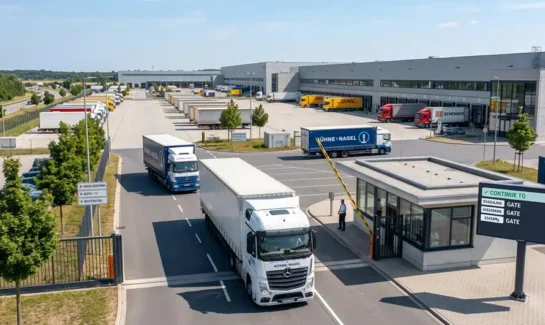
Detention vs demurrage comes down to where a shipment is delayed and which equipment is being held. Truck detention typically applies when a driver or trailer waits at a facility beyond the agreed service period. Container demurrage generally applies when an import container remains at a port terminal beyond its permitted free period. Both create avoidable logistics costs, disrupt schedules, and reduce equipment availability.
For logistics managers, the distinction matters because the solutions are different. A congested warehouse gate calls for better arrival coordination. A container stuck at a port may require faster customs clearance, documentation, or pickup coordination.
Understanding how these charges work is the first step toward controlling them.
Streamline gate check-in, dock scheduling, and yard movements to minimize delays, improve visibility, and avoid unnecessary charges.
Detention vs Demurrage: What Is the Difference?
Detention and demurrage are time-based logistics charges, but their exact definitions depend on the transport mode, applicable tariff, and contractual agreement. The terminology can also vary between trucking and ocean shipping.
Truck detention definition
Truck detention occurs when a driver or vehicle remains at a pickup or delivery facility longer than the agreed loading or unloading period.
For example, a truck arrives for a scheduled 10:00 a.m. delivery. The agreement allows two hours for unloading, but the vehicle cannot leave until 2:00 p.m. Depending on the contract, the additional waiting period may generate detention fees.
Common causes include:
- Congested receiving docks and unavailable unloading teams.
- Delayed check-in or incomplete shipment documentation.
- Trailers waiting for an available dock door.
- Poor coordination between warehouse operations and transport providers.
Truck detention time is usually calculated using agreed arrival, service, and departure events. Some contracts exclude early arrivals, driver-caused delays, or specific waiting periods.
Truck detention is a contractual charge for keeping transport equipment or a driver beyond an agreed service window.
Container demurrage definition
Container demurrage generally applies when an ocean container remains inside a marine terminal beyond the permitted free period.
Shipping lines establish free-time allowances through their tariffs or service agreements. Once the allowance expires, additional days may generate demurrage charges.
Consider an import container discharged at a port. The shipping agreement allows five days before charges begin. If customs clearance or transport arrangements delay pickup beyond that period, the responsible party may receive a demurrage invoice.
The exact calculation depends on the governing agreement, terminal calendar, applicable regulations, and relevant exceptions.
Container demurrage is generally associated with container dwell at a terminal after the permitted free period expires.
Related terms: storage, per diem, and free time
Several related terms appear on freight invoices, but they describe different services and obligations.
- Free time: The agreed period during which equipment or terminal space can be used without the relevant time-based charge.
- Last free day: The final day of the applicable free period before additional charges begin.
- Per diem: A daily equipment-use charge, often associated with keeping a shipping line’s container outside the terminal beyond the allowed period.
- Storage charge: A fee assessed for occupying terminal or warehouse space, potentially separate from shipping-line demurrage.
In ocean freight, detention often refers to containers held outside the terminal after pickup. This differs from truck detention, which concerns waiting during loading or unloading.
Container storage and equipment-use fees may also be billed by different parties. An invoice should therefore be checked against the relevant tariff rather than judged by its label alone.
Comparison table by asset, location, clock, and payer
| Factor | Truck detention | Container demurrage |
|---|---|---|
| Primary asset | Truck, trailer, and sometimes driver | Shipping container |
| Typical location | Warehouse, distribution center, factory, or customer facility | Port or container terminal |
| Clock starts | According to the agreed arrival or appointment rules | According to the applicable terminal or shipping-line free-time rules |
| Charge begins | After the contractual service allowance expires | After the permitted terminal period expires |
| Common causes | Dock congestion, slow loading, check-in delays | Customs holds, documentation issues, delayed pickup |
| Typical billing party | Motor carrier | Ocean carrier or other authorized billing party |
| Potential payer | Shipper, consignee, broker, or another contracted party | Merchant, consignee, or another party responsible under the agreement |
| Main prevention measure | Better dock and yard coordination | Earlier release preparation and container pickup |
The table describes common arrangements, not universal billing rules. Liability and charge calculations must be checked against the governing contract and tariff.
Why Detention and Demurrage Charges Occur
These charges usually arise when physical operations, transport schedules, and administrative processes fall out of sync. The delay may originate inside a facility, at a terminal, or somewhere outside either party’s direct control.
Appointment bunching and gate queues
When too many trucks arrive within the same short period, gate and dock capacity becomes overloaded.
A distribution center may have enough unloading capacity for 40 vehicles across a shift but not for 15 trucks arriving simultaneously. The resulting queue increases carrier waiting time even if the daily workload appears manageable.
Early arrivals, late deliveries, and overlapping appointments can make the situation worse.
Missing paperwork or shipment data
A vehicle may reach the facility on time but remain idle because the shipment cannot be processed.
Common problems include incorrect purchase order references, missing delivery appointments, mismatched container numbers, or incomplete customs documents.
In international freight, an incorrect bill of lading or an unresolved release requirement can prevent cargo collection.
A truck that arrives on time can still incur detention costs when shipment information is incomplete.
Dock, labor, and equipment constraints
Warehouse operations depend on several resources being available simultaneously: a dock door, personnel, handling equipment, and sufficient storage space.
A shortage in any one area can stop the entire process.
For instance, a forklift breakdown may delay unloading even when the assigned dock is available. Similarly, an overloaded staging area can prevent the warehouse from receiving additional goods.
These dock delays can spread across subsequent appointments.
Poor trailer or container visibility
Without reliable status information, teams struggle to determine which equipment is waiting, being processed, or ready for departure.
A trailer may already be unloaded but remain parked because dispatchers have not received an update. A container may be available for pickup, yet the transport provider has not been informed.
Poor visibility turns small coordination failures into longer delays.
External disruptions and disputed responsibility
Not every delay originates with the warehouse or transport provider.
Weather, customs inspections, terminal closures, road restrictions, and labor disruptions can interfere with normal operations.
Responsibility becomes complicated when multiple organizations contribute to the delay. Accurate event records are essential for determining whether a charge is valid and whether an exception or dispute applies.
How These Costs Affect Operations
Detention fees logistics teams encounter are more than isolated invoice items. Persistent delays affect transport procurement, warehouse productivity, and the reliability of customer deliveries.
Direct charges and administrative work
The most visible impact is financial.
Organizations may incur detention, demurrage, container storage, and other accessorial charges. The amounts depend on contract terms, equipment type, location, and duration.
Additional work follows each disputed invoice. Logistics personnel must retrieve timestamps, contact service providers, review tariffs, and establish responsibility.
These administrative activities consume resources even when a charge is eventually reversed.
Carrier relationships and capacity
Repeated waiting makes a facility less attractive to transport providers.
Drivers and equipment tied up at congested locations cannot serve other loads. Carriers may respond by adjusting rates, limiting available capacity, or prioritizing more efficient facilities.
During peak periods, these consequences can be particularly disruptive.
Unpredictable loading and unloading times reduce the effective capacity of a transport network.
Warehouse throughput and customer service
When inbound trucks occupy docks longer than planned, outbound movements may be delayed.
The warehouse can experience:
- Missed dispatch windows and delivery commitments.
- Congested staging areas and higher yard dwell time.
- Increased overtime and inefficient labor allocation.
- Reduced flexibility during demand peaks.
The operational impact can extend well beyond the shipment that originally caused the delay.
How to Measure the Problem
Effective cost reduction begins with reliable operational data. Companies need to establish when a delay occurred, how long it lasted, and which circumstances caused it.
Build an event timeline from arrival to departure
A complete truck movement record should capture the key operational milestones.
Example: truck movement event timeline
- 09:45 — Gate arrival: Vehicle reaches the facility
- 10:00 — Check-in: Driver and shipment details verified
- 10:50 — Dock assignment: Vehicle directed to a door
- 11:05 — Service begins: Unloading starts
- 12:20 — Service completed: Goods unloaded and confirmed
- 12:40 — Gate departure: Vehicle leaves the facility
Illustrative timeline. Total on-site time is 2 hours 55 minutes; billable time depends on the contract.
These timestamps help distinguish waiting before service, active handling time, and delays after completion.
Separate controllable and external delay
Every significant delay should receive a reason code.
Facility-controlled causes might include dock unavailability, labor shortages, or internal paperwork errors.
External causes may include late carrier arrival, customs inspection, severe weather, or terminal restrictions.
Some events involve shared responsibility. Rather than assigning blame automatically, the organization should preserve the evidence needed to evaluate each case.
Track dwell by facility, carrier, load type, and reason code
Average dwell time alone can hide recurring operational problems.
A better approach segments results by location, transport provider, shipment category, shift, and delay reason.
Useful metrics include average and median dwell, 90th-percentile dwell, percentage of visits exceeding contractual allowances, and total disputed charges.
Comparing these measures over time reveals whether operational changes are working.
Validate invoices against operational timestamps
Invoices should be matched to actual event records and the applicable billing rules.
For truck movements, compare arrival, service, and departure timestamps with the contractual allowance.
For containers, verify discharge, availability, release, pickup, and return events where relevant.
A charge cannot be reliably validated without both operational timestamps and the governing billing terms.
How to Reduce Truck Detention
The most effective way to reduce detention fees is to prevent avoidable waiting before it develops. This requires coordination between appointment planning, gate operations, warehouse teams, and transport providers.
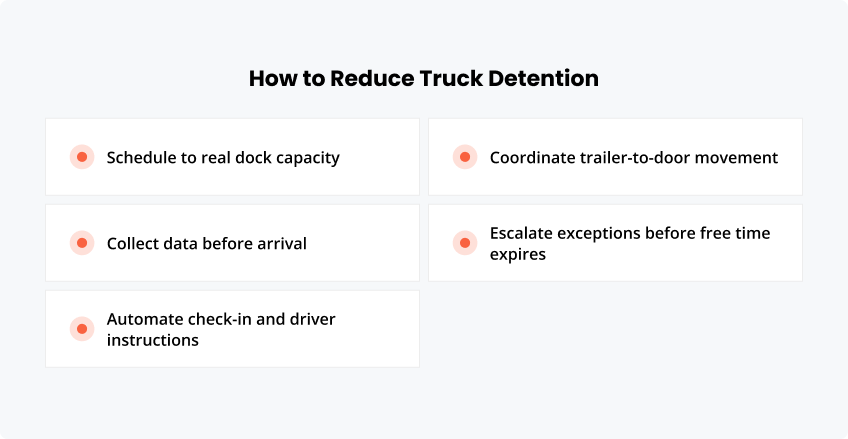
Schedule to real dock capacity
Appointment scheduling should reflect actual handling capacity rather than the number of available time slots.
A facility must account for labor availability, shipment complexity, dock equipment, and expected unloading duration.
For example, a full truckload requiring manual unloading should not necessarily receive the same service allowance as a palletized delivery.
Dynamic scheduling and realistic capacity buffers help prevent appointment bunching.
Collect data before arrival
Shipment information should be verified before the truck reaches the gate.
Pre-arrival processes can collect vehicle registration, driver details, appointment references, cargo information, and required documentation.
When information is incomplete, the responsible team can resolve the issue before arrival instead of keeping a vehicle waiting.
This also reduces repetitive administrative work at the entrance.
Automate check-in and driver instructions
Manual gate procedures can become bottlenecks during busy periods.
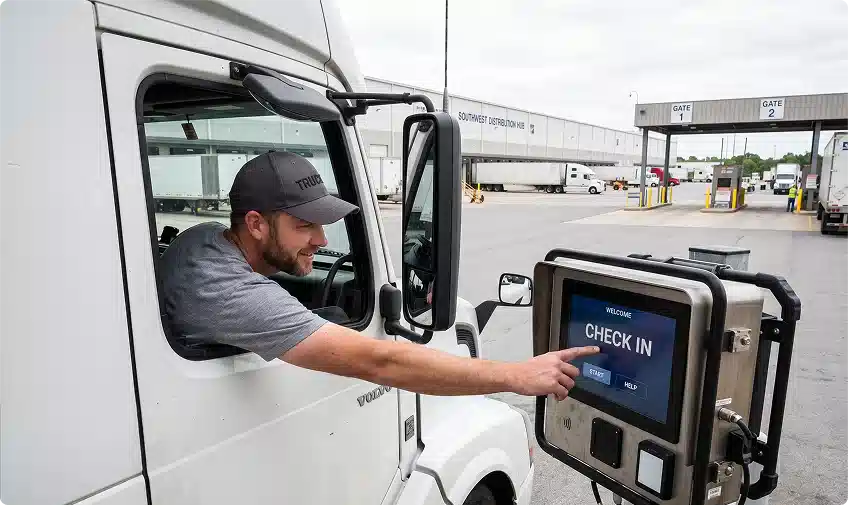
Digital check-in allows drivers to submit required information through a kiosk or another supported interface. Depending on the system, the process can include identity verification, appointment confirmation, and delivery instructions.
Clear communication is equally important. Drivers should know where to park, which dock to approach, and when to move.
Coordinate trailer-to-door movement
A truck may pass through the gate quickly but still spend hours waiting in the yard.
Coordinating trailer locations, dock availability, and yard movements helps reduce this hidden idle time.
For drop-and-hook operations, dispatchers also need to know when a trailer is loaded, unloaded, or ready for collection.
Escalate exceptions before free time expires
Waiting-time alerts should provide enough lead time for corrective action.
If a vehicle is approaching its contractual allowance, supervisors can prioritize unloading, reassign a dock, or communicate with the transport provider.
The objective is to intervene while the delay is still manageable, rather than investigate it after receiving an invoice.
Bring scheduling, gate workflows, live coordination, and connected self-service into one operational process.
How to Reduce Container Demurrage
Reducing container demurrage requires close coordination between shipping lines, terminal operators, customs brokers, freight forwarders, and inland transport providers.
Unlike warehouse detention, the critical events often occur across several independent organizations.
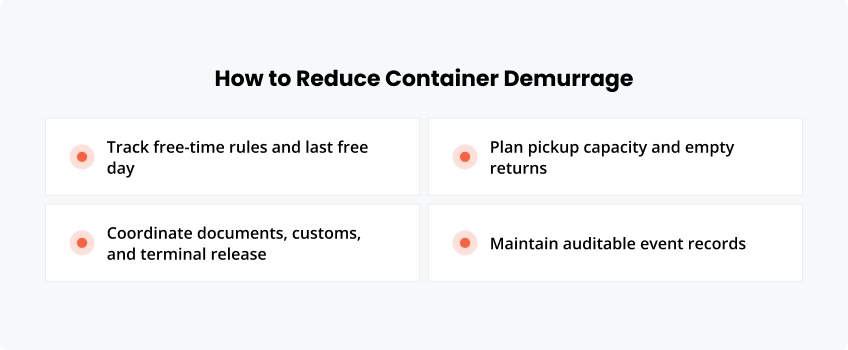
Track free-time rules and last free day
Each shipment should have a clearly recorded free-time allowance and last free day.
The calculation must reflect the relevant shipping-line agreement, terminal rules, equipment type, and applicable calendar.
Operations teams should not assume that all carriers use the same start dates or count weekends and holidays identically.
Automated reminders can help prioritize containers approaching their deadlines.
Coordinate documents, customs, and terminal release
Cargo cannot always be collected immediately after vessel discharge.
Release may depend on customs clearance, payment status, shipping documentation, and terminal requirements.
Teams should verify these prerequisites before arranging pickup.
Where possible, document checks and release preparation should begin before the vessel arrives.
Plan pickup capacity and empty returns
Pickup planning should account for terminal appointments, trucking availability, warehouse receiving capacity, and delivery distance.
After the container is unloaded, equipment return deadlines must also be monitored.
A shipment may avoid terminal demurrage but still incur per diem charges if the empty container is returned late.
These are separate operational risks and should be tracked accordingly.
Maintain auditable event records
Disputes require more than a general explanation that a container was unavailable.
Relevant evidence may include terminal availability notices, customs release timestamps, pickup appointments, gate transaction records, and equipment return receipts.
In European logistics, detention and demurrage disputes should be assessed against the applicable shipping-line tariffs, contractual terms, and documented operational events. FIATA’s best-practice guidance provides additional recommendations for transparent billing and dispute resolution.
Container charge disputes are stronger when the event history identifies exactly when equipment became available and what prevented collection.
Role of Yard Management Technology
Yard management technology helps logistics teams coordinate vehicle arrivals, gate processing, trailer movements, and dock operations. A yard management system (YMS) creates a more consistent view of what is happening across the facility.
Rather than relying on phone calls, spreadsheets, and manual status updates, teams can use connected operational records to identify delays and respond earlier.
Dock scheduling and arrival smoothing
Digital dock scheduling connects transport appointments with available handling capacity.
Scheduling software can help distribute arrivals across shifts, assign appropriate service windows, and identify conflicting bookings.
For facilities handling mixed freight, appointment rules can account for vehicle types, unloading requirements, and available resources.
The result is a more predictable flow of trucks through the facility.
Gate timestamps and status visibility
Digital gate processes provide a structured record of vehicle arrivals and departures.
Solutions such as friendlyway offer technology for digital gate processes and logistics coordination. Depending on the implemented configuration, these workflows can support driver registration, check-in, and communication at facility entrances.
Connecting gate events with warehouse and transport systems can create a more complete operational timeline.
The goal is to establish a reliable record of vehicle movements rather than depend on handwritten logs or reconstructed timestamps.
Alerts, analytics, and reason codes
A connected yard management environment can help organizations monitor dwell time and identify operational bottlenecks.
Relevant functions to evaluate include:
- Alerts for vehicles approaching contractual waiting limits.
- Dashboards showing current vehicle and trailer status.
- Reason codes for delayed loading, unloading, or departure.
- Historical reporting by facility, shift, and transport provider.
- Integration with transportation management systems (TMS) and warehouse management systems (WMS).
These capabilities depend on the selected product, integrations, and implementation. They should not be assumed to exist in every YMS.
The greatest value of yard visibility is the ability to identify and address delays before they become expensive.
Limits: technology cannot remove every external delay
Even sophisticated yard management software cannot prevent every detention or demurrage charge.
Customs inspections, severe weather, terminal closures, and unexpected transport disruptions remain outside a warehouse operator’s control.
Technology can nevertheless improve the response. Reliable timestamps, clear communication, and documented exceptions make it easier to investigate incidents and establish responsibility.
For organizations considering a new system, the priority should be measurable improvements in coordination, data quality, and operational decision-making.
Conclusion
Reducing detention and demurrage costs requires more than negotiating better rates. Logistics teams need to understand where time is lost, identify preventable delays, and coordinate the parties involved.
Start by reviewing operational timestamps and recurring delay reasons. Then address the largest bottlenecks through realistic appointment planning, earlier document verification, clearer driver communication, and better yard visibility.
For warehouse and distribution operations, digital gate processes and coordinated yard management provide a practical foundation. The aim is not simply to avoid individual invoices but to build a more predictable, efficient flow of vehicles and goods.
Sources
FIATA — Best Practice Guide on Demurrage and Detention
European Commission — Electronic Freight Transport Information (eFTI)
European Commission — Digital Transport and Logistics Forum (DTLF)
FAQ
Truck detention usually refers to a vehicle or driver waiting beyond the agreed loading or unloading period at a facility. In ocean freight, demurrage generally applies when a container remains at a terminal beyond its permitted free period. Ocean detention, by contrast, commonly applies when equipment is held outside the terminal too long. Exact definitions and billing rules depend on the relevant agreement.
The party responsible for detention charges depends on the transport agreement, applicable tariff, and circumstances of the delay. In European road freight, the shipper, consignee, freight forwarder, or another contracted party may bear the cost. In container shipping, responsibility follows the relevant shipping-line agreement. Companies should verify contractual terms and documented events before accepting an invoice.
Free time is the agreed period during which a truck, trailer, or shipping container may remain at a specified location without triggering the relevant time-based fee. In trucking, it often refers to the loading or unloading allowance. In ocean freight, it commonly describes permitted container use or terminal dwell. The duration and calculation method depend on the contract or tariff.
No. A YMS can reduce avoidable waiting through better appointment coordination, gate visibility, and yard movement planning. However, it cannot eliminate delays caused by customs inspections, weather, road closures, or other external disruptions. Its effectiveness also depends on accurate data, operational discipline, and integration with existing systems. The realistic objective is fewer preventable delays, not zero charges.
A dispute should include the applicable contract or tariff, appointment confirmation, arrival and departure timestamps, and relevant service records. Depending on the shipment, useful evidence may include gate logs, dock activity, proof of delivery, container availability notices, customs release information, and equipment return receipts. Reason codes and communications help explain why the delay occurred and which party could control it.