
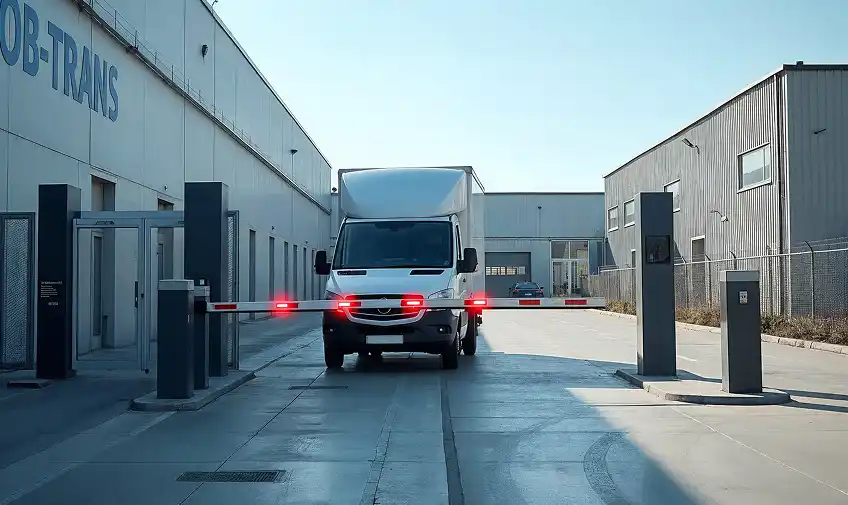
A truck can cross a continent in perfect sequence and still lose the day in the last 200 metres.
That final stretch matters more than many businesses admit. It is the yard: the space between the public road and the warehouse door, between transport planning and warehouse execution, between “arrived” and “actually handled.” When that space is poorly managed, everything backs up. Drivers wait. Dock doors sit idle. Warehouse teams chase trailers that are already on site but effectively invisible.
For years, companies treated the yard as a grey zone. Not quite transport. Not quite warehousing. Just operational spillage. That view no longer works. In a supply chain shaped by tighter margins, shorter delivery windows, and constant pressure on labour, yard management has become a front-line discipline.
Key Takeaways at a Glance
- Yard management controls the flow of trucks, trailers, drivers, and assets across a facility’s outdoor operations area.
- A yard management system brings order to that activity through scheduling, gate check-in, trailer tracking, dock assignments, and reporting.
- Better yard visibility helps reduce delays, detention, and demurrage, manual errors, and unnecessary radio traffic.
- A strong YMS connects the yard with transport, warehouse, ERP, security, and communication systems.
- The result is faster truck turnaround, better dock utilisation, and a calmer overall operation.
What Is Yard Management?
The simplest definition is still the best: yard management is the orchestration of everything that happens to vehicles and trailers from the moment they enter a site until they leave it again.
That sounds straightforward. It is not.
Definition in logistics and supply chain operations
In logistics yard operations, yard management covers gate arrivals, digital registration, trailer parking, yard moves, dock assignments, check-out, and the information that ties those steps together. It is the operating logic for a space that is often busy, exposed, and time-sensitive.
The role of the yard between transportation and warehousing
The yard sits in the middle of a handover that many companies still underestimate. A transport team may mark a load as delivered. A warehouse team may still be waiting for it. Until the right trailer reaches the right dock at the right time, freight is on site but not operationally available.
Why yard operations impact costs and efficiency
This is where the hidden costs pile up. A late gate check-in can delay unloading. A misplaced trailer can waste labour. A door assigned to the wrong load can push outbound schedules off course. In a chilled-food operation, that delay can threaten product integrity. In manufacturing, it can starve a production line. In e-commerce, it can turn next-day promises into apology emails.
What Is a Yard Management System (YMS)?
Once the yard gets busy enough, memory stops being a system. So do phone calls, paper notes, and whiteboards.
Yard management system definition
A yard management system is software designed to manage and optimise yard activity. It gives logistics teams a live picture of who is arriving, what is waiting, where assets are located, which docks are available, and what should happen next.
How a YMS digitizes yard operations
A YMS system digitizes tasks that are often handled manually, such as carrier appointment scheduling, gate check-in, trailer yard management, dock door management, dispatching yard moves, and performance reporting. It replaces fragmented updates with one operational view.
YMS vs WMS vs TMS: Key differences
The distinction matters.
- A TMS manages freight on the road.
- A WMS manages goods inside the building.
- A YMS manages the territory in between.
That “in between” is where many real-world delays begin. Not because the software landscape is weak, but because the handoff is weak.
Cloud-based vs on-premises YMS
Cloud-based yard management software tends to suit modern operations. It is faster to deploy, easier to scale, and better aligned with multi-site visibility. On-premises systems still have their place, especially in tightly controlled IT environments, but they usually demand more effort to maintain.
Connect gate check-in, digital workflows, and live site communication to reduce queues, errors, and avoidable delays.
How a Yard Management System Works
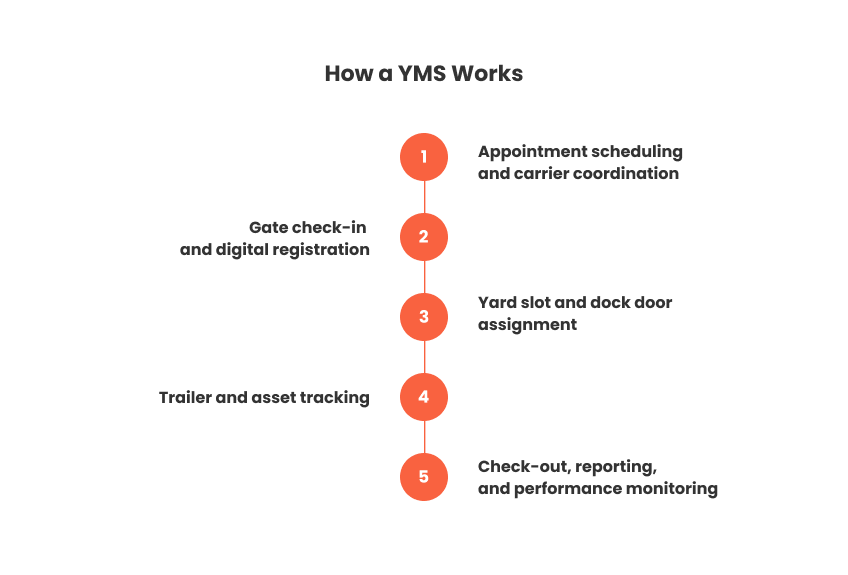
A good YMS follows the vehicle journey from the booked appointment to the final exit. It does not remove complexity. It makes complexity visible and manageable.
Appointment scheduling and carrier coordination
The process often begins before a truck reaches the gate. Carriers book time slots in advance, sometimes through self-service portals. This spreads arrivals more evenly and helps planners match inbound flow with labour and dock capacity.
A large grocery supplier, for example, may receive ambient, chilled, and frozen loads within the same morning window. Without structure, the yard becomes a queue. With appointment control, it becomes a schedule.
Gate check-in and digital registration
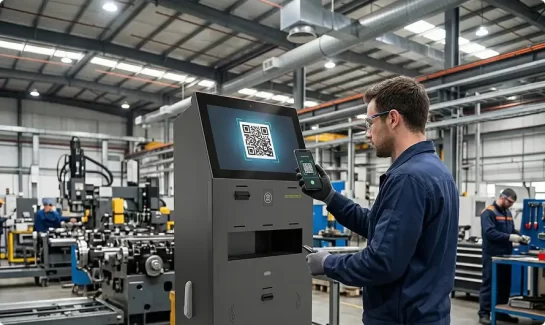
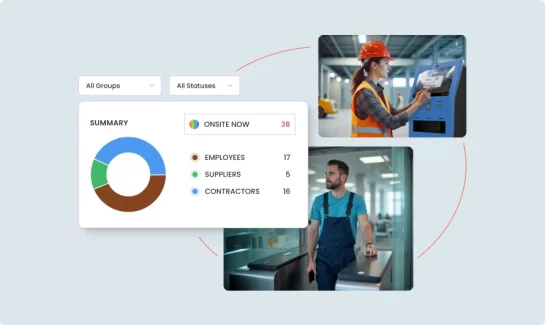
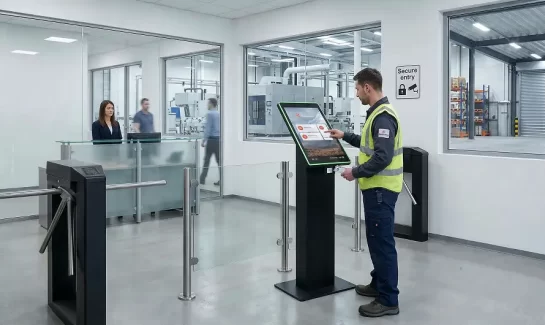
Upon arrival, drivers register through a gate check-in system. That may involve appointment validation, licence plate capture, language-specific instructions, and safety acknowledgements. Integrated with visitor management, the same workflow can handle contractors and service providers without creating separate processes.
Yard slot and dock door assignment
After check-in, the system assigns a waiting area, parking slot, or dock door based on rules. Some loads need immediate handling. Some can wait. Some require specific doors, temperature zones, or warehouse teams. A YMS makes those decisions faster and with fewer errors.
Trailer and asset tracking
This is where the value becomes obvious. Real-time trailer tracking gives teams immediate yard visibility. They can see what is on site, where it is parked, how long it has been idle, and whether it is ready for the next move.
In practical terms, that means less searching. A yard jockey is not sent on a scavenger hunt. A warehouse supervisor is not making three calls to find one urgent load.
Check-out, reporting, and performance monitoring
When the vehicle leaves, the system closes the loop. Arrival time, service time, dwell time, exceptions, and departure are recorded. Over weeks and months, that data shows what is really slowing the site down. Not assumptions. Patterns.
Core Features of a Yard Management System
Not every facility needs the same setup. A regional warehouse and a multi-site industrial campus have different pressures. Still, the core functions are remarkably consistent.
Real-time yard visibility dashboard
The dashboard is the control room. It shows arrivals, waiting vehicles, trailer locations, dock status, exceptions, and service times in one view. Without that, teams work from fragments.
Dock scheduling and optimization
Dock scheduling software helps sites assign doors more intelligently. The goal is not simply to fill every slot. It is to sequence work so that the right goods reach the right team at the right moment.
Automated notifications and alerts
A good YMS tells people what they need to know when they need to know it. Drivers receive instructions. Warehouse staff get updates when a trailer is ready. Supervisors see alerts when dwell times creep upward.
Access control and security management
The yard is also a security zone. Vehicle access, contractor registration, audit trails, and route guidance all matter. Combined with kiosks, a digital process can be both tighter and faster.
Integration with ERP, WMS, and TMS
A YMS should not be an island. It works best when it shares data with transport systems, warehouse systems, ERP platforms, and on-site communication tools such as digital signage.
Mobile access for yard staff
Yard work happens outdoors, in motion, often under pressure. Mobile access lets staff update statuses, confirm moves, and respond in real time without returning to a fixed desk.
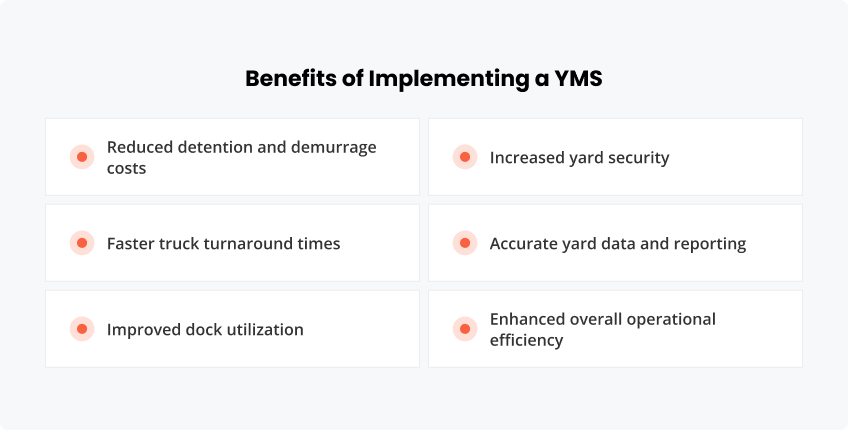
Benefits of Implementing a Yard Management System
The benefits are rarely dramatic on paper. On site, they feel dramatic very quickly.
Reduced detention and demurrage costs
Fewer waiting hours mean fewer penalties. A YMS shortens idle time by making appointments, assignments, and movements more precise.
Faster truck turnaround times
Drivers get through the gate faster. Trailers reach doors faster. Departures happen with fewer surprises. That improves throughput without expanding the yard footprint.
Improved dock utilization
Many operations think they need more doors when what they really need is better orchestration. Smarter sequencing makes existing capacity work harder.
Increased yard security
Digital logs create traceability. Teams know who entered, when they arrived, what they handled, and when they left. That supports both compliance and incident response.
Accurate yard data and reporting
A clipboard records an event. A YMS records a process. That difference matters when managers need reliable data for planning, carriers’ reviews, or continuous improvement.
Enhanced overall operational efficiency
When transport, yard, and warehouse teams share a single operational truth, friction falls. Calls drop. Guesswork shrinks. The day becomes more predictable.
Challenges of Yard Management Without a YMS
Most unmanaged yards do not look chaotic from a distance. The inefficiency hides in motion.
Manual and paper-based tracking
Manual systems break first at the edges. A missed update here. A wrong trailer number there. By midday, nobody is quite sure which version is correct.
Lack of real-time yard visibility
Without live visibility, everything takes longer. Staff searches for assets. Drivers wait for directions. Supervisors escalate problems they cannot fully see.
Communication gaps between the yard and the warehouse
The yard says the trailer is ready. The warehouse says no slot is available. The truth is somewhere in between, and the load sits still while both sides improvise.
Higher risk of delays and errors
Missed appointments, wrong dock assignments, duplicate yard moves, forgotten trailers. These are not unusual failures. They are ordinary failures, which is precisely why they are so costly.
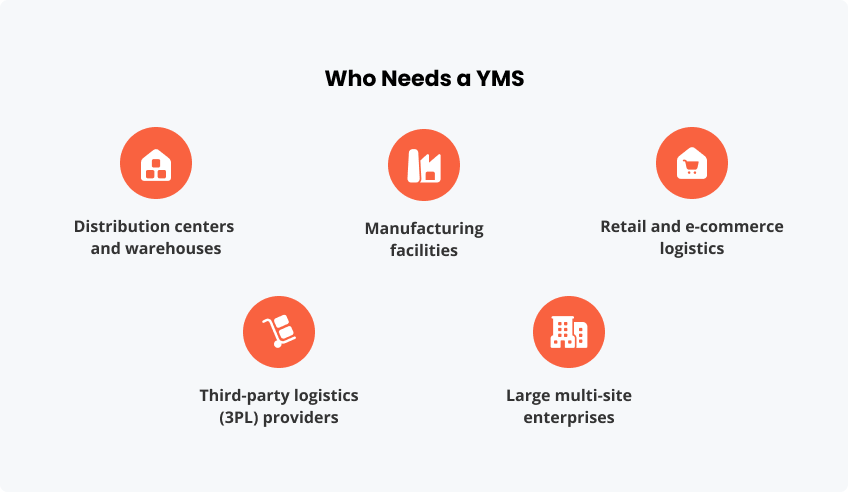
Who Needs a Yard Management System?
Not only giant distribution campuses. Not only global brands. The trigger is simpler: regular site traffic plus operational pressure.
Distribution centers and warehouses
High volume, tight schedules, constant dock competition. These sites gain quickly from better yard operations management.
Manufacturing facilities
In manufacturing, the yard is closely tied to continuity. Late materials can stop production. Delayed outbound loads can disrupt customer delivery windows.
Retail and e-commerce logistics
Retail and e-commerce live on peaks: Black Friday, promotions, seasonal inflows, returns. A weak yard process buckles fast under those conditions.
Third-party logistics (3PL) providers
3PL operators need clean supply chain visibility across customers, carriers, and contracts. A YMS helps them deliver that consistently.
Large multi-site enterprises
For multi-site businesses, standardisation matters. One approach to check-in, trailer tracking, and reporting is easier to scale than six local workarounds.
How to Choose the Right Yard Management System
The best system is not the one with the longest feature list. It is the one that fits how the site actually works.
Scalability and multi-site support
Look for software that can support a single facility now and a broader network later.
Integration capabilities
A YMS should slot into the wider stack, not sit beside it in operational isolation.
Ease of use and yard automation
If the workflow is clumsy, people will route around it. Simplicity is not a luxury feature. It is adoption.
Security and compliance
Role-based access, auditability, and clear process control are essential, particularly in regulated environments.
Vendor support and implementation process
Rollout matters. Training matters. So does practical guidance from a vendor that understands the site reality, not just the software menu.
Implementing a Yard Management System
The strongest implementations begin with a simple question: where, exactly, is time being lost?
1. Operational audit and needs assessment
Map the current flow from booking to check-out. Find the waiting points. Measure the handoff failures.
2. Pilot testing and gradual rollout
A pilot allows teams to refine rules and workflows before scaling across the site or network.
3. Staff training and change management
The system has to make sense to the people using it under pressure. Training must be practical, short, and role-specific.
4. KPI monitoring and continuous optimization
Track dwell time, turnaround time, dock utilisation, and exceptions after launch. Then adjust. Good warehouse yard management is never static.
Use self-service registration, live updates, and clear on-site guidance to connect drivers, staff, and operations.
The yard used to be treated as operational background noise. It is not. It is a pressure point, a visibility gap, and, when managed well, a serious competitive advantage. Companies that digitize this space do not just move trucks more cleanly. They connect the road to the warehouse with fewer blind spots and less friction.
In modern logistics, that is no small upgrade. It is the difference between motion and control.
FAQ
Yard management is the process of coordinating vehicles, trailers, and dock activity on site. A yard management system is the software used to support and optimize that process.
It reduces waiting through better scheduling, faster gate processing, smarter dock assignments, and stronger real-time visibility.
Yes. Most modern YMS platforms are designed to integrate with WMS, TMS, ERP, and related operational tools.
Yes. Even smaller sites can benefit if they have recurring truck traffic, limited dock capacity, or manual check-in processes.
That depends on the size of the facility, the number of integrations, and whether the rollout begins with a pilot or a full deployment.