
A factory can lose an hour without anyone noticing — not because a line crashes. Because 10 operators arrive 3 minutes late, 2 temporary workers wait at the wrong entrance, 1 machine sits idle during a handover, and a supervisor only sees the full picture at the end of the week. That is the real cost of poor time tracking for manufacturers: not one dramatic failure, but a hundred small blind spots that quietly drain productivity.
Modern manufacturing cannot run on paper timesheets, guesswork, or delayed reports. It needs real-time time tracking. The kind that shows who is on site, where labor is being used, how shift time is flowing, and where bottlenecks begin. When time data becomes visible, factory managers stop reacting late and start making decisions while the shift is still moving.
At a Glance
- Time tracking gives manufacturers a live view of attendance, labor allocation, and production support activities.
- Traditional timekeeping creates delays, errors, and blind spots during shift changes, overtime, and contractor management.
- Modern systems combine employee check-in for factories, dashboards, alerts, and integrations with ERP, MES, HR, and access workflows.
- The biggest gains usually come from better resource planning, cleaner payroll data, stronger compliance, and faster response to disruptions.
- In manufacturing, the best systems are simple on the shop floor and powerful in the background.
Why Time Tracking Matters in Manufacturing
Manufacturing lives on rhythm. Shift starts. Breaks. Changeovers. Maintenance windows. Delivery slots. If time data arrives late, management decisions arrive late too.
Challenges of traditional timekeeping systems
Manual time capture looks harmless until volume hits.
A simple sheet of paper at one entrance may work for a ten-person workshop. It breaks down in a large plant with multiple gates, temporary workers, and rotating shifts. Handwritten records are easy to miss, hard to audit, and almost impossible to analyze in real time.
The same problem appears with disconnected digital tools. One system logs payroll hours, while another monitors access. A spreadsheet handles overtime. A supervisor keeps separate notes on reassignments. Suddenly, factory time management becomes a reconciliation exercise instead of an operational advantage.
Why real-time data is critical for factory operations
Real-time visibility that manufacturing teams rely on is not a luxury. It is a control layer.
A production manager needs to know whether Line 3 is short-staffed now, not tomorrow. An EHS lead needs to know who is on site during an incident. A shift supervisor needs to know whether the maintenance crew actually checked in at the right zone. These are live operational questions.
friendlyway’s manufacturing-focused solutions highlight the same need: automated reporting, real-time workforce visibility, and on-site status tracking help teams react faster and manage labor more precisely.
Impact on productivity, costs, and compliance
When production time tracking software is accurate, manufacturers reduce hidden waste. Employee overtime becomes easier to control. Labor can be moved sooner. The number of billing disputes with staffing partners drops. Audit trails improve.
There is also a compliance angle. In Europe, employers must organize working time within legal limits and rest requirements under rules such as the EU Working Time Directive. Globally, the ILO’s guidance on working time and work organization reinforces the importance of managing hours, rest, and shift patterns to protect workers and support sustainable operations.
Connect check-in, attendance, and operational workflows on one platform built for physical locations.
Key Features of Modern Time Tracking Solutions
Once manufacturers move beyond basic clocking, the value grows quickly.
Real-time data collection and dashboards
The priority is speed.
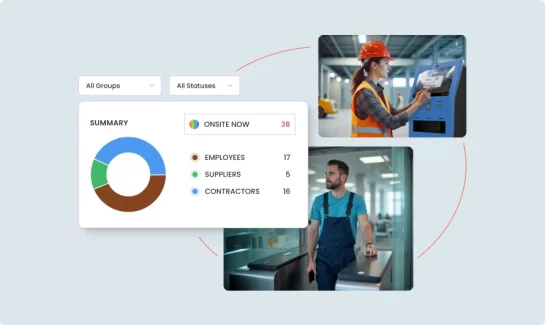
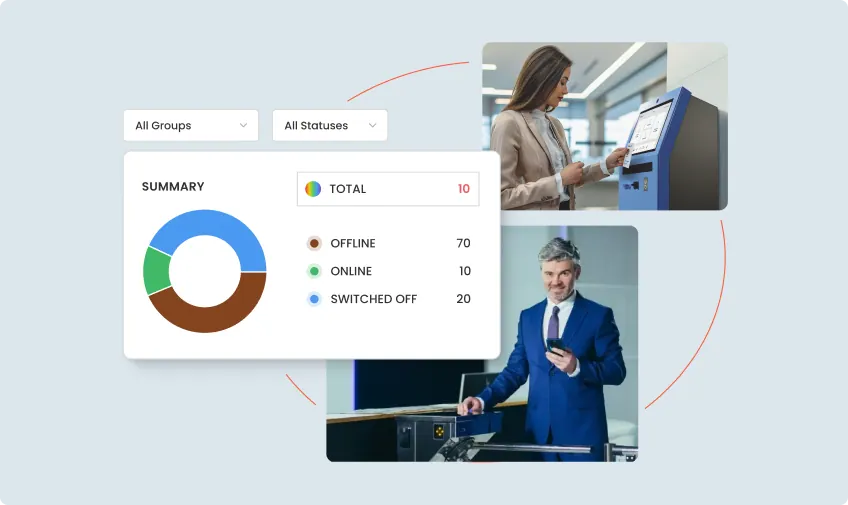
A modern digital time clock system should capture events instantly and feed them into dashboards that managers can actually use. Think live headcount by shift, late arrivals, missing check-outs, overtime risk, and labor distribution by area.
A good dashboard does not drown users in data. It answers practical questions fast:
- Who is on site right now?
- Where are gaps forming?
- Which teams are nearing overtime?
- What changed in the last hour?
Integration with machines and production lines
Labor data is useful. Connected labor data is better.
When shop floor data collection is linked to machine states, line events, or production orders, managers can compare labor time with output, downtime, and throughput. That is when time tracking stops being an HR function and becomes an operations tool.
Imagine a packaging plant where a line repeatedly underperforms during the last two hours of the night shift. Pure attendance data might look normal. Machine usage tracking may reveal the real issue: one operator is being pulled away for end-of-shift quality checks, leaving the line understaffed.
Employee check-in/check-out via kiosk or RFID
Manufacturing environments need check-in tools that are fast, simple, and durable.
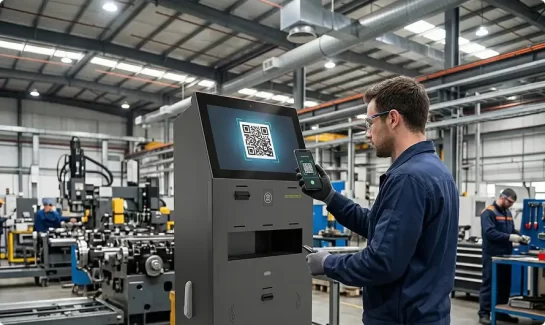
That is why employee check-in at factories often works best via a kiosk, an RFID badge, a tablet station, or a secure scan point. The experience should take seconds, even during peaks.
friendlyway supports self-service workflows through kiosks and a cloud platform designed for check-in, data capture, and process control across physical sites.
Shift planning, overtime tracking, and alerts
A strong system does more than record hours. It helps prevent bad hours.
With built-in alerts, supervisors can spot attendance gaps before they become production losses. Overtime thresholds can trigger warnings. No-shows can be escalated. Temporary workers can be routed to the correct area instead of standing idle near the entrance.
That is where automated timekeeping starts paying back every day.
Real-Time Visibility – What It Means
The phrase sounds abstract. On the factory floor, it is very concrete.
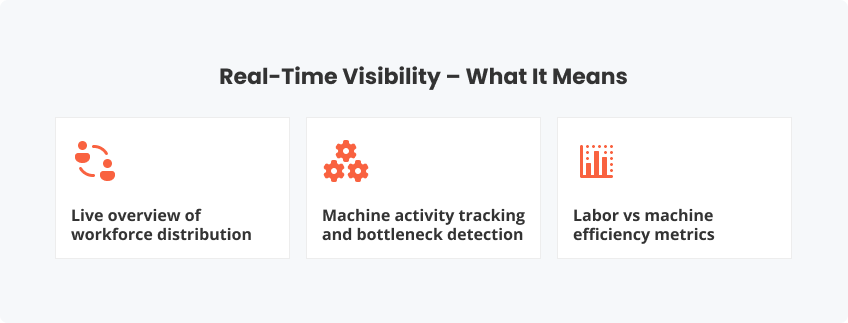
Live overview of workforce distribution
Manufacturing workforce tracking should show where people are, not just whether they showed up.
A stamp of “present” is useful for payroll. It is not enough for operations. Managers need a live overview of workforce distribution across zones, buildings, and lines.
One practical example: a plant manager notices that assembly is fully staffed, but packaging is short by three people due to reassignment after a delayed inbound shipment. With live visibility, the gap is visible immediately. Without it, the problem only appears when throughput falls.
Machine activity tracking and bottleneck detection
Real-time visibility also means seeing friction as it forms.
A single issue rarely causes a bottleneck. It is usually a chain: late check-in, slow handover, delayed setup, a short maintenance window, an idle machine, and a missed target. When time data and machine activity tracking meet, patterns become easier to spot.
This is especially valuable in high-mix environments, where different products, crew sizes, and setups can hide the root cause of lost minutes.
Labor vs machine efficiency metrics
A smart manufacturing dashboard compares effort and output.
Not to police workers. To improve planning.
For example, if labor hours increase but machine utilization stays flat, leaders can investigate setup complexity, training gaps, or scheduling friction. If machine uptime is high but output is still low, labor allocation may be off. These labor productivity insights are where real operational improvement begins.
Integration with Manufacturing Systems
No system should sit alone.
ERP, MES, and HR software integration
Production time-tracking software delivers the most value when it flows into the systems manufacturers already use.
ERP needs labor cost signals. MES needs an accurate labor context. HR needs attendance and overtime records. Payroll needs approved hours. Security needs entry logs. The operations team needs one version of the truth.
friendlyway’s platform is modular, cloud-based, and integration-friendly, with connected workflows across software and hardware touchpoints. Our broader manufacturing and workforce solutions also support multi-party staffing scenarios and centralized reporting.
Linking time tracking to production KPIs
This is the bridge many companies miss.
If time tracking exists only to process payroll, it will always feel like admin. If it links to scrap, output, downtime, first-pass yield, and order completion, it becomes part of the continuous improvement process.
That is how factory workforce monitoring helps plant leadership answer better questions:
- Why did productivity dip on Shift B?
- Why are changeovers running long in one hall but not another?
- Which staffing patterns create the best output without overtime spillover?
Role of IoT and automation in modern factories
IoT in manufacturing time tracking is not about adding complexity. It is about removing manual gaps.
Badge scans, kiosk events, gate entries, mobile approvals, and machine signals can all feed a clearer picture of what is happening on site: the more automatic the capture, the more reliable the data.

Benefits for Factory Management
The upside is broad, but three benefits stand out.
Better resource planning and cost control
Accurate time data sharpens planning.
Managers can match staffing to demand, reduce unnecessary overtime, and redeploy labor sooner. Agencies can be billed more accurately. Internal teams can see where paid hours are creating value and where they are leaking away.
Improved compliance and audit readiness
Audits are less painful when records are already clean.
That includes attendance history, contractor presence, shift logs, and proof that the required steps have happened. In manufacturing, that matters not just for labor records, but also for site security, safety procedures, and visitor or vendor workflows.
Enhanced worker accountability and transparency
The best systems make expectations clearer for everyone.
Workers know where and how to check in. Supervisors see attendance issues early. Staffing partners can work from the same data. Disputes become shorter because the record is cleaner.
That creates transparency without turning the workplace into a surveillance exercise.
How friendlyway Supports Real-Time Tracking
Manufacturers often need more than a clock. They need a reliable process around the clock.
Touchscreen terminals and self-service kiosks
friendlyway combines self-service workflows with on-site hardware, which is especially useful for manufacturing entrances, gatehouses, and production-area check-in points. That supports fast arrivals, digital acknowledgements, and structured worker flows.
Cloud platform with real-time analytics
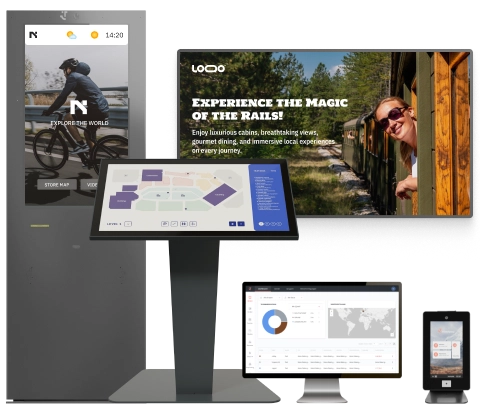
The friendlyway Cloud Platform is built to manage digital experiences and data collection across locations, while our manufacturing solutions feature real-time reporting, shift support, and workforce visibility.
Custom integrations and flexible deployment
For manufacturers with contractors, agency labor, or multiple entry points, friendlyway also offers contingent workforce management to help standardize scheduling, roster control, timesheets, and reporting across vendors. That makes it easier to connect access events, workforce processes, and operational oversight into a single flow.
A real-world example comes from Millennium Print Group. friendlyway introduced mobile scan stations across the facility to improve reporting granularity, track time spent in production areas, and increase visibility of personnel movement. That is exactly what practical real-time time tracking should do: turn scattered events into usable control.
See how self-service check-in, cloud workflows, and workforce visibility can support safer, faster manufacturing operations.
Industry Use Cases
Different plants need different workflows. The principles stay the same.
Automotive production tracking
In automotive, seconds matter. A missing operator at a station can ripple through the line. Real-time manufacturing workforce tracking helps supervisors spot gaps immediately and reassign labor before takt time suffers.
Food and beverage factory time reporting
Food and beverage sites often juggle hygiene zones, temporary labor, and strict shift timing. A time-and-attendance kiosk at controlled entry points helps standardize check-in and support compliance-friendly records without slowing throughput.
Heavy industry and logistics centers
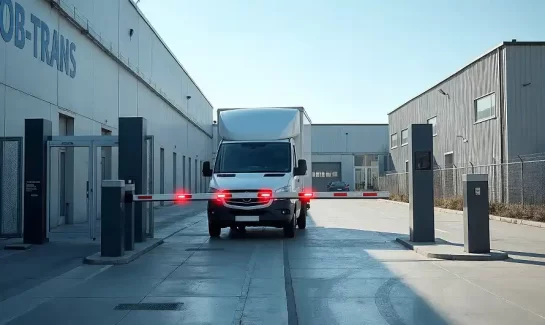
In heavy industry and logistics, workforce movement covers gates, yards, warehouses, and production areas. Real-time check-in and zone visibility help teams manage high-volume arrivals, contractor activity, and emergency accountability with greater confidence.
Cloud-based time management in manufacturing works best when it fades into the background. Workers check in quickly. Managers see what matters. Compliance records build themselves. And the factory runs with fewer blind spots. That is the real goal: not more admin, but more control.
FAQ
Common options include RFID badges, barcode scanning, biometric devices, mobile apps, tablets, and kiosk systems. In more advanced setups, these tools connect with ERP, MES, access control, and IoT data.
That depends on the platform, permissions model, and integrations. In general, manufacturers should look for role-based access, audit logs, secure cloud architecture, and clear data retention policies.
Yes. It will not fix machine failures on its own, but it can reveal staffing gaps, delayed handovers, late starts, and zone-level attendance issues that often contribute to downtime.
It varies by scope. A simple kiosk-based check-in flow can move faster than a full multi-site rollout with ERP, MES, and staffing integrations. The key is to start with one high-impact workflow and expand from there.
Yes. In fact, this is one of the biggest use cases in manufacturing. The right system can handle agency labor, contractor check-in, roster validation, timesheets, and reporting without forcing teams back into spreadsheets.