
(Prefer videos? Watch a brief summary of this article below.)
A fire alarm goes off. People move fast. Supervisors reach the assembly point and face the question nobody wants to answer from memory: who is still inside? In that moment, an emergency mustering system stops confusion from becoming a second risk.
Key Facts at a Glance
- An emergency mustering system gives you a live view of who is safe, who is missing, and who still needs confirmation.
- It replaces paper roll calls with digital evacuation tracking and real-time emergency check-in.
- It helps manage employees, contractors, and visitors through a single process.
- It supports faster decisions during fires, gas leaks, security incidents, and drills.
- It strengthens workplace evacuation management, reporting, and day-to-day preparedness.
What Is an Emergency Mustering System?
The basic idea is simple. When people leave a building or worksite during an incident, the system helps your team confirm who has left and who may still need assistance.
Definition and core function
An emergency mustering system is a digital tool for employee mustering and emergency headcounting. It creates an active list of people on-site and updates that list as they check in at a safe location.
That matters most in facilities where occupancy fluctuates throughout the day. Think employees on rotating shifts, delivery drivers entering and leaving, or contractors working in restricted zones.
Traditional methods vs digital mustering
Many facilities still rely on printed lists or verbal roll calls. That can work in a small office. It breaks down much faster in a warehouse, plant, or campus with multiple exits.
Digital mustering is different because it turns a manual process into a shared, live one. Instead of several supervisors comparing notes, a single system displays the same status to security, EHS, and floor leaders simultaneously.
Use cases in high-risk industries
This is where the value becomes obvious.
A chemical site, for example, may have maintenance crews, third-party technicians, and office staff all on-site at once. A paper list from the morning no longer reflects reality by mid-afternoon. An emergency assembly point system helps teams respond to what is happening now, not what was true hours ago.
Key Components and Technologies
A modern solution does not depend on one single device. It works best as a combination of hardware, software, and process design.
RFID badges and wearable trackers
An RFID evacuation system allows fast, low-friction check-in at a muster point. Employees tap a badge, contractors scan a temporary pass, and supervisors get instant visibility.
In tougher environments, wearable tags can also help. This is useful in large yards, energy sites, or outdoor operations where people may gather at different points.
Self-check-in and mobile app support
Not every site wants the same workflow. Some prefer supervised check-in at a kiosk. Others need mobile support for dispersed teams or remote contractors.
That flexibility is important. A logistics center, refinery, and public building do not evacuate the same way, so the check-in method should match the site rather than forcing everyone into a single model.
Real-time dashboards and location data
Evacuation monitoring tools are the control room view. They show who is accounted for, which groups are still open, and where supervisors should focus attention.
This is also where digital evacuation tracking becomes more useful than a simple attendance list. Decision-makers can see the situation developing rather than waiting for fragmented updates.
Integration with access control and fire alarm systems
The strongest mustering platforms connect with the rest of the building ecosystem. Fire alarms can trigger workflows. Access control can help confirm who was on-site. Visitor data can close the gap for guests who would otherwise be missed.
That is one reason friendlyway’s emergency mustering and evacuation tracking fits naturally into a broader safety strategy with connected tools such as visitor management and wayfinding software.
Bring employees, contractors, and visitors into one live evacuation workflow.
Benefits of Using a Mustering System
The biggest benefit is not the dashboard. It is clarity under pressure.
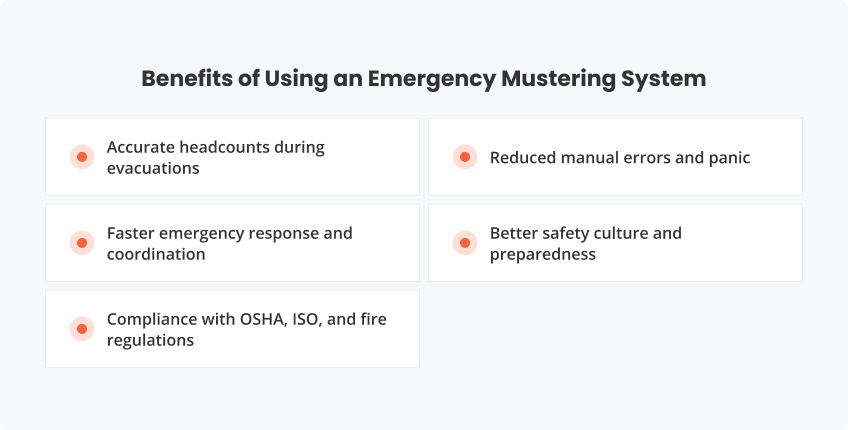
Accurate headcounts during evacuations
A good emergency headcount solution gives supervisors a faster, cleaner answer to the question that matters most: who is out?
That reduces duplicate searches, missed names, and unnecessary delays. In a real evacuation, certainty is a safety tool.
Faster emergency response and coordination
When security, EHS, and site managers see the same live data, they can move from counting to coordinating. That changes the rhythm of an incident.
A supervisor can confirm a zone. Security can investigate an exception. Incident leaders can escalate only where needed.
Compliance with OSHA, ISO, and fire regulations
Most businesses are not looking for software to tick a box. They want a process that stands up during audits, drills, and real incidents.
That said, mustering systems also support compliance efforts. OSHA requires procedures to account for employees after evacuation, while ISO 45001 places clear emphasis on emergency preparedness, response, and continual improvement. Safety compliance software helps turn those expectations into repeatable practice, especially across large or multi-site operations.
Reduced manual errors and panic
Manual processes tend to slow down at exactly the wrong time. Names are misheard. Lists are outdated. One group checks in twice, while another is forgotten.
Digital workflows reduce that friction. They also help people stay calmer because the process feels structured and visible.
Better safety culture and preparedness
The long-term gains are often underestimated.
Once teams can use a fire drill tracking system properly, they begin to spot patterns. Which assembly area creates bottlenecks? Which shift needs more training? Which zones take the longest to clear? That is where safety drills automation starts improving behavior, not just reporting.
How Emergency Mustering Works Step-by-Step
The best systems are easy to understand before an emergency happens.
1. Alarm triggers and automatic list generation
When an alarm or incident is triggered, the system creates a live roster of who is expected on-site. This can include employees, visitors, contractors, and temporary workers.
That first step matters because it removes the scramble for static spreadsheets or reception logs.
2. Evacuation and check-in at muster points
People move to assigned assembly areas and complete check-in. Depending on the site, that may happen through RFID, QR codes, tablets, mobile devices, or supervised mustering kiosk check-in.
At a busy manufacturing site, this keeps the evacuation process moving without causing another delay at the assembly point.
3. Supervisor validation and live updates
Supervisors then review exceptions and validate group status. Someone may have checked in at a secondary point. Another person may have left the site before the incident. A contractor may need manual confirmation.
Live updates make those situations manageable instead of chaotic.
4. Post-incident reporting
After the event, the system generates evacuation audit reports. These can show timestamps, response gaps, unresolved exceptions, and drill performance by location or team.
That reporting is especially valuable for continuous improvement across multiple facilities.
Deployment Best Practices
Technology works best when the process around it is clear.
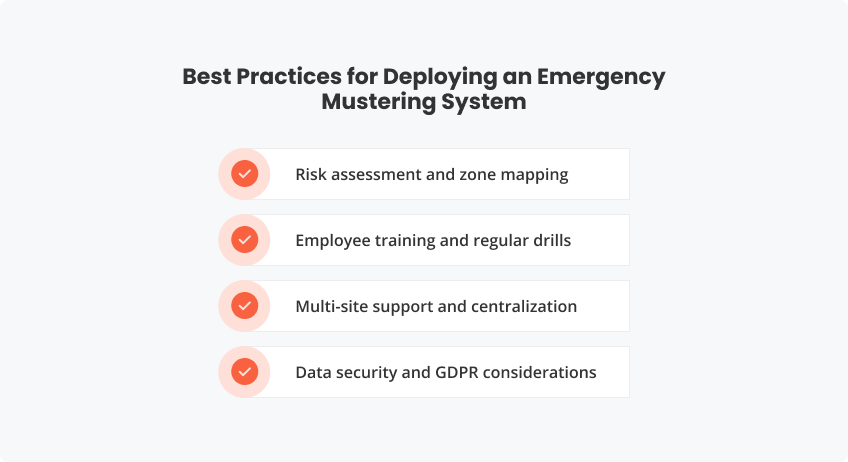
Risk assessment and zone mapping
Start with your site realities. Map exits, muster points, backup zones, and high-risk areas before you think about devices.
A manufacturing site including hazardous materials requires a different setup than a school, hospital, or distribution center. The mustering plan should reflect that from day one.
Employee training and regular drills
Training should be short, clear, and repeated often. Most people do not need a full technical explanation. They need to know where to go, how to check in, and who is responsible for validation.
Wardens and supervisors, of course, need more detail. They are the people who turn the process into action.
Multi-site support and centralization
For larger organizations, central visibility is a major advantage. A shared platform helps standardize reporting while still allowing local teams to run site-specific procedures.
This is particularly useful for global companies that need one safety framework across different facilities, languages, and operating models.
Data security and GDPR considerations
Mustering data is operational, but it is still personal data when individuals can be identified. For European organizations, that means collecting only the information you need, limiting access, and defining clear retention rules.
That approach aligns with the EU framework on worker evacuation measures and GDPR’s broader principles around minimization and data protection by design.
Industries That Benefit Most
Almost any large site can improve emergency accountability. Some environments, however, gain much faster value than others.
Manufacturing and warehousing
Fast-moving shifts, temporary labor, and constant vehicle traffic make manual headcounts unreliable. That is why mustering software for factories is often one of the first digital safety upgrades teams prioritize.
Chemical and energy plants
High-risk operations leave little room for uncertainty. One unconfirmed person in the wrong zone can delay critical decisions for the entire site.
Oil & gas facilities
Remote assets, outdoor conditions, and changing contractor populations make real-time personnel tracking especially important in this sector.
Government buildings and schools
These environments combine mixed populations with strict procedures. Staff, students, visitors, and contractors may all need different workflows, but one clear accountability process.
Transportation hubs and logistics
Traffic is constant. Occupancy shifts by the minute. In these settings, industrial evacuation solutions help teams maintain control when conditions change fast.
Connect mustering, visitor flows, and operational visibility in one platform.
An emergency mustering system is not just another layer of software. It is a practical way to reduce uncertainty when seconds matter, improve evacuation compliance without adding paperwork, and give your teams a process they can trust under pressure.
For facilities that still rely on paper lists and verbal roll calls, the real risk is not complexity. It is waiting too long to modernize.
FAQ
Usually, no specific technology is required by name. What regulators expect is a reliable way to evacuate people, account for them, and train staff to follow the process.
Yes. Many systems also support QR codes, mobile check-in, tablet stations, and supervised manual validation.
Accuracy depends on roster quality, process discipline, and system integration. In dynamic environments, it is generally more reliable than paper-based roll calls because it uses live data.
It should fit into your current emergency plan, not replace it. The system supports alarm workflows, assembly procedures, warden responsibilities, and post-incident reporting.
That should be addressed during deployment. Strong solutions are designed with fallback procedures, local resilience, and clearly defined manual backup steps.