
Smart Yard Logistics in Agriculture: How Spreenhagener Automated Driver Check-In and Gate Access
A steady stream of delivery vehicles arrives at Spreenhagener’s Bestensee site every day. Drivers come from different countries, speak different languages, and need to reach different destinations across the extensive facility.
Managing this traffic was particularly challenging because the entrance is located some distance from the main building and is not permanently staffed.
Together with friendlyway, Spreenhagener automated its yard logistics with a solution combining multilingual self-check-in, license plate recognition, gate control, and visual wayfinding. The project demonstrates how a straightforward, pragmatic solution can deliver effective automation for a mid-sized business.
Client Profile
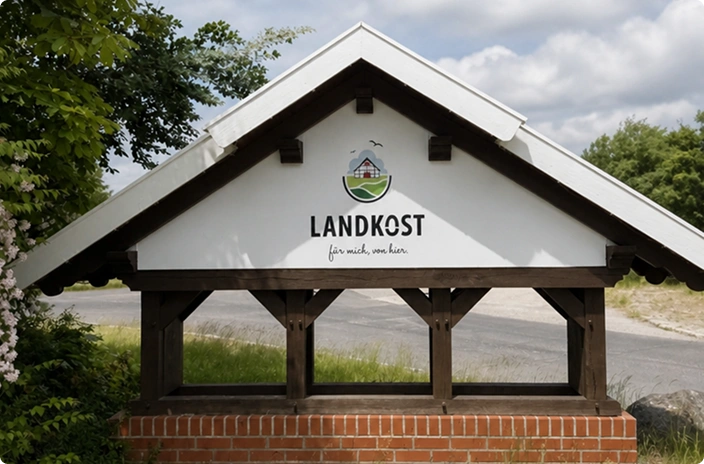
Spreenhagener Vermehrungsbetrieb für Legehennen GmbH is a leading, long-established company in poultry breeding and agriculture. Operating under the well-known Landkost brand, the company stands for quality, freshness, and consistent reliability.
Its busy Bestensee facility experiences continuous delivery traffic. Spreenhagener needed a modern, structured way to manage vehicle movements while maintaining the industry’s strict security standards and accelerating the flow of goods.
Challenge
The combination of an extensive site, a closed gate-and-barrier system, and an unattended entrance located away from the main building created the potential for bottlenecks and time-consuming coordination.
Before the digital solution was introduced, the company faced the following main operational challenges:
- Language barriers and different destinations: Suppliers, contractors, and service providers speak different languages. Depending on the purpose of their visit or delivery, they may also need to travel to entirely different locations across the site.
- Manual gate operation: Opening the gate and barrier manually for vehicles entering and leaving the facility took valuable time. Permanently assigning an employee to the remote entrance was not a practical option.
- Recurring traffic: Many drivers visit the facility regularly. Requiring them to complete the same full registration process at every visit unnecessarily slowed vehicle processing.
- Changing entrance infrastructure: The entrance area, including its gates and barriers, was still under construction when the project began. The solution therefore had to be developed around evolving infrastructure and remain highly flexible from a technical integration perspective.
Spreenhagener defined four clear objectives for the automation project:
- A cost-effective overall solution: Implement a streamlined system without investing in an expensive, highly complex access control platform.
- Fully automated site access: Create an intelligent entrance process that could operate autonomously, without a staffed gate or additional personnel in day-to-day operations.
- A smooth flow of traffic: Connect license plate recognition with gate and barrier control in real time to prevent queues of waiting trucks.
- Clear driver guidance: Ensure every driver knows exactly where to go immediately after check-in, regardless of the site’s size and complexity.
Solution
friendlyway developed a practical gate management workflow built around robust outdoor hardware and the flexible friendlyway Cloud Platform.
Rather than introducing a large and expensive access control system, the project focused on connecting the digital check-in process with Spreenhagener’s existing infrastructure. This approach reduced technical overhead while delivering the automation required for day-to-day operations.
The hardware setup
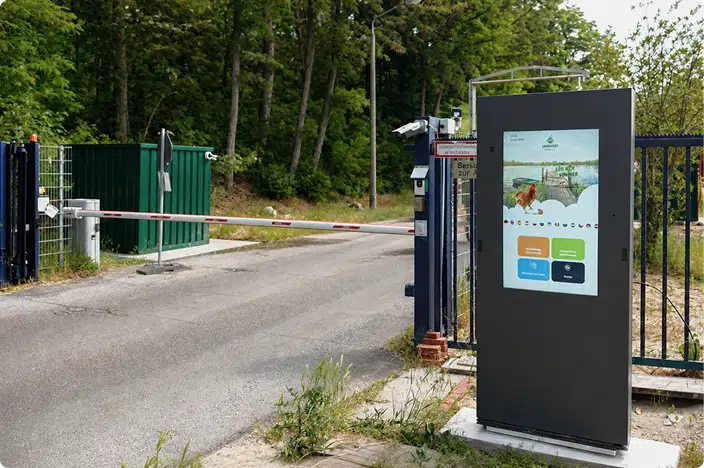
- friendlyway Outdoor kiosk: A weather-resistant 43-inch kiosk was installed in a designated stopping area before the barrier. Its large display makes it easy to identify and provides drivers with a clear first point of contact upon arrival. Designed for outdoor environments, the kiosk supports reliable self-service operation year-round.
- Existing cameras for license plate recognition: The solution uses the site’s existing Dahua cameras at the entrance and exit to recognize vehicle license plates. This allowed Spreenhagener to retain its established security infrastructure while adding an automated digital approval process.
- Cost-effective gate integration: A lightweight Shelly relay interface connects the friendlyway workflow with the physical gate and barrier controls. This enables approved vehicles to enter automatically without the cost and complexity of installing an entirely new access control environment.
The automated driver journey
The friendlyway Visitor Management software solution guides each driver through a clear, structured process:
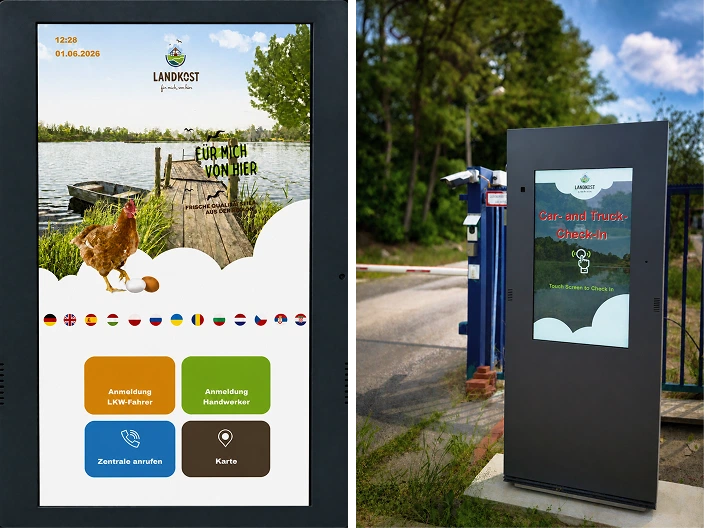
- Multilingual self-check-in: Upon arrival, the driver selects their preferred language and follows the instructions shown on the kiosk. The intuitive interface helps prevent misunderstandings and makes the process accessible to international suppliers and service providers.
- Vehicle registration: The driver enters the required information, including the vehicle’s license plate number. The friendlyway platform then transfers the approved vehicle data to the connected access environment.
- Direct telephone assistance: When additional support is required, the kiosk can connect to the central operations team via phone. Drivers can resolve questions without leaving the entrance area or searching for an employee onsite.
- Dynamic wayfinding: Once check-in is complete, the screen displays a visual route to the driver’s assigned destination. Directions can be adapted to the type of delivery, loading area, or service appointment. This helps drivers reach the correct location directly and reduces unnecessary traffic across the facility.
- Automated gate access: When the registered vehicle approaches the entrance, the camera identifies its license plate. If the plate matches an active registration, the gate and barrier are released automatically.
Access authorization is temporary and expires after the defined validity period. Returning drivers must therefore complete a new check-in, ensuring that Spreenhagener retains control over who is currently authorized to enter.
Implementation
The project was delivered through a structured implementation process:
- Requirements and workflow design: friendlyway worked with the Spreenhagener team to define the different driver and visitor types, registration workflows, technical requirements, kiosk location, network setup, and camera integration.
- Configuration and integration: The friendlyway platform was configured to align with the Customer’s operational processes. Check-in paths, user interfaces, language options, and data transfers were adapted to the site’s requirements.
- Testing and optimization: All key scenarios were tested jointly before launch. Particular attention was given to license plate recognition, gate interaction, user guidance, and the reliability of the complete arrival process. Customer feedback was incorporated directly into the configuration.
- Go-live and training: Following successful testing, the system was put into operation. The responsible on-site team received training so that workflows and content could be managed securely from the first day.
Success
Spreenhagener now benefits from an automated yard access process that combines operational efficiency, security, and clear communication with drivers.
- Unattended gate operation: Drivers can complete registration and enter the site without a permanently staffed gate. Internal teams spend less time on repetitive access coordination and manual barrier control.
- Controlled vehicle access: Only vehicles with a valid, recently completed registration are permitted to enter. Temporary authorization and license plate verification help prevent unauthorized access while maintaining a smooth arrival process for approved drivers.
- Faster, more predictable traffic flow: Check-in, license plate approval, and gate access work together in a single connected workflow. This reduces unnecessary waiting and helps prevent congestion at the entrance.
- Clearer onsite navigation: Drivers receive visual directions immediately after registration. They can proceed directly to the correct loading point or service area, reducing wrong turns and avoidable vehicle movements.
- Efficient use of existing infrastructure: The solution integrates with the Customer’s existing cameras and access components (Dahua and Paxton). By adding a flexible digital workflow rather than replacing the entire infrastructure, Spreenhagener achieved meaningful automation with a controlled level of investment.
The project demonstrates that advanced yard logistics does not always require a large, highly complex system. With the right combination of self-service technology, software integration, and pragmatic hardware connectivity, mid-sized businesses can securely and cost-effectively automate vehicle access.
Key Lessons for Similar Projects
What can we learn from this successful real-world example?
Simplicity wins
The most effective solution is not necessarily the most complex one. Connecting digital registration and license plate recognition to existing gate infrastructure can deliver substantial operational benefits without introducing unnecessary IT overhead.
Allow flexibility during construction
When entrance areas, foundations, gates, or barriers are still under development, project plans should include sufficient flexibility. Close coordination between construction, operations, IT, and technology providers helps prevent delays.
Involve IT from the beginning
Early participation from the internal IT team makes it easier to clarify network requirements, system interfaces, security responsibilities, and data flows. At Spreenhagener, strong technical involvement helped support a smooth and efficient implementation.
Get in Touch
Have questions or want to learn more? Leave us a message — our team will get back to you shortly.